Home Blog Page 33

Mobile Learning Ultimate Guide » Small Business Bonfire

0
Mobile Learning Ultimate Guide » Small Business Bonfire

If you’re new to mobile learning, don’t worry. You have come to the right place!

This mobile learning guide will help you understand Mobile Learning and all its advantages.

What is Mobile Learning?

Mobile Learning is an approach to learning that uses mobile devices such as smartphones, tablets, and other mobile-enabled devices to enable access to educational materials anytime and anywhere.

Mobile Learning is becoming increasingly popular as a form of education due to its flexibility and convenience.

What are the Benefits of Mobile Learning?

Mobile Learning offers numerous advantages and benefits. Some of the main ones include the following:

  • Learning wherever you want
  • Learning whenever you want
  • Better motivation for learning
  • Real-time learning feedback

Learning Wherever You Want

One of the most significant benefits of Mobile Learning is the convenience it provides. With a mobile device, you can study or work virtually anywhere.

Whether in a library, coffee shop, park, or even at home on the couch, if your device has a reliable internet connection, you can access course materials, lectures, and other educational resources necessary to complete assignments and further your educational goals. 

This type of freedom gives learners more control over when and where they learn. For those with family obligations or full-time jobs that make attending traditional classes difficult, Mobile Learning allows them to continue their education while remaining flexible with their schedules and location.

With Mobile Learning tools such as smartphones or tablets, students can quickly review lecture notes while commuting to work, which may have been recorded during class time without having to miss out on important information. 

Accessing course materials from any location also makes it easier for students who are balancing multiple courses at different institutions or traveling for extended periods but still need to stay on top of their schoolwork.

Mobile devices make it easy for students to stay connected and remain vigilant about their academic progress no matter where life takes them.

Additionally, this type of anytime-anywhere access encourages greater self-discipline since learners must be responsible for managing their schedules and not rely solely upon instructors to remind them when due dates are approaching. 

The ability to leverage technology into an educational setting has opened up new possibilities and opportunities for those who seek higher education but are constrained by other responsibilities or circumstances outside the classroom environment.

Learning Whenever You Want

Another advantage Mobile Learning has over traditional classroom settings is that learners can determine when they want to study and for how long.

Unlike a physical class where lectures must be attended at set times, Mobile Learning allows students to review course materials whenever it fits best into their schedules.

This could be during lunch breaks or before bedtime. Alternatively, mobile devices also make it easy to access course materials while waiting in line at the grocery store or even during a commute on public transport.

By having the freedom to choose when and where learners study, Mobile Learning can help keep motivation levels high as students can focus on their studies without feeling restricted by traditional class times.

Better Motivation for Learning

When learners are passionate about a subject and feel capable of taking on the challenge, Mobile Learning can help increase their enthusiasm and maintain interest in their studies.

With mobile devices and apps, students can quickly review essential materials as often as they’d like while also having access to supplemental resources that can help further their understanding.

Mobile Learning also allows students to customize the way they learn.

Some learners may prefer interactive educational activities, while others may need more visual aids, such as diagrams and videos, to better comprehend the material.

The options mobile devices give learners are endless – making Mobile Learning an ideal platform for those who are eager to learn but don’t want to be confined by a traditional educational setting.

Mobile learning is an excellent way for learners to take ownership of their education and build confidence in their ability to learn.

With mobile devices, students can learn whenever and wherever they choose and progress toward achieving their educational goals.

Real-Time Learning Feedback

Feedback is an integral part of the learning process, and mobile devices make it easier for learners to receive real-time feedback on their progress.

By utilizing mobile apps that provide instant feedback on quizzes or assignments, students can get a better idea of where they stand in relation to their classes and how they need to adjust their study habits to improve their grades.

Mobile Learning also gives students a chance to get personalized instruction from tutors, professors, or mentors if they struggle with a particular concept or want additional support in a specific area.

The ability to receive real-time feedback on mobile devices allows learners to stay informed of their progress and make improvements promptly.

Ultimately, Mobile Learning provides an engaging and interactive way for learners to stay on top of their studies while enjoying the convenience of mobile devices.

With so many advantages Mobile Learning has, it’s no wonder why more and more students are turning to mobile technology to further their education.

What are the Drawbacks of Mobile Learning?

Although mobile learning has many advantages, it is not without its drawbacks.

Some of the drawbacks of Mobile Learning include the following:

  • Connectivity issues
  • Online distractions
  • Small phone screens

Connectivity Issues

Connectivity issues can be a significant problem when it comes to Mobile Learning. If the device doesn’t have a secure connection, learners won’t be able to access course materials or participate in activities.

This can be frustrating and may even cause them to miss important deadlines.

Online Distractions

Mobile devices can be a source of distraction when it comes to Mobile Learning. It’s easy for learners to get sidetracked by social media, games, or other apps available on their phones.

To ensure that mobile learning is as effective as possible, students must prioritize and focus on the tasks to avoid distractions.

Small Phone Screens

The small screens of mobile devices can make it difficult for learners to read lengthy materials or participate in activities that require a lot of visual interaction. This can be an inconvenience, particularly if the course material is challenging and requires extended concentration.

To combat this issue, Mobile Learning providers should invest in mobile-friendly versions of their materials or develop mobile apps that increase the usability of content on small screens.

The Best Mobile Learning Platforms

With Mobile Learning becoming increasingly popular, more mobile platforms have been developed to make mobile learning easier.

Some of the best Mobile Learning platforms include: 

  • Duolingo
  • Ted-Ed
  • Udemy
  • Solo Learn

Duolingo

Duolingo is one of the best mobile learning platforms available today. It is an incredibly effective app-based language learning program focusing on making language education fun and accessible for all users.

As a free platform, Duolingo offers its users a well-designed, intuitive, and user-friendly interface that makes it easy to navigate the course content and progress through the lessons.

With Duolingo, learners can quickly learn the basics of a language by completing engaging exercises, listening to audio recordings of words and phrases, and taking tests that measure their performance.

The platform also provides helpful feedback along the way so learners know exactly what to do to keep improving their language skills.

Furthermore, Duolingo has an interactive chatbot that allows learners to practice speaking with conversation partners in real time. This helps build confidence in their ability to communicate in their chosen language. 

Ted-Ed

TED-Ed is an exceptional mobile learning platform that allows users to create, share, and interact with educational material.

It puts the power of creating and curating digital content into the hands of educators – allowing them to capture their students’ attention and make learning more engaging.

TED-Ed offers a wide variety of tools for educators to use in the classroom, such as the following:

  • Interactive quizzes
  • Virtual lectures
  • TED talks
  • Lesson plans

The goal of TED-Ed is to help both teachers and students become better learners.

Udemy

Udemy is a leader among the best mobile learning platforms, offering learners various options for developing their skills. Udemy’s platform is designed to help users develop and enhance their knowledge through interactive courses, tutorials, and lectures.

With over 150,000 courses taught by more than 35,000 instructors, Udemy provides learners with an exceptional educational experience. The platform supports a wide range of topics, such as business, design, marketing, and programming, in many different languages.

With its intuitive interface and user-friendly features like offline content support, Udemy makes learning accessible even if you are on the go.

The platform also offers valuable insights into course progress with its progress tracker feature so that users can stay organized while they learn. 

Solo Learn

Solo Learn is an incredibly popular mobile learning platform that allows learners to build and hone their programming skills on the go.

The platform provides users with interactive courses in the most widely used languages, such as:

  • HTML
  • CSS
  • JavaScript
  • Python
  • Java
  • C++

With Solo Learning’s mobile app, learners can easily brush up on their coding skills and learn new ones in the comfort of their own homes.

The mobile app offers a variety of interactive courses, quizzes, and tutorials that will help users to improve their programming proficiency. As well as this, Solo Learn also has a vibrant community where users can ask questions and collaborate with other learners.

How to Make Mobile Learning Engaging

mobile learning - engaging

Mobile learning can be incredibly effective when done right. Here are some tips for making Mobile learning more engaging:

Use interactive content – Interactive content is key to making mobile learning engaging. Provide learners with activities, quizzes, and video tutorials so they can interact with the material and gain a deeper understanding of the topic.

Incorporate mobile-friendly features – Mobile devices come with a variety of features that can help you to create engaging mobile learning experiences. Incorporate things like audio, video, and animations into your mobile courses to keep learners engaged.

Keep content bite-sized – Remember that when it comes to mobile learning, shorter is better. Keep your mobile learning content concise, and to the point so learners don’t get overwhelmed.

Make it collaborative – Create a community where learners can share their ideas, ask questions and collaborate with each other. This will help to keep them engaged and motivated to learn.

These are just a few tips for making mobile learning more engaging. With the right mobile learning platform and the right strategies, you can create an effective mobile learning experience for your students.

How to Incorporate Mobile Learning In your Small Business

For small businesses, strategically incorporating mobile learning into the workplace can be a great way to boost employee engagement and productivity. With mobile devices becoming more easily accessible and user-friendly, workers can stay connected no matter where they are located geographically. 

One of the most important aspects of implementing successful mobile learning initiatives is to design curriculums that fit the needs of your business.

This could include training modules and other digital content specifically designed for mobile device users with appropriate levels of the following:

  • Interactivity
  • Navigation
  • Feedback features

To further leverage mobile learning strategies in your small business, it’s essential to provide employees with access to the necessary tools and resources needed to engage with digital content.

This includes both hardware (i.e., smartphones or tablets) as well as instructional materials like online courses or tutorials.

Additionally, you may want to consider providing ongoing support for learners so they can get help if needed when accessing content or following through on new skill sets acquired from the mobile learning experience. 

Online certificate courses, mobile-friendly learning platforms, and mobile app development tools are just a few of the mobile tools that may come in handy when incorporating mobile learning into your small business. 

Mobile Learning Wrap Up

Mobile learning is becoming increasingly important in today’s digital world. There are many mobile learning platforms available to choose from, but the ones outlined here are some of the best available.

Each one offers its own unique advantages and features, so find the one that suits your needs and start exploring mobile learning today!

Startups set to go to space for the first time on SpaceX’s Transporter-6 mission • TechCrunch

0
Startups set to go to space for the first time on SpaceX’s Transporter-6 mission • TechCrunch

SpaceX is poised to launch 114 payloads to orbit on a Falcon 9 tomorrow morning, the sixth mission of its smallsat rideshare program. But while the rocket company is now an old hand at launches – SpaceX just completed a record year with 61 launches in 2022 alone – for a handful of space startups, Transporter-6 marks a milestone.

Those startups include Launcher, which is conducting its first space tug mission; an inaugural in-orbit tech demonstration from Magdrive; and Epic Aerospace, which is also launching a space tug for the first time.

Launcher CEO Max Haot told TechCrunch that the company realized that there was a big market opportunity to develop a space tug after SpaceX debuted its rideshare program, which dramatically lowered the cost of launch. Launcher’s tug, called Orbiter, will deploy or host payload for 10 separate customers. The company is also developing a small launch vehicle; Orbiter will be its third stage.

Space tugs are filling a market segment for customers that need a specific orbit but want to pay less than the cost of a dedicated rocket launch, Haot said.

“There’s always a need eventually for a dedicated rocket if you need a specific orbit at a higher price, and eventually we’ll compete there, but the space tug really helps make these rideshare flights more useful since you can reach more than just one orbit,” he said.

Launcher isn’t the only company that has its eye on the emerging space tug market. Epic Aerospace, which bills itself as a space transportation network company, will also be launching a tug on Transporter-6 for the first time. Space services companies Momentus, D-Orbit and Exolaunch will also be deploying or hosting satellites for customers on this mission.

It may seem like the space tug market is already crowded with players, but Haot said the ultimate winners are far from decided.

Image Credits: Launcher/John Kraus / Flickr (opens in a new window)

“If you look at the press reporting, it looks like a lot of companies are building space tugs. But if you look at the customers, this is very new and no one has yet really demonstrated a big transfer capability that’s useful to satellite companies,” he said.

Magdrive, a UK-based startup developing a high-thrust spacecraft propulsion engine, will also be going to space for the first time for an in-orbit technology demonstration. The prototype propulsion system will draw in power from onboard solar panels, store it, and discharge it at varying power levels.

“The mission lasts 12 months, but we’ll be aiming to try as many charge and discharge options as soon as possible so we get as much data as we can,” Magdrive CEO Mark Stokes told TechCrunch.

Transporter-6 is set to take-off at 9:56 AM EST from Cape Canaveral Space Force Station. It will be the fifteenth flight of the Falcon 9 booster dubbed B1060. Transporter-6 will also carry satellites for Planet Labs and Spire Global, as well as other payloads for scientific, research and commercial customers.

The launch will be streamed live on SpaceX’s website.

Omnichannel contact center — The What & Why

0
Omnichannel contact center — The What & Why

What is an omnichannel contact center?

An omnichannel contact center is a software solution allowing agents to handle requests and share information across multiple channels, including phone calls, webchat, email, SMS, and social media. It creates a seamless experience as conversations move across channels by sharing context and providing additional customer data.

An omnichannel contact center brings all your communication channels together into a single, easy-to-use interface. And customers love it. According to Aberdeen Group, companies that use an omnichannel approach saw a 91% year-over-year increase in customer retention than those without!

Customers want you to use the channels they’re most comfortable with, from phone calls to web chat, SMS, email, and social media. They expect a seamless experience across all of them.

There’s one undeniable truth to providing a great customer experience: if people must find you, they’re going to find someone new.

That’s a lot to digest. So here’s an example to show you how an omnichannel contact center works in practice.
Let’s say a customer is dealing with a technical issue. They’ve read a few self-service help docs but have hit the point where they need help.
Their first stop is your website’s chat to explain the issue. But after some back and forth, they decide to call in to “talk to a real person.”
An omnichannel customer experience solves this problem. This way, when that customer calls customer support, live agents already have:

  • The customer’s history and key data
  • A transcript of their previous chat conversations
  • A record of relevant touchpoints, such as help docs they read

Rather than force customers to repeat themselves, your agents start with a holistic view of every customer interaction and can pick up right where their colleagues left off.
This sort of unified communication isn’t easy. But it’s what your customers expect.
Research from McKinsey shows that most customers engage with three to five different channels on their way to resolving a request. In addition, 86% of customers expect conversations to move seamlessly between service channels.

Omnichannel vs. multichannel contact center

You’re probably familiar with handling support requests across multiple service channels. Contact centers have been adding new channels for years, which has led to people describing them as multi-channel because it works across more than one form of communication.
However, a few significant features separate a multichannel approach from an omnichannel one.
In a multichannel contact center, each channel is managed separately and even by different teams. This means your customer interaction history isn’t updated as they transcend from one medium to the next. When a customer moves from a call to chat, they’re essentially starting over.
On the other hand, the omnichannel approach combines all your communication channels, customer history, and data into one tool. Customers can use their preferred channel without repeating themselves. Agents can gracefully handle each topic using centralized contact center software.
Here’s a quick comparison between a multichannel and omnichannel contact center.

Functionality Multichannel contact center Omnichannel contact center
Supports multiple channels
Seamlessly switch between communication channels
CRM integration for relevant customer data
Real-time insights on customer activity
One team can handle requests across all channels

Beyond the lack of features, there are a few downsides to a multichannel contact center as compared to an omnichannel one:

  • Multichannel contact centers provide a worse customer experience. Customers must repeat themselves when switching messaging channels. They also don’t get the personalized experience they crave today.
  • Multichannel contact centers can be more expensive to run. When customers need to make several requests for one issue, companies need to hire more customer service agents. On the other hand, Omnichannel platforms minimize repeat calls and combat long hold times using the IVR.
  • Multichannel contact centers could harm customer engagement. A 2017 survey by American Express indicated that one-third of Americans said they’d switch companies after a single poor experience. What will your existing omnichannel call center cost you?

More channels don’t create a better customer experience. Instead, the more channels you support, the more critical an omnichannel approach becomes.

Why choose omnichannel contact services

Cloud contact centers simplify complex interactions. When you streamline customer service tools, you’ll help them become more productive and effective.
But where do you start when building out an omnichannel approach?
Here are seven of the must-have features for choosing an omnichannel contact center:

1) Cloud-based with a unified interface

An omnichannel strategy works when employees can effortlessly move between channels while maintaining customer history and context.
For this to happen, your contact center software needs an easy-to-use, intuitive interface that provides real-time data for each agent.
Here are a few qualities to look for when evaluating an omnichannel contact center’s interface:

  • Customer data and conversations in one place: Agents shouldn’t have to jump between screens, tools, or apps to maintain a seamless customer experience. API integrations are imperfect — strive for complete functionality without middleware.
  • Cloud-based redundancy: Look for a tool that manages all your data sources and conversations in the cloud. The cloud not only keeps all your CRM organized but allows agents to work from home comfortably.
  • Quick access to real-time data: Agents should have access to customer insights, past interactions, and customer satisfaction scores to deliver the best experience possible.

2) Seamless integration between channels

Customer expectations change rapidly. A few years ago, most people wouldn’t use a chatbot to answer their questions; today, 74% of customers prefer them for quick answers.
An omnichannel contact center needs to be scalable and agile enough to integrate with any new channel that comes to the market without downtime or changing workflows.
Here are a few questions to ask when evaluating how your omnichannel contact center will handle integrations:

  • What other tools integrate with this contact center? Look for integrations with your customer CRM and every communication channel you use, such as the phone, and digital channels like email, SMS, and social media.
  • How are integrations displayed in the interface? Look for contact center software that reduces friction by bringing cross-channel conversations together into a single view. Agents shouldn’t need to bounce between screens to keep the conversation moving.
  • Is it easy to share data or merge reports across channels? Look for reports that put the customer experience first rather than a specific channel. For example, the first response time is preferred to the first email response time. It’ll help you with forecasting and workforce optimization.

3) Customer insights render personalized experiences

Your customers are unique in how they use your product and seek help. Some customers enjoy using self-service options like a knowledge base. The preferred channel to solve a significant issue is the phone, then email and social media.
The more access agents have to information, the better equipped they’ll be to handle requests.
A CRM like one from Nextiva pulls all your customer data into one place. This capability means that your team can see interaction history, account value, and satisfaction during their conversations.
Here are some customer insights your omnichannel contact center should include:

  • Customer info: Name, company, alternative contact info, and open or closed tickets can help you personalize the interaction.
  • Interaction history: A list of conversations across all channels and a brief rundown of their outcomes.
  • Real-time insights: Product pages, help docs, or features they recently used to add context to the issue.
  • Account value metrics: Customer value, trending satisfaction, and survey results. Support agents should instantly know they’re assisting a high-value account.

4) Intelligent routing of inbound requests

With more channels, proper routing becomes crucial. A seamless customer experience means connecting customers to the right agent the first time around.
Look for a contact center solution that offers intelligent routing features such as:

  • Automatic call distribution (ACD): Route inbound calls to the right person or team depending on history, time, or support level.
  • Deep CRM integration: Leverage your existing customer data to direct customers to the right agent or department. These surface actionable insights across the entire customer journey.
  • Conversational AI: Respond to customers seeking help with answers based on artificial intelligence. Select omnichannel contact center solutions that leverage AI and natural language processing to pick up on real-time sentiment.

5) Integrated data across the customer journey

The only way to execute a seamless omnichannel experience is to gather data along each customer touchpoint. As people shift from social media to chat to phone calls, their history should reflect each customer interaction.
Here are a couple of data-focused features your omnichannel contact center should support:

  • Insights into the customer journey: See where your customers came from and what channels they used to connect. Examples of these contact methods include a mobile app, email, or SMS.
  • Track and analyze your entire pipeline: Understand each step customers take throughout their business relationship. Add or subtract “points” depending on the intent and outcome.

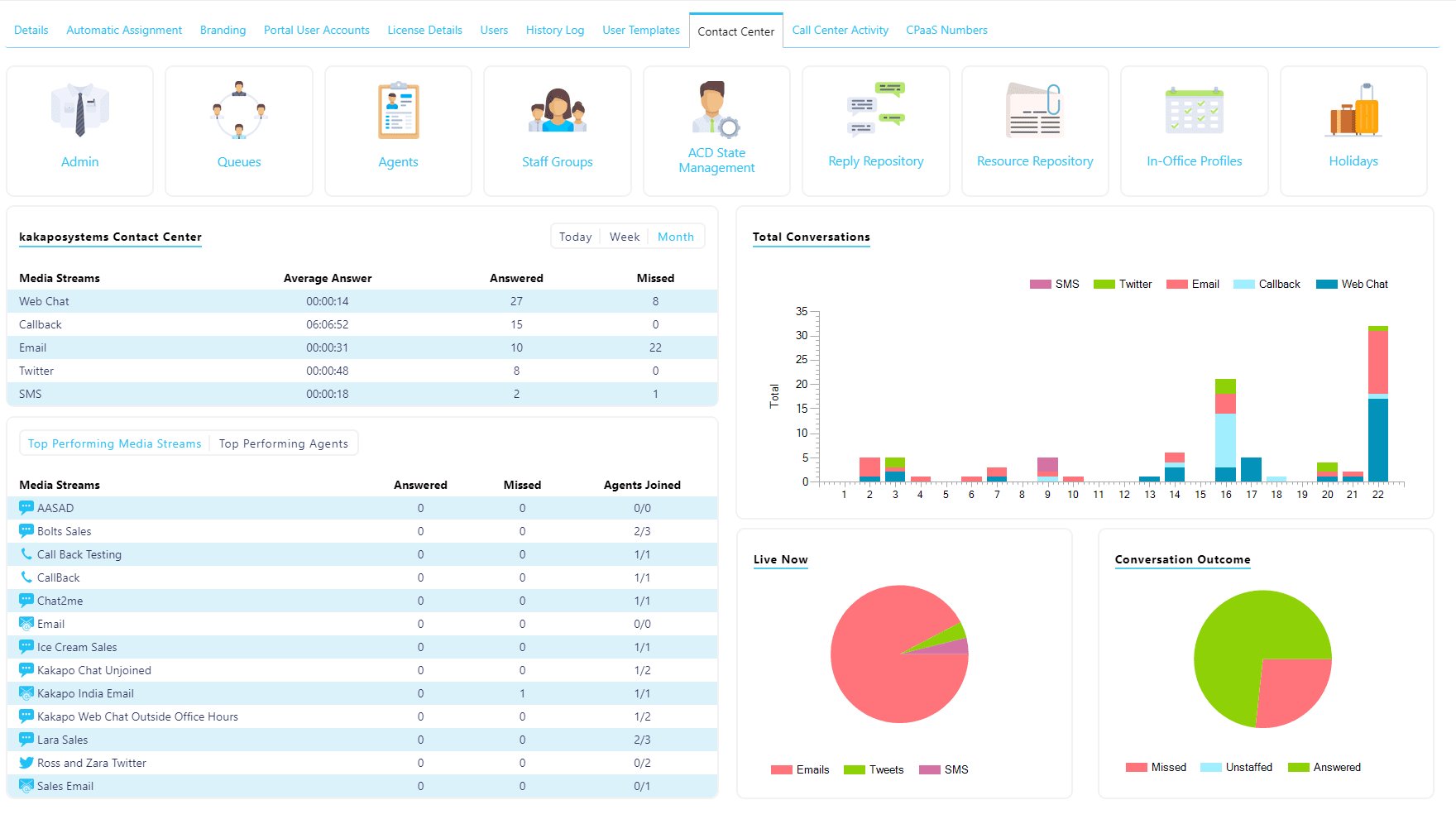
Screenshot of an omnichannel contact center dashboard.
An omnichannel contact center streamlines customer communications.

6) Performance management and reporting

An omnichannel contact center can give managers deep insights into the performance of their team. Instead of trying to streamline metrics or reports across several tools, everything is in one place.
Here are a few essential reporting tools that your contact center should include:

  • Historical and daily data trends: Contact center leaders should see at a glance where agents and processes need to improve. Most call center solutions offer this out of the box.
  • Customizable KPIs and goals: What’s most important to you? Speed of answer? CSAT score? Identify which ones reflect your customer’s needs and business drivers.
  • Agent dashboards for coaching: Reporting should be empowering and actionable for both call center agents and managers. Adopt team-based wallboards to drive awareness and friendly competition.

7) Enterprise-grade security and reliability

Finally, security and uptime are critical when a single tool handles all your customer data and support channels. For example, Nextiva’s enterprise-grade network has the industry’s highest uptime, which means you can be there for your customers.
Your omnichannel solution is up to the task if it:

  • Meets stringent industry standards such as PCI, SOC 2, or HIPAA
  • Maintains a status page with updates on past events and planned maintenance
  • Undergoes regular security audits and 24/7 monitoring

In the age where data breaches and outages can happen to almost anyone, you can’t afford to go with the bare minimum. You need a proven leader to power your communications.

Omnichannel contact center strategies

Embracing an omnichannel strategy means defining a cohesive vision to optimize the customer service experience. This effort results in revisiting tools, workflow automation, and customer touchpoints.
Let’s start by looking at some strategies and best practices as you move to a multichannel environment.

1) Build more personalized experiences

Personalization is at the core of the omnichannel approach. According to Microsoft’s research, 72% of people expect your customer service team to know who they are, what they’ve purchased, and insight into their past interactions.
A unified contact center platform streamlines all this information and puts it at your agents’ fingertips. It increases agent productivity and allows you to leverage personalization to keep customers coming back.

2) Map out common customer journeys

Customers rarely take a linear path when engaging with your company. They might read a self-service knowledge base article or send a tweet before engaging with your support team.
The more you understand your customer journeys — the channels they use and their paths — the more impactful your omnichannel approach can be.

3) Be proactive about data collection

The omnichannel approach is only as good as the data you make available to your agents.
At a minimum, this includes any previous conversations the customer has had across channels. However, you can empower your support team even more by including real-time data and insights from your customer service CRM such as:

  • Previously viewed pages
  • Abandoned carts
  • Survey results
  • Upcoming anniversaries or renewals
  • Customer value

Aim to unify segmented customer data into a consolidated CRM instead of separate data silos.

4) Monitor changes in customer preferences

If COVID has taught businesses anything, it’s that markets and entire industries can change overnight. Using an omnichannel contact center, you can rapidly adapt to their changing needs.
Examples of this could mean looking for an uptick in social media outreach or declining customer satisfaction on specific channels.
If customers grow frustrated with the limitations of an automated chatbot, offer them an easy way to reach a live agent. This way, a rep takes over for a personalized and seamless experience.
Brands should collect phone numbers in web chat. Doing so allows agents to initiate an outbound call to squash any outstanding concerns. Plus, it provides another means for cloud contact centers to identify and track accounts.

5) Strike a balance between humans and technology

Omnichannel contact centers are powered by some of the best customer support technology. However, support quality still comes down to human interaction.

It’s great to see calls getting shorter and reps handling more issues. Yet, none of that matters if your customers are leaving unsatisfied.
Your omnichannel strategy should include vital human elements, such as:

  • Be consistent across channels: An omnichannel approach means that response time and quality are channel-agnostic. Treat all channels equally.
  • Make ‘customer-centric’ the core of your strategy: Balance agent effectiveness with customer satisfaction. Speed should never outshine amazing service.
  • Integrate before launching a new channel: Plan how any new platform will fit into your existing omnichannel strategy and agent desktops before going live.

How to train agents for omnichannel customer service

With more contact methods and context to consider, customer service staff face increasingly complex situations.
Behind every great customer experience is a team that delivers the seamless experience customers rave about.

As you move to an omnichannel model, your team will need training. Here are a few suggestions to get you started:

  • Decide on your omnichannel KPIs: Update your contact center KPIs to closely measure your customer experience. For example, you might want to focus on multi-channel issue resolution rather than call volume as a success metric.
  • Share your strategy: Educate your team on your company’s omnichannel strategy and how it impacts them. It should yield appreciation for the customer journey and how each customer interaction influences customer success. It should also outline efforts made to augment customer data to create a better experience.
  • Promote real-time collaboration: Help agents find the resources they need to handle more complex requests. Since each customer touchpoint matters, empower agents to take ownership of customer issues. Leverage your cloud contact center software for messaging internal experts, so customers don’t have to attempt a second or third contact.
Omnichannel contact center software by Nextiva

Simple changes to how you coach your team can make a sizable impact on your omnichannel strategy. Over time, you’ll create a proven customer care playbook that spans every service channel.

Omnichannel is the future of customer support

The days of a single point of contact are gone.
Today’s customers expect you to be responsive on their preferred channels. What matters most is to arm call center teams with the means to streamline multiple communication channels.
An omnichannel contact center makes it easy for customer support agents to provide exceptional customer satisfaction regardless of how customers contact them. While it may sound complicated, the results speak for themselves.
You don’t have to take on every digital channel at once. A phased approach lets you gracefully add more inbound contact methods, so you provide a seamless experience.
Going with a survey stating 84% of customers regularly go out of their way to spend more money with companies that provide great experiences — You can’t afford not to use an omnichannel platform.

11 Benefits of Video Marketing in 2023 » Small Business Bonfire

0
11 Benefits of Video Marketing in 2023 » Small Business Bonfire

Are you an entrepreneur looking to get ahead of the competition in 2023? If so, it’s time to start thinking about a video marketing strategy!

The potential benefits of video marketing are numerous, ranging from creating greater brand awareness and improving your website’s SEO ranking to increasing sales and building meaningful customer relationships.

Ready to know all the ways video marketing can help take your business to new heights in 2023? Then keep reading and learn the 11 essential benefits that await you!

What are the 11 Benefits of Video Marketing in 2023?

Video marketing is becoming increasingly popular as a way to grow businesses.

Here are 11 benefits of video marketing in 2023.

Benefit 1: Google Loves Videos

Videos are becoming increasingly popular for businesses for one big reason: Google loves them!

One of the benefits of video marketing is that it will appeal to Google and help boost your site’s visibility. 

  • Videos are one of Google’s favorite online content types, and they’re quickly recognized and indexed by the search engine at a much faster rate than text-based content.
  • Videos often inspire responses from viewers in the form of comments or engagement on social media networks.

From increased visibility on Google to boosting authentic organic traffic, there are many clear benefits to investing in video marketing for your business.

Benefit 2: Videos Increase EAT (Expertise, Authority, and Trust)

Video marketing offers many benefits, and one of the most important benefits is its ability to build up your online presence. 

By creating engaging videos, you can show the world that your business has the expertise, authority, and trustworthiness; this is known as EAT for short.

  • Expertise: Video allows you to demonstrate your knowledge and establish yourself as an expert within your field.
  • Authority: Video facilitates a deeper connection between you and customers by humanizing your brand; explaining processes or services through video establishes credibility for potential customers.
  • Trust: Videos are also great for sharing customer stories or success stories to develop customer trust further.

Investing in video marketing can help you gain customers and also help you build relationships with them that could last a lifetime.

Benefit 3: Video Gets More Social Shares

Videos truly present an incredible opportunity in the digital age. Not only are they an effective tool for sharing knowledge, but they can also boost your marketing strategy by increasing visibility and social shares. 

  • By taking advantage of trending topics and search engine optimization techniques, companies can easily share their video content to reach larger audiences. 
  • Moreover, videos are more likely to be shared on social media platforms than static images or text alone.

This allows a company to get even more benefits from the same amount of effort – proving that video marketing is one of the best benefits any business can take advantage of today!

Benefit 4: Video Helps Build Trust

The benefits of video marketing don’t just stop at increased reach and engagement – they can also help to foster a fantastic relationship between you and your audience.

With video, it’s easy to connect instantly with viewers as you showcase your personality, products, or services.

Video marketing helps build trust by:

  • Showing potential customers the benefits of your product or service gives them a glimpse into the benefits they could experience with your company.
  • Whereas customers may view written copy skeptically, seeing real people engage in honest conversations about their experiences with a product or service provides legitimacy.
  • With video, customers can see that the company is open and honest about what they offer.
  • Video helps build relationships with customers by creating a sense of familiarity and showing the human side of your brand.

Whether you post customer success stories as testimonials or feature behind-the-scenes glimpses of how you make your products, video gives viewers an inside look at your business.

Benefit 5: Video Can Be a Multi-Channel Strategy

One of the great benefits of video marketing is the ability to create a multi-channel strategy. 

  • This is more than just beneficial from a cost and time management perspective and brand consistency and visibility standpoint.
  • You can quickly and easily spread your message far and wide by uploading the same video onto different platforms – YouTube, Facebook, Twitter, etc.

By having unified video content across different platforms, businesses can ensure that their messaging is consistent and easily accessible to potential customers regardless of where they are.

Multi-channel video marketing benefits any organization looking to establish its reputation and build an audience that will keep coming back for more.

Benefit 6: Video Helps Inform (More than Written Content)

Using video content as part of your marketing strategy has huge benefits – one of them is bringing complex topics alive and educating viewers.

For example:

  • Say your business is a law firm that specializes in corporate compliance. By utilizing Law firm video marketing, you can explain complex statutory requirements in an easy-to-understand manner.
  • This visual representation adds another level to written content, creating a more engaging experience for the audience.
Video helps to inform more than written content

Written content only goes so far, but video makes it easy to add visuals that drive home points and help people better understand a subject.

Video is one of the most effective methods for informing your audience – it adds engagement and interaction. It boosts understanding above and beyond what written content can do.

Benefit 7: Video is Great for Mobile

With all the benefits of video marketing comes one compelling one: it’s great for mobile. 

Nowadays, most people access the internet from a phone or tablet, and video marketing has quickly become one of the most powerful lead-generation methods for businesses across the board.

The benefits of utilizing video for mobile platforms are:

  • Videos are easily consumed on a small screen.
  • Videos are typically shorter than other forms of content, giving users quick access to info without having to dedicate too much time or effort.
  • Videos are captivating and are more likely to keep people engaged.
  • Videos take up less data, meaning customers can view them on any device regardless of internet speed or bandwidth limitations.
Video is great for mobile

By taking advantage of video’s mobile capabilities, you’re opening up a wider audience who can now watch and appreciate your content!

Benefit 8: Video Content is Preferred over Written Content in 2023

In 2023, the benefits of video content are set to shine through like never before. 

Business entities of all types should take note and adjust their digital strategies accordingly – as video is swiftly becoming the preferred form of content.

It’s time to shift away from static text and straight into eye-catching motion; video marketing will enable companies to:

  • reach a broader audience in shorter amounts of time
  • increase customer engagement exponentially
  • convey your message effectively
  • fostering an environment of authenticity

Take advantage of this trend now and bring your marketing efforts into the future with the power of video!

Benefit 9: Video Helps Grow Revenue

The benefits of video marketing are becoming increasingly apparent. For companies looking to increase their revenue, video is an excellent way to do so.

  • Video provides customers with a visual representation of the product or service without ever having to leave their homes. 
  • This convenience makes it far more likely for customers to make purchases.
  • People are also much more likely to remember the company, product, or service if they’ve seen it in a video format.
  • As such, higher click-through rates and increased brand recognition can help grow any business’s revenue in no time.

Put simply; video can be a game changer for businesses hoping to bring in more income when used correctly.

Backlinks are created when other websites or platforms link back to yours. This indicates that your content is valuable and credible, which can help boost your site’s search engine ranking.

Including videos on your website will give you more chances for those beneficial backlinks – as other sites are much more likely to link to a video than simple text.

There are a few ways to use video to generate backlinks, including:

  • Show off your expertise with a featured video on popular websites
  • Upload videos to other platforms such as YouTube or Vimeo
  • Embed videos into blog posts
  • Allow viewers to share the content across networks and receive a greater reach

The benefits of utilizing video marketing for backlink building are clear – the right approach ensures maximum viewership, leading to more high-quality links pointing back to the website.

Benefit 11: Video Shows Brand Personality

One of the benefits of video marketing is that it can give people an understanding of your brand personality. 

Whether you choose to use colorful animations, professional actors, or even yourself as the face of your business, video provides a direct way to demonstrate who you are and what you’re about. 

Video marketing shows brand personality

Not only will this help to build loyalty for existing customers, but upping your video’s production value can also go a long way in hooking prospective buyers due to its impactful visuals.

Overall, incorporating video into your marketing efforts provides benefits beyond just adding engaging content – it breathes life into your brand.

Wrap Up

By 2023, video content will likely be the consumer’s preferred option for digesting information and staying up to date on important topics.

From visually engaging potential customers to showcase products or services more effectively to expanding reach outside of traditional text-based media – there is much to gain by investing in video content. 

Ultimately it’s no surprise that video content continues to make strides as the preferred medium of communication!

Now we’d like to hear from you; what benefits have you seen from incorporating video into your marketing efforts? Share your thoughts in the comments below! 

Video Marketing FAQ

What are the benefits of video?

The main benefits of video include increasing engagement, improving website performance, better user experience, boosting SEO rankings, and creating more backlinks. Videos also help showcase a company’s brand personality and build consumer loyalty.

What are the pros and cons of video marketing?

The pros of video marketing include increased engagement, improved website performance, higher SEO rankings, and more backlinks. The cons are that producing quality videos can be expensive and time-consuming.

What are the outcomes of video marketing?

The outcomes of video marketing can include increased website traffic, higher conversion rates, more leads and sales, improved brand recognition, greater customer loyalty, and better SEO rankings. Additionally, videos can help increase social media engagement and generate more backlinks.

Why is video marketing the future?

Video marketing is the future because it has become one of the most effective methods for conveying messages and engaging with potential customers. It provides an opportunity to showcase a company’s brand personality, connect with consumers emotionally, and create more backlinks. Videos are also much easier to consume than text-based content and have been known to improve website performance and SEO rankings. 

How important is video in 2023?

Video will become increasingly important in 2023 due to its ability to engage and capture viewers’ attention. As more companies realize the potential benefits of video marketing, this medium will likely continue to grow.

Best NFC Business Cards (2023) » Small Business Bonfire

0
Best NFC Business Cards (2023) » Small Business Bonfire

Ready to make a big business splash in 2023? We’ve got just the thing for you – NFC-enabled business cards that can turn your small company into an industry leader.

Forget boring old swipe cards and paper business cards that get lost in wallets; NFC technology enhances customer service experiences to create cutting-edge authenticity and convenience when networking with clients.

Keep reading as we list some of the best NFC-enabled business cards available this year!

What is an NFC (Near Field Communication) Card?

NFC cards are one of the best ways for businesses to keep track of sales, marketing, and customer rewards.

  • NFC stands for Near Field Communication, which lets customers tap their credit or debit card at a checkout terminal and instantly access personal information.
  • NFC cards eliminate the need for manually entering information every time someone purchases and provide businesses with improved security and data accuracy.
  • By using NFC business cards, companies can access valuable insights into customer behavior quickly and accurately.

This type of technology is becoming increasingly popular within the retail industry as it enables quick transactions without sacrificing security or accuracy.

What Are The Best NFC Business Cards for 2023?

Blinq

Blinq is a clever way for businesses to take advantage of NFC technology.

It revolutionizes how people exchange digital business cards by providing best-in-class contactless card-sharing. 

By encoding all your important contact information on a dynamic digital card, Blinq gives businesses the potential to

  • improve lead generation
  • expedite sales cycles 
  • and contribute to successful brand recognition

Blinq’s ever-evolving digital marketing capabilities create tremendous opportunities in terms of customer engagement and new kinds of innovative content showcasing.

These best-in-class NFC business cards enable users to experience enhanced networking while ensuring they never miss out on an opportunity to make an important connection.

Features

Blinq is one of the best providers of NFC business cards. 

Blinq understands that modern businesses need up-to-date digital tools to stay competitive, which is why they offer a comprehensive suite of features for their NFC cards.

Blinq features

Features of Blinq NFC Business cards include:

  • Fully customizable NFC Business cards so your card can represent your brand
  • The ability to share your card with anyone, even if they aren’t Blinq users themselves, via LinkedIn, QR code, or email
  • The ability for prospects to save your contact information directly to their phone when they open your NFC business card

Blinq makes it easier to quickly exchange contact details with customers and partners and adds professionalism to any business. If you’re looking for the best NFC business cards, look no further than Blinq’s superior offerings!

Pricing

Blinq is among the best in NFC business cards, providing pricing options tailored to every budget and situation. 

With various pricing plans tailored to individuals, businesses, and enterprises, Blinq can easily provide a solution that meets each customer’s needs.

Blinq pricing

Not only does it offer best-in-class NFC cards, but it also offers high-quality physical business cards, with both of these costing a fraction of the price you would normally pay for such services.

Blinq business cards pricing

There are three pricing plans offered by Blinq; Essential ($14), Infinite ($40), and Custom ($60).

Depending on your needs, each plan has its benefits, ensuring something suitable for everyone. So if you’re after high-quality and best-value business cards, look no further than Blinq.

Pros

Blinq is the best RFID business card service on the market. It offers several excellent features that make managing your virtual and physical cards quick, efficient, and hassle-free.

Pros of Blinq include:

  • Convenient – Blinq’s NFC business cards make it easier than ever for you to exchange contact information with customers, partners, and prospects.
  • Customizable – You can customize your NFC business card with your logo, design, content, and more.
  • Secure – By taking advantage of the latest security protocols to protect customer data, you can be sure that data passed through Blinq’s cards are safe and secure.

Cons

Although Blinq is best known for its best NFC business cards, they also have some drawbacks that can’t be overlooked when considering them as a potential technology solution.

Cons of Blinq include:

  • Popularity – As the technology is still relatively new, there is a chance that not all of your customers are aware of NFC business cards.
  • Limited Compatibility – Check if your devices are compatible with Blinq before investing in their services.

Popl

Popl is an industry leader in the best NFC business cards and has revolutionized the traditional way of exchanging contact information. 

Popl brings a whole new functionality to the digital business card market by giving businesses an integrated analytical tool for managing their contacts.

Popl

With the use of Popl, you can:

  • Easily create teams for your employees.
  • Perform bulk changes and registrations
  • Access analytics that enhances lead identification
  • And much more.

This latest technology simplifies and streamlines digital networking while providing important insights into a company’s outreach and presence within the industry.

Features

Popl is a great business solution that provides users with best-in-class NFC business cards.

Popl features
  • The app includes a professional profile with all your contact information, pertinent business details, social media platform links, and more.
  • You can digitally send your business card to any iPhone or Android user via NFC technology, text, email, or QR code—no need for them to have the app! 
  • If utilizing the Pro version of Popl, you gain access to a scanner and CRM integrations for Salesforce, Outlook, and Hubspot.
  • With Popl’s tracking system for leads by team members combined with CRM integration, businesses can track contacts and grow their business potential.
more Popl features

Popl offers customers a variety of product options for their best NFC business card experience.

Choose from:

  • Popl’s are the standard NFC tags you can customize with a logo and your preferred colors.
  • Sleek card designs come in various shapes and sizes, including my favorite 24k Gold Card!
  • If you prefer something stylish for an upcoming networking event, you might want to check out some of Popl’s best badges, bands, and keychains. 
  • Lastly, upgrade your case to a smart one where the NFC technology is already embedded; no more worrying about attaching a tag or making extra space within your wallet.
Popl products

Pricing

Popl offers a free profile and downloadable app to easily store and share your digital contact information.

For further usage of the most advanced features, such as video and CRM integrations, the Popl Pro Version or Team account is recommended. 

The best part is that all purchases include a free profile and downloadable app, making it incredibly convenient.

Popl pricing

Pros

Popl is an ideal choice for businesses looking to make their best first impression. 

  • With vast options available, you can find the best NFC business cards that suit your needs.
  • Not only are these hassle-free products easy to use and compatible with Android and Apple devices, but they also hold detailed contact information to keep track of important contacts in one secure location quickly.

Cons

One con to using Popl cards is that upgrading their higher tiers to access certain features may be necessary.

However, despite the need for an upgrade to access select features, Popl nonetheless offers a reliable and convenient option for those who want an easy-to-use NFC business card.

Mobilo

Mobilo Card homepage

Mobilo Card is the best of the best when it comes to NFC business cards.

This company offers various quality materials, such as wood and metal, for their cards – they also offer CRM integration with app connections that make it incredibly easy to share your business information with more people.

Mobilo Card material options

There are three products available from Mobilo Card:

  • Business cards available in classic, metal, and wood designs
  • Attachable Smart Buttons, which can be placed anywhere, such as on your phone or wallet
  • Key Fobs for on-the-go access to your digital business card

For teams, businesses, or anyone looking for RFID business cards, Mobilo has you covered!

Features

Mobilo offers best-in-class NFC business cards, giving you a cutting-edge networking opportunity.

  • By using their extremely secure cards that draw upon a unique QR code, users can quickly, flexibly, and securely share their cards on an array of platforms that range from online digital events to in-person physical meetups.
  • Their integrated Team version also allows admins to log into the account and distribute leads to their team’s respective CRM without ever having to leave Mobilo. 
  • The powerful app allows users to utilize onboarding/offboarding tools and lead generation boards to not only maximize ROI but also increase overall engagement between customers and your business and conversions.
Mobilo features

With Mobilo’s best NFC business cards, conversations with potential leads have evolved from virtual phone calls to live video conference meetings!

Pricing

Mobilo offers a variety of pricing options, from personal cards to comprehensive Team management plans.

Whether you’re looking to step up your networking game or provide your team with best-in-class contactless business cards, Mobilo has something perfect for your needs.

Mobilo Card pricing

The metal option may be the best NFC business card around – and it comes with a higher price tag – but its superior construction and sleek design are worth every penny.

With Mobilo, you can join the ranks of opportunists who know that first impressions matter.

Pros

Mobilo offers best-in-class NFC business cards, giving users a cutting-edge networking opportunity. 

  • Secure QR codes allow customers to easily share their cards on digital and physical scenes.
  • The Team version lets admins transfer leads from Mobilo to their CRM efficiently and quickly.
  • The powerful app enables users to use onboarding/offboarding tools and lead generation boards that help grow ROI and enhance customers’ engagement with businesses for effective conversions.

Cons

If you’re in the market for the best NFC business cards, Mobilo might be on your radar. But what are the cons to Mobilo?

  • The biggest is its upfront cost which can get quite expensive.
  • This cost is greatly reduced if you sign up for a team account, but it can still be steep for some users.

Linq

Linq homepage

Linq is revolutionizing how people exchange their contact information, send invites, and share their portfolios.

These best-in-class NFC business cards offer various options to make an everlasting impression – making them more than your typical business card.

With Linq, you can share your portfolio anywhere, anytime, with just the tap of a card.

Linq offers a unique suite of products ideal for businesses looking to make a great first impression.

  • Their best NFC business cards come with an array of stunning designs, from classic flat black to bamboo.
  • Customize Taps with NFC tags or stickers that can easily be placed anywhere, such as on your phone.
  • With a badge program, you can also get badges or hubs best suited to networking events or offices.
  • If you’re an Apple Watch user, Linq’s Smart Bands are something to check out, as they offer a great way to keep your business contacts close by.
Linq standard product options

Features

Linq is a powerful digital identity platform offering best-in-class features like NFC business cards and a sleek, professional design.

  •  Linq gives users access to professional design tools with plenty of options, enabling users to craft the perfect portrait of their business.
  • With Linq Pro, users can take their digital profiles to the next level with advanced multimedia content such as music, videos, and calendars.
  • Users can access powerful marketing analytic tools like click tracking, lead conversion tracking, and more to watch their business grow and give customers the key information they need.

All these features come together for a comprehensive online profile that will help you succeed online.

Pricing

Linq pricing options

For businesses looking for the best in NFC business cards, Linq Pricing provides an unbeatable deal.

  • Anyone can get started without a large upfront investment with their free profile.
  • But if you want all the added benefits like access to advanced analytics and video, you only need to sign up for their Pro level – costing just $5 a month.
Linq pricing options continued

Should your company’s needs require additional features, Team setups are also available so customers can get in touch to discuss all their needs depending on the size of their team.

Linq’s pricing system puts all the best features within reach for any budget or setup.

Pros

Linq is a powerful digital identity platform that allows users to take their business to the next level.

  • It offers best-in-class features, such as the best NFC business cards and a sleek, professional design.
  • With its selection of design tools, users can build an identity tailored specifically to their brand. 
  • Linq Pro grants access to more than just the best NFC business cards but also advanced multimedia content like music, videos, and calendars.
  • Marketers and entrepreneurs wishing to track the progress of their campaigns can do so with features such as click tracking and lead conversion tracking – all with the help of Linq.

Cons

Although Linq offers a wide array of the best NFC business cards with the option to customize, the downside is that it does not have many background options. 

In other words, business owners looking for more customizability options for designing their best NFC business cards may feel limited when using Linq.

Despite its limited background choices, LINQ still looks attractive with its large range of colorful icons allowing users to create something aesthetically pleasing without worrying about being restricted.

V1CE

V1ce homepage

V1ce business cards are unique and offer a great way to present a business profile.

  • They specialize in products that contain NFC technology, giving users the ability to quickly and easily scan their profiles onto phones or other products.
  • V1ce provides many options for best presenting professional information, from phone cases to wallets.
  • What sets them apart is their ability to store multiple profiles, allowing consumers to decide which best suits their clients’ needs. 
  • These profiles can be updated online or on your phone with just a few simple steps – making V1ce the best option for NFC business cards.
V1ce wallets

Features

V1ce has revolutionized the way business cards are presented and shared. They offer the best NFC business cards with various coloring options to convey your professional persona.

V1ce features
  • The design process is simple and straightforward, and you can select from the various materials offered, such as black, bamboo, gold, walnut, or cherry.
  • All you need to do is upload your logo for printing, then approve it for delivery. The digital interface of these business cards includes personal information such as name and contact details to ensure everyone understands exactly who you are and how best to reach out to you professionally.
  • QR codes embedded at the back of these cards make it easier for individuals to access more information about your company on their phones.

Make your next networking opportunity memorable with V1ce’s best NFC business cards!

Pricing

Whether you are a business professional or need something to fit in your wallet, V1ce has the best NFC business cards. 

For those looking for something of quality, their pricing is reasonable – with many products starting at $68. 

V1ce cards

With such a great selection, you’re sure to find exactly what you’re looking for without breaking the bank.

Pros

V1ce is best known for providing top-notch NFC business cards.

  • The design process of these cards is simple, and customers can select their preferred materials from a list of options like black, bamboo, gold, walnut, or cherry.
  • Customers can upload logos to customize their cards.
  • Along with contact information such as name and address details printed on the business cards, customers may incorporate QR codes at the back to access further information about their company.

Cons

V1ce cards are some of the best NFC business cards, as they’re stylish and modern-looking. However, their cost can be prohibitive for many people.

Though there is no subscription fee, the single purchase of these cards is often pricier than similar cards in the market, making it an unappealing choice for budget-conscious customers.

TapTok

TapTok homepage

TapTok is redefining the best NFC business cards industry. Their TapTok Business Cards and “dots” are easy to use and set up. 

  • With no extra app required, users can share their information with one tap. 
  • As eligible iPhones and Android phones will be updated with the contact information immediately, those receiving the cards will have a smooth experience. 
  •  The adhesive dots are not just stickers but also a phone holder – so if you already have a phone holder, switch it out for this two-in-one combination.

TapTok combines convenience and efficiency, making it the perfect option for any business partner or a client looking to exchange contact information easily.

Features

TapTok offers the best in NFC business cards that allow users to instantly share their contacts without the hassle of manually entering details.

  • With just one tap, you can integrate information such as social media profiles, phone numbers, and emails into your contacts without needing an app. 
  • TapTok also includes a QR code for those who don’t yet have NFC capability on their phones.
  • To top it all off, there is no subscription cost – just an easy one-time payment for the card itself. Talk about convenience!

Pricing

TapTok provides the best NFC business cards money can buy with a straightforward price structure. 

  • There is no subscription and only a one-time cost for the product, making it accessible to anyone regardless of budget.
  • The cards vary in value from $29.99 to $79.99, while a single dot retails at $19.99, perfect for those who need more portability than the larger cards offer.
TapTok pricing

With TapTok, you’ll get the best quality NFC cards on the market without spending extra money on recurring subscriptions – leaving more cash to make an impact with digital branding!

Pros

  • TapTok is an innovative NFC-enabled business card provider that offers best-in-class service with no subscription fees and no necessary app downloads
  • It’s simple and can quickly integrate contacts into your communication networks.
  • Plus, the cards are completely customizable, so the best NFC business cards don’t have to look like others on the market. 

These features make TapTok a great choice for anyone who needs a professional networking solution without the headache of costly software or extensive tech setup.

Cons

Although TapTok is best known for its best NFC business cards, it has limited use in the larger business landscape. 

  • By not integrating a CRM system, users of TapTok are left without an automated means to track customer data and outreach.
  • With no ability to embed videos from other platforms like YouTube or Vimeo, businesses miss out on the full range of promotional possibilities using video content.
  • TapTok lacks sophisticated analytics capabilities that provide insights into user engagement and growth.

These features make it difficult to rely solely on TapTok as the primary source of data analysis, marketing automation, and video hosting.

Now You Decide

Having an NFC business card is becoming more important for businesses, as it allows them to ensure their customers get the best deals and services. 

When choosing an NFC business card, there are a few things you should keep in mind, such as: 

  • Whether your card requires an app or additional integration.
  • Features are important since they determine what (or how well) tasks can be completed using NFC cards.
  • Additionally, consider if the data stored on the card can be managed easily to ensure that all customer information is kept safe and secure.

With all this considered, you can ensure that you get the best NFC business card out there.

Now we’d like to hear from you; which of these NFC business cards are you excited to try? Let us know in the comments below!

NFC Business Cards FAQ

Are NFC business cards a good idea?

NFC business cards are a great idea for businesses looking to make exchanging contact information easier and more efficient. They also provide additional features such as QR codes and customized designs, making them even better.

Are NFC business cards safe?

Yes. NFC business cards provide a secure and efficient way to store data, as well as additional features such as custom designs and QR codes.

Are NFC cards worth it?

Yes, NFC business cards are worth it for businesses looking to streamline the exchange of contact information.

How do I make business cards with NFC?

Making business cards with NFC is easy. All you need to do is choose a design, print it onto the card, and attach an NFC tag. You can then use any compatible device to transfer data quickly and securely. Additionally, many companies offer custom designs and printing services that make creating your own NFC business card even easier.

What is an NFC business card? How do customers use it?

An NFC business card is a contactless form of a business card that utilizes near-field communication (NFC) technology to allow users to quickly and securely exchange data with one another. They are becoming increasingly popular due to their convenience and efficiency, as well as the additional features they provide, such as QR codes and customizable designs.

We’re Reinventing Online Education for Entrepreneurs (Because It Needs It) – Smart Passive Income

0
We’re Reinventing Online Education for Entrepreneurs (Because It Needs It) – Smart Passive Income

The digital world moves pretty fast, but the way experts and leaders are teaching new entrepreneurs hasn’t really changed much over the years. 

And in the digital world, “years” means a very long time

I took my first online course in 2008. Today, they don’t look much different: a video-centric, do-it-yourself solo adventure.

  1. Watch a video lesson.
  2. Do the video lesson thing.
  3. Hope for the best.
  4. Have no one else to really talk to about it.

No wonder the average completion rate for an online course is 15%

Although our average completion rate at SPI is above that number, we still knew that we could do better. In testing various approaches to SPI’s courses, a study by The American Society of Training and Development supported our theory on the importance of accountability in completing online courses. This study found that people are 65 percent more likely to meet a goal after committing to another person; their chance of success increases to 95 percent with ongoing meetings with their accountability partners. This study, coupled with completion rates from thousands of SPI courses taken, shed much-needed light on what has been missing within online courses—the connection and accountability that comes with community. 

With that, we’re thrilled to introduce you to community-powered courses.

Although we didn’t come up with the term itself, it’s exactly what we’ve created here at SPI. 

SPI’s community-powered courses combine the connection and accountability of a professional community with innovative course curricula and custom-built educational pathways. It’s the community that will help propel success with these courses, much like how we all know it’s easier to go to the gym and get better results when you’re doing it alongside others who share a common goal. 

There’s an energy there, but there’s also real support and accountability, too.

SPI’S All-Access Pass

We’ve sold traditional online courses since 2017, but starting in December 2022, we’re changing it up and launching our version of community-powered courses.

With our experience running communities at SPI and micro-testing this kind of curriculum within a community, this is the natural next step for us, and we want to lead the charge for others too.

SPI’s All-Access Pass gives you access to SPI’s trailblazing course catalog with new curriculum and workshops built by experts. (Hence, all-access.)

But gaining entry to our courses alone isn’t the point—that would actually be counter to the goals of what we’re trying to achieve. What you don’t need is more information, it’s the right information at the right time, with the right support system alongside it. 

Pathways

In addition to our course library and workshops (with new workshops added monthly), you’ll also have access to custom pathways that act like a roadmap to help you reach your business goals faster.

For example, if you’re just starting out in online business and have yet to even pick your niche, you’d go through our Starter Pathway, which works like this:

  1. Start by going through our course Smart from Scratch, to nail your niche and define your target audience. 
  2. Next, build your website and claim your brand online with our course, Build Your Own Brand.
  3. From there, you’re going to want to get into our Traffic Booster Workshop to focus on a couple of ways to begin to drive traffic to your new brand.
  4. And finally, you’ll head into Email Marketing Magic to start building up your email list and a database of potential customers

Or, perhaps you want to start (or have already started) a podcast. You’d be perfect for the Podcasting Pathway:

  1. Work your way through Power-Up Podcasting to get your quality show up and running as soon as possible. 
  2. After that, make your way through our Podcast Advertising Workshop to begin generating revenue from ads and sponsorships relevant to your brand.
  3. Then, Amp’d Up Podcasting will take your podcast from beginner to advanced by automating most of the workload and building a business strategy using your show.
  4. From there, you’re ready to take on the Video Podcasting Playbook Workshop so you can begin to repurpose your content and add it to video platforms for even more reach and findability.

We also have an Income Booster pathway, and more will be added over time.

Learn more here. If you’re interested….

The Future of Community Is Now

The clincher is that with All-Access Pass, you have SPI’s team of experts to support you, as well as opportunities to connect with other entrepreneurs in the community.

In addition, we’ll be leading cohorts of students through the various pathways and individual courses. With this, you’ll still have the crucial accountability that comes with a cohort-type setup, without hours of set meeting times.

This is the best of what we have to offer, put into a package that will best support entrepreneurs as they launch and grow their businesses. 

Oh, and the best part—the price of access is significantly cheaper than buying an individual course, which doesn’t include community, custom programming, or the pathways as a part of the package. 

This allows us to support more entrepreneurs, and hold them accountable to achieve their goals with our proven educational materials and the irreplaceable support of our community.

All future courses and workshops will be included in All-Access, and we will be releasing a new workshop about Goal Setting for 2023, led by yours truly, very soon!

We really hope to set an example here in the industry. If you’re interested in learning about building an online business you can be proud of, give our All-Access Pass a try!

Again, check it out here!
A Guide for 2023 » Small Business Bonfire

0
A Guide for 2023 » Small Business Bonfire

Do you run a small business? If so, understanding the vulnerability management lifecycle is more important now than ever.

Vulnerability management (VM) is essential to protecting your organization’s cyber security and reducing the risk of cyberattacks.

As we embark on a new year, it’s time to re-evaluate your VM strategy and ensure it’s running smoothly going into 2023.

With that in mind, here’s a guide to understanding the entire cycle of managing vulnerabilities so that you can feel confident about where your company stands regarding cybersecurity.

What is Vulnerability Management?

A vulnerability management solution is a comprehensive approach to managing a computer network’s potential security risks and weaknesses. It involves identifying, classifying, remediating, and mitigating software applications and hardware systems vulnerabilities.

VM is an ongoing process that begins with identifying any potential security vulnerabilities in the system, followed by their classification as either exploitable or non-exploitable. This classification helps inform how to respond to them through either patching or mitigating measures.

Once identified, it is important to determine which ones apply to the current environment and take steps to remediate relevant ones. 

Remediation can include the following:

  • Applying patches or updates immediately
  • Implementing additional controls, such as firewalls or antivirus software
  • Deploying host-based defense tools, such as intrusion detection systems

VM also focuses on mitigating operations by regularly scanning for newly discovered threats and ensuring the proper level of protection against known threats implemented across all systems.

Organizations must maintain an up-to-date database of vulnerabilities along with reliable processes for risk assessment and response so they can quickly detect suspicious activity before it becomes too late.

Vulnerability Vs. Risk Vs. Threat

Vulnerability, risk, and threat are three distinct yet interrelated concepts in cybersecurity that can help protect your business. Vulnerability refers to a flaw or weakness in a system’s design or implementation that a malicious actor could exploit.

Risk is the likelihood of an attack exploiting the vulnerability, while the threat is the potential damage or harm resulting from such exploitation.

For organizations to effectively manage their cyber security posture, they need to understand the vulnerabilities within their environment and the associated risks and threats posed by these weaknesses.

As an organization identifies a vulnerability within its environment, it should assess the likelihood of the vulnerability being exploited and the potential impact should it be successfully attacked. Risk assessment is essential to prioritize remediation efforts and allocate resources appropriately.

For instance, if there is a high likelihood that an identified vulnerability will be easily exploited, then security teams should address this issue before those with lower risk scores. In some cases, there may be multiple vulnerabilities with similar levels of risk.

In addition to understanding risk scores for individual vulnerabilities, organizations must also comprehend how different threats interact with each other and cumulatively affect their overall cyber security posture. Attackers can chain together multiple exploits to breach systems or networks.

Organizations must understand how different threats play off each other to determine the defense measures necessary for a comprehensive security strategy. Businesses should also consider both active and passive threats when assessing and planning defenses against potentially damaging attacks.

Ultimately, VM lifecycles require situational awareness across both technical and non-technical aspects to ensure full coverage against any type of attack vector or malicious actor that may target an organization’s assets.

Categorizing Vulnerabilities

Categorizing vulnerabilities is an essential part of the VM lifecycle. It allows security teams to assess risk profiles and prioritize remediation efforts while preventing cyber criminals from attacking your business.

Vulnerabilities can be classified in several different ways, including the following: 

  • Severity
  • Asset Type
  • Attack Surface

The Common Vulnerability Scoring System (CVSS) is a useful tool for assessing the severity of a given vulnerability and determining whether it should be addressed immediately or mitigated later. It assigns each vulnerability a score on a scale of 0-10, with ten being the most severe.

CVSS Score Severity Rating
0.0 None
0.1-3.9 Low
4.0-6.9 Medium
7.0-8.9 High
9.0-10.0 Critical

Attack surface refers to the number of potential entry points an attacker might use to access system resources and data. Lastly, asset type refers to which physical or virtual assets are affected by the vulnerability.

Knowing the asset type can help security teams focus their vulnerability remediation activities on specific areas of the infrastructure where they are most needed.

Categorizing vulnerabilities helps ensure that security teams can accurately identify, assess, prioritize, and address potential risks quickly and effectively.

The Vulnerability Management Lifecycle

The VM lifecycle is a vital process for ensuring the security of an organization’s systems and networks. It can also help you determine how secure your small business is against cyber theft.

This cycle consists of five distinct stages: 

  1. Assessment
  2. Prioritize
  3. Act
  4. Reassessment
  5. Improve

1. Assessment

The VM lifecycle assessment stage is critical for adequately mitigating vulnerabilities. This stage typically involves identifying and measuring the risks associated with software and hardware to determine potential exploits and weaknesses in an organization’s IT infrastructure.

The assessment process must consider the threats from internal and external sources and any changes to the security posture of systems or networks. During this stage, organizations should consider past experiences, compliance requirements, industry best practices, system complexity, and available resources. 

The assessment should include scanning network assets and applications for common vulnerabilities and exposures and evaluating any new risks associated with changes in technology or innovation.

Vulnerability Management Lifecycle - Security Assessment

Organizations will often leverage automated tools such as vulnerability assessments and penetration testing solutions to identify unknown risks or threats. Once identified, organizations must prioritize their findings so they can promptly begin implementing remediation efforts.

Additionally, organizations can quickly respond to high-priority issues by developing a risk score for each finding based on its severity level while monitoring lower-priority items over time.

Finally, regular review cycles should be established so the risk profile is constantly monitored and updated accordingly without starting from scratch during every assessment cycle.

2. Prioritize

Prioritizing is a crucial step in the vulnerability management lifecycle as it helps ensure that resources and efforts are used most effectively. The process involves ranking threats according to their severity, with those presenting the greatest risk to the organization given priority.

This step is done by evaluating the potential impact of each vulnerability on an asset or system, including disruption of service, data loss, financial losses, privacy issues, compliance risks, and reputational damage. Additionally, any dependencies that exist between vulnerabilities should be taken into account when prioritizing them.

Factors such as ease of exploitation and difficulty of mitigation also need to be considered when deciding which vulnerabilities should take precedence.

By prioritizing vulnerabilities in this way, organizations can focus their security capabilities on the areas with the greatest risk of attack or compromise.

3. Act

The act stage of the VM lifecycle is the most important step in the VM lifecycle. Organizations must identify and address potential vulnerabilities during this stage by developing and implementing appropriate countermeasures.

To do this effectively, organizations should create an inventory of their assets and resources and assess any risks they may be exposed to. This process includes assessing threats, analyzing risk levels, and evaluating existing control measures. 

Once risks have been identified, action must be taken to reduce or eliminate them. This may include patching systems, updating software or hardware components, or creating policies to ensure proper security practices are followed.

Organizations should also document any changes made during this stage to track progress and monitor the ongoing performance of security systems. Additionally, regular training sessions for employees can be beneficial in ensuring that all staff members understand how to properly handle sensitive data or detect malicious activity on the network.

4. Reassessment

The reassessment phase of the VM lifecycle is important in ensuring that systems are secure and potential security issues can be identified and addressed promptly. This stage involves looking at existing systems, identifying new ones, and re-evaluating security gaps that may have been missed or overlooked during the earlier stages.

During this phase, organizations should take the time to review their current processes, procedures, technologies, and other components to ensure their security posture is up to date. Reassessments should look at the overall risk profile of an organization as well as its current security posture to identify areas where there may be weaknesses.

Organizations should also consider implementing additional controls to reduce the risk of being exposed to vulnerabilities or cyberattacks. They should also pay close attention to emerging threats and new technology trends that could lead to new attack vectors or compromise existing solutions.

By taking the time to reassess their security posture every few months or more frequently if needed, organizations can stay one step ahead of potential threats and continue to effectively manage their security landscape.

5. Improvement

The improvement stage of the vulnerability management lifecycle is another crucial phase of any organization’s security strategy. This step allows an organization to measure the effectiveness of the previous stages while providing the necessary information to improve and further strengthen its systems.

Vulnerability Management Lifecycle - Improvement

During this phase, analyzing existing workflows and processes is important to identify any weaknesses or gaps that malicious actors could potentially exploit. Additionally, all parties should strive to improve incident response times and capabilities and increase collaboration between security teams within the organization.

Organizations must ensure that their remediation processes are regularly updated based on new threats and vulnerabilities. Additionally, organizations must assess whether any additional tools or services may be necessary for improved cyber security.

Overall, through proper analysis and evaluation during the improvement stage of the VM lifecycle, organizations can effectively reduce risks associated with cyberattacks and maintain high levels of digital security.

Wrap Up

The vulnerability management lifecycle is important for any organization or business in 2023. It is essential to monitor and manage threats and assess risks throughout the entire organization.

The lifecycle allows organizations to remain prepared for potential threats, including those that have yet to be identified. With a thorough understanding of the VM lifecycle, companies can more effectively manage security risks and ensure protection against malicious attacks.

Are you a business owner interested in the vulnerability management lifecycle? Do you have any questions about the VM lifecycle? Let us know in the comments below!

Top 5 Reasons to Join an Entrepreneurial Community – Smart Passive Income

0
Top 5 Reasons to Join an Entrepreneurial Community – Smart Passive Income

After leaving the corporate world, the one thing I missed most was the connection I had with the people I worked with. From water-cooler talk to focused group work, that sense of camaraderie can disappear when you start to do business on your own.

With 14 years of solo entrepreneurial experience behind me, I can tell you this: I wouldn’t be where I’m at today if it wasn’t for the people that I’ve connected with along the way. 

I didn’t just associate with random people though, I specifically put myself into communities where other like-minded entrepreneurs exist, and I owe most of my success to those communities. 

Here are 5 reasons why a professional, entrepreneur-specific community will help you grow, and how to maximize your results within the community. 

1. You’ll Be Around People Who Understand

When I started my business, I felt like everyone else around me thought I was crazy.

“Go get a real job,” they’d say. 

Oh, and my favorite: “So you’re just going to turn your back on everything you’ve worked so hard for?”

That one always got me.

If you’ve been there, remember that the people who say those things aren’t starting a business of their own, so they can’t truly understand your “why.” And in many cases, those especially aggressive responses come from people who are externalizing their own insecurities.

When you link up with other entrepreneurs though, it truly feels like you’ve found your people. They just get it, because they’re doing it along with you. They understand your “why.” 

When I joined my first community, this was the most valuable part for me. Just knowing there were other people out there who were just like me (and yeah, maybe a little crazy) felt good. It made me realize I wasn’t alone and gave me the courage to keep pushing ahead. 

2. You’ll Find Potential Partners and People to Collaborate With

In addition to being around the right people, the community itself acts as a filter to help you find perfect prospects for potential partnerships and collaborations. 

The best online groups all have a give-and-then-take attitude, and when everyone comes from a place of serving first (knowing well that it’ll come back in return), that’s when the magic happens. 

For example, in our SPI Pro community, two of our founding members actually created a product together. Now, they are business partners and doing incredible things. And we have more examples just like this, all because of our communities. 

On a smaller scale, guest swaps are something that happen quite often in our groups, and other groups around the world. If you have a podcast or a YouTube channel, or even a blog, it’s so much easier to find the right person to pitch a swap with when you’re part of a community. 

Here’s an episode of the Amplify podcast featuring two of our members together: Bob Gentle and Junaid Ahmed. Now they’re benefiting from the reach of each other’s audiences and growing together!

If you’re interested in learning more about our entrepreneurial communities, click here to find the best fit for you! 

3. You’ll Get All the Inspiration and Information You Could Ever Ask For

In a professional community, two things are likely to happen:

1. People will share their progress and wins.

2. People will detail how they did it.

As a business owner, there’s no better form of inspiration than witnessing another entrepreneur’s success.

And for the most part, community members are VERY happy to share what has worked for them and how they’ve overcome obstacles. That’s because they’re also learning from the lessons of others. It’s reciprocal. 

A Pro Tip from Pat:

One of my favorite things to do when joining a new community is to create a post and share a specific strategy or tactic in my business that has recently worked very well and that I know will help others, too. I’ll go into great detail, provide step-by-step instructions, and ask for nothing in return. 

When you do this, it makes a great first impression because you’re giving first, not taking. In many cases, it’ll capture the attention of the members. I’ve seen it time and time again — you can quickly become an authority in these spaces and gain access to more people, places, and events. It takes time, but participate, overdeliver, and great things will happen.

4. You Get Accountability

Just like going to the gym, it’s SO much more difficult to get up and go when it’s just you. But when you have other people to go with, you’re SO much more likely to get it done. 

Just sharing what you’re doing can help, but when you declare your goals and band together with others, it holds you accountable and keeps you moving forward.  

In some communities, you might find there’s a specific structure to accountability. In SPI Pro, this includes sharing progress reports weekly, to what we call Demo Day, which happens every quarter. Members of SPI Pro declare what they’ll be working on, and at the end of the quarter they present their work to show what they’ve done and the progress they’ve made.

It’s become one of my favorite things about SPI Pro, and the results from students have been outstanding! Nothing like a little accountability to push you forward.  

5. You Get To See What Community Building Is Like Firsthand

At SPI, we’ve seen firsthand how community has become an essential part of growing a business. We believe this so strongly, in fact, that community has become the center of our business! 

Niche communities are where things are headed. We’ll close with a few important questions to contemplate if you’re considering joining a community:

What do you like? What do you not like? What motivates you, and what motivates you to stay?

The goal is no longer about gaining the most fans and millions of subscribers. Long-term business success comes from forming a core group of amazing people, a community who become superfans of you and your work and support your business in the long term.

If you’d like to get a first-hand view of what our communities are like, check out our community page and learn about the various communities we have available. There’s a community for youwherever you are in your entrepreneurial journeyto help you launch, grow, or exponentially accelerate your business!

SPI’s Next Big Thing – Smart Passive Income

0
SPI’s Next Big Thing – Smart Passive Income

If you don’t know me, I’m the director of community experience at SPI Media.  

Since the beginning of 2022, I’ve been focused on creating a new type of community experience that I’ve never actually seen before. It started when I was tasked to create a subscription model for our course catalog, but quickly evolved into something much more unique. 

Throughout this project, my team has been looking to solve a problem we see in the online course space. Or perhaps a set of problems:

  1. Oversaturation. The online course space is oversaturated. There is a course (or ten) for any and every subject you could possibly want to learn about. 
  2. Completion rates. Online course completion rates hover between 5-15% (depending on the source). This tells us that people like buying courses a whole lot more than they like doing the work (no shade, I too am guilty of this).
  3. Time commitment. Cohort-based courses provide a better experience than evergreen courses but require a more significant time commitment.
  4. Outdated curricula. Cohort-based courses provide the opportunity to answer questions in real time, but the answers or solutions likely don’t make it back into the main course curriculum. Similarly, evergreen course content risks becoming quickly outdated.
  5. Time-consuming programming. Having a community component to an evergreen course will not solve low participation or completion without programming baked in, which can be time-consuming for community managers.

Ultimately I tasked my team with creating something more supportive than an evergreen course, different than a course community, and less time intensive than a cohort-based course. A comprehensive learning experience that anyone at any level of digital entrepreneurship would find valuable, whether they had purchased every course we have ever made or never heard of us. No big deal, right?  

After A LOT of coffee and contemplation, the All-Access Pass was born, which is SPI’s version of community-powered courses. Keep reading to get a breakdown of the key takeaways from our findings.

Let’s get unstuck, community edition.

All Roads Lead to …

When it comes to community or courses, there is one universal truth:

All roads lead to the customer outcome.  

Prioritize it above all else. If your customer can’t visualize the outcome they will get, they will not convert. This is why we took the concept of a course catalog and morphed it into a multi-dimensional experience that is measurable. 

For us, the customer outcome is mastering the skills they set out to learn with a first-class support system that prioritizes accountability

We measure the success of this goal through metrics (like engagement and course progress) while incentivizing success through accountability checkpoints and certificates of completion.

Two Ways to Focus on Customer Outcome 

Take (calculated) risks.  

We are making some significant changes and were intentionally thoughtful about how these changes may impact our incredibly supportive existing customers. This is why we aren’t just launching a course catalog.  

The hill I will die on is that I want a person who has purchased every single course we sell to see the value of joining All-Access Pass. They already own all the courses, why would they join? Because it isn’t a course catalog. Its an immersive experience.

We have designed accountability programming, curated curriculum pathways, additional resources and materials, and ongoing learning opportunities with supplemental workshops. Oh, and a thriving community where it all happens (of course). There is so much value baked into the experience that the course content almost takes a back seat.

Do it your way.

It can be easy to get caught up in what everyone else is doing and feel like you need to follow suit. Member communities and newsletters are two prime examples of recent trends that everyone seems obligated to launch because everyone else is doing it.  

It can be hard to avoid getting caught up in the trends, so go back to who your customer is and what outcome they want to get. Use your expertise and skill set to deliver that in the way that makes sense for you and for your customer. At SPI, we’ve seen a lot of creators leaning into cohort-based courses while we’ve chosen to prioritize a different route (the All-Access Pass) that better serves our customers.  

Don’t be afraid to try new things. You have to be willing to adapt to a changing market, and what worked a few years ago may not be relevant today. This work is not set it and forget it. As Charles Darwin used to say: evolve or die (okay I might be paraphrasing).

Your Call to Action

Put your customer outcome into words if you haven’t already. Write it on a post-it and stick it to your monitor or the wall so you see it every day.

Need inspiration?  Check out our All-Access Pass to discover firsthand what we’ve built for the next generation of course communities.

How to Scale Client Services Using Asynchronous Communication – Smart Passive Income

0
How to Scale Client Services Using Asynchronous Communication – Smart Passive Income

Whether you work as a freelance consultant or a manager at a digital agency, people are at the heart of what you do. Helping clients solve problems, expand their business, and navigate new territory is all part of the service you provide. 

This requires clear, consistent, and collaborative communication. (After all, they’re paying you the big bucks to get access to you.)

Unfortunately, because your clients value your expertise and often want more face time, your business likely takes a backseat. When you’re busy with back-to-back Zoom calls and catching up on Slack it’s challenging to grow your business or scale your services. 

But it doesn’t have to be like that. 

Today I’m going to talk about a delightfully different approach to communicating with clients (that will save you both time!): asynchronous communication. I’ll elaborate on the problem it addresses, why it’s an effective solution, and how to shift your client workflow to take full advantage of it.

The Problem: Too Many Live Calls (It’s Draining!)

At first glance, having a calendar packed with client meetings seems like a good problem to have. More calls mean plenty of business, and more business means more money in the bank.But a large volume of live calls each week also comes with some significant downsides. Here are the big three: 

  1. Your Mental Health Takes a Nosedive

Have you ever heard of meeting fatigue? Spending hour upon hour in meetings and calls isn’t just tiring; it’s exhausting.

Zoom fatigue can wreak havoc with your emotions and significantly impact your mood. As a result:

  • Your concentration dips.
  • Your critical-thinking and problem-solving skills take a hit. 
  • Your stress levels soar.

And these adverse effects can ultimately impact your client communications, too; when you’re feeling tired and groggy, clarity can suffer. 

  • You might not have the patience to explore solutions and provide explanations properly. 
  • You may overlook essential facts and miss out on vital details. 
  • Your memory can suffer. 

This can be a great source of frustration for you and your clients.

  1. Your Physical Health Deteriorates

As you know, spending too much time in front of your laptop (without proper breaks) is unhealthy. But the problem is, how do you make time to take meaningful breaks with so many call commitments? Sitting in one position for too long, like at your desk while discussing brand strategy with a client over Zoom — can cause a wide range of health problems: 

  • Back pain 
  • Muscle fatigue
  • Achy joints 
  • Dehydration
  • Eye strain
  • Headaches
  • Weight gain 

(To name a few)

Plus, when your mental well-being suffers and your brain feels frazzled, it often shows up in your appearance. If you’re hoping to present a professional front to your clients and coworkers, the face of exhaustion staring back at them through a screen is less than ideal.

  1. Your Business Goals Suffer

As well as adverse health effects, too many calls can harm your business long-term. It just isn’t sustainable. 

Consider what might happen if you drop the ball or start under-delivering. If your clients decide to go elsewhere, they’re not just taking their money with them but a piece of your professional reputation too.

Plus, when you’ve run out of hours in the day, it’s impossible to focus on other areas of your business: 

  • Research projects
  • Attending professional events 
  • Expanding on your area of expertise 
  • Creating an online course 

All your big, bold business goals go unmet when you spend your energy working on other people’s projects.  

This brings us to the crucial question: 

How can you offer consistent, high-quality, on-demand knowledge and advice to clients without neglecting your health and business?

The Solution: Scale Client Services with Asynchronous Communication

In short, asynchronous communication involves discussions and conversations that don’t occur in real-time.

Sounds fancy, right?

Async communications have been around for a surprisingly long time. Our ancestors used cave paintings to communicate with each other and grab the attention of anyone passing. People then responded in a similar artistic fashion, almost like ancient graffiti, only with more purpose. 

Carrier pigeons, foot messengers, telegrams, and postal services followed, with the later addition of more modern messaging tools.

Today, everyday async communications include:

  • Email
  • SMS, MMS
  • Messaging platforms such as Slack and Microsoft Teams. 
  • Messaging Apps: WhatsApp, Facebook Messenger, WeChat, Line, and Telegram 

You almost certainly use some form of async messaging tool already. 

But, which is the best for scaling client services?

Asynchronous Messaging with Video

The beauty of async messaging is that it removes the need for everyone to be present online simultaneously. 

You’re probably all too familiar with trying to set up online meetings involving several people spread across different time zones. It’s a nightmare. 

Async video messaging provides the same benefits as in-person or virtual meetings; they’re just not live. And rather than simply using text-based or voice messages, video async messages offer excellent opportunities to communicate with your clients.

You can still: 

  • See and hear each other 
  • Share ideas effectively
  • Ask detailed questions 
  • Discuss ideas 
  • Provide in-depth information and explanations

Complete with all the voice inflections, gestures, and visual aids of real-time communications.

Your clients are busy people, too. They, too, can benefit from the flexibility that async solutions provide. Instead of sitting in meetings all day, you are allowing them to focus on more pressing priorities (like implementing your suggestions and putting your knowledge to good use!).

At ZipMessage, we’ve built the perfect tool for this async-first communication approach.  

ZipMessage lets you give clients a dedicated conversation thread where they can send and receive messages with you asynchronously. 

And you have the option of using video (screen recording or camera), audio, or text.

The beauty of ZipMessage is in its simplicity. Sharing a ZipMessage thread is as simple as sending a client a link; that client can then record or type straight into that web page without installing special software. 

It’s easy to use and has a clean, professional layout.

Major Benefits: 

  • It’s better than email — it’s a quiet, dedicated space for just you and your client. No noise. 
  • It’s better than chat apps like Voxer and Whatsapp — those offer too much access to you with no control over when (and how long) clients can keep sending you messages.
  • It’s better than video recording tools like Loom, CloudApp, and others — those are one-off, one-way, easily lost, and forgotten messages.

ZipMessage is designed for back-and-forth threaded conversations that are easily stored and referred to in the future. 

Key Features:

  • Message recording using video, microphone, and text for both you and your clients.
  • Screen-sharing capabilities.
  • Threaded conversations are displayed on one page, removing the chance of messages being lost in a non-stop chat app or a crowded inbox.
  • Syncs with email, enabling you to keep important communications in one place, wherever they originate from.
  • No need for clients to install special software.
  • Incredibly easy to set up and use.

ZipMessage is user-friendly, effective, efficient, personable, and practical. With various options to suit communication styles and needs, what more could you want?

How to Shift Your Client Communication to Asynchronous Methods

Okay, we’ve covered the problem, the solution, and the tech. Now, you’re perhaps wondering how to switch to more async communication methods with your clients. 

Well, whether you’re onboarding someone new or encouraging a long-term retainer to make the shift, these four tips can help make it a breeze:

1. Give Clients a Preview and Walkthrough in Real-Time

During a live consultation, send your client their first video message. 

This sets up the initial communication thread. While speaking in real time, explain how to use ZipMessage. Then, ask them to send a reply. 

Walking clients through a new process step-by-step, and performing a live demonstration will get them feeling confident and comfortable using async tools. Keep them informed to keep them engaged.  

2. Propose an Async Option for a Piece of the Process

At the end of a live meeting, propose using async messaging for feedback and follow-ups outside of longer consultancy meetings.

This gives your client a dedicated space to converse with you. Start the conversation, and provide your notes and feedback from the call. Urge them to reply if they need to. 

You don’t have to make all your meetings asynchronous; you can simply change one part of your process to free up that time. 

3. Show Your Work

Before replying to messages from clients, jot down key ideas and information to keep your messages on point, brief, ordered, and relevant. 

Record your screen as you write your notes so your clients can see them. This illustrates how they can create their replies and gives them an example to use. Plus, notes help to demonstrate to a client that you’ve given the issue prior thought and approach your consulting work with professionalism and dedication.

4. Scale Client Requests with Video Intakes

When clients want notes or feedback, videos can often clarify details more effectively than emails. 

Furthermore, it’s human nature to pay more attention to a recorded message — the temptation to quickly skim through words on a screen is all too real for most!

ZipMessage makes it easy to direct clients to a video intake page. From there, they can easily record a message and send you a request.

Async Communication = Smarter Business

Asynchronous communication with video messaging can be a game changer when scaling your client services.

It gives you the power to: 

  • Focus 
  • Take back control of your day 
  • Give clients their valuable time back 
  • Communicate more effectively 
  • Offer new services 
  • Reach high-value clients

If you’re looking for a simple way to get clients onboarded with an async messaging channel, give ZipMessage a try for free.

Don’t forget to send me your feedback and shoot me a “ZM” at ZipMessage.com/brian. Are you excited about scaling client services (and reducing meetings) with asynchronous messages? Sign up for ZipMessage now!

Twitter battles all things ElonJet, SBF gets arrested, and OpenAI tries to figure out watermarking • TechCrunch

0
Twitter battles all things ElonJet, SBF gets arrested, and OpenAI tries to figure out watermarking • TechCrunch

Hello, hello! Greg here again with Week in Review, the newsletter where we quickly recap the most read TechCrunch stories from the past seven days. Been too busy to read tech news? WiR should leave you with a pretty good idea of what people were reading/talking/tweeting about.

Want it in your inbox every Saturday AM? Here’s the link.

Oh! And before we dive in, a bit of a plug: I’m told we’ve got a handful of “Founder” tickets left for the TC Early Stage event coming to Boston next year. These tickets let current/prospective founders get into the (seriously excellent) event for just $149, and they’re letting us bump that down to $75 for Week in Review readers. Get ’em here while supplies last.

most read

Twitter vs. ElonJet: Another wild one at Twitter this week. First came the news that @ElonJet, an account that tracked the whereabouts of Elon’s private jet, had been suspended. Then the official account of Twitter-competitor Mastodon got suspended (with links to Mastodon flagged as “potentially harmful”) shortly after posting about said jet trackers. Then a bunch of tech reporters all got suspended, at least some of whom had been tweeting about the jet tracker ordeal. And then — yes, there’s more! — Elon joined a Twitter Space that featured a handful of said suspended reporters (with Twitter Spaces seemingly not recognizing/respecting the suspensions); after a few minutes of questions, Elon left the session and the entire Twitter Spaces feature was taken offline.

SBF arrested: Sam Bankman-Fried, founder of the FTX cryptocurrency exchange/Gordian knot that exploded oh-so-dramatically over the last few months, was arrested in the Bahamas this week. Shortly thereafter, the U.S. Securities and Exchange Commission announced that it was officially charging SBF with defrauding investors, with investigations on other charges underway.

OpenAI wants to watermark the stuff its AI writes: “Did a human write that, or ChatGPT?” Kyle Wiggers asks. “It can be hard to tell — perhaps too hard, its creator OpenAI thinks, which is why it is working on a way to ‘watermark’ AI-generated content.”

NSA warns of exploits in popular networking gear: “The U.S. National Security Agency is warning that Chinese government-backed hackers are exploiting a zero-day vulnerability in two widely used Citrix networking products,” writes Carly Page. The flaw, which Citrix confirms is being actively exploited, allows hackers to run malicious code on devices often found in enterprise networks.

iOS 16.2: This week Apple shipped out the latest version of iOS, and Ivan Mehta took a look at some of its best features, from end-to-end encryption of more iCloud data, a karaoke mode for Apple Music, and the public rollout of the “infinite whiteboard” collaboration app, Freeform.

Instagram gets text-only posts: Ever wished you could post to Instagram without having to take a picture? No? Me neither. But Instagram added a text-centric option this week, and it’s at least proving popular enough to crack our top posts list — or, more likely, people are googling what the heck this new Instagram “Notes” thing is and landing on our site. Whatever the case, they kinda remind me of old-school AIM status messages — they’re short, ephemeral updates that live in your DMs rather than the main feed (see image below.)

Image Credits: Instagram

audio roundup

The Equity crew may not be clairvoyant, but they are very, very smart — and this week, after a few absurdly unpredictable years, they dared to make some predictions about 2023. The Found podcast, meanwhile, chatted with Tiny Health founder Cheryl Sew Hoy about the importance of the gut microbiome — particularly in how having a good gut microbiome as an infant can help prevent chronic health issues down the road.

TechCrunch+

TC+ is the premium, members-only section of the site where we get to step away from the news cycle and go a bit deeper on some of the stuff our readers tell us they like most. Here’s what TC+ members were reading most this week:

The one slide 99% of founders get wrong: Between his time as a reporter, a VC, and a startup pitch coach, Haje has looked at more pitch decks than just about anyone I know. The most common mistake he sees? It’s all about “the ask.”

How much money should you raise for your startup?: It’s a Haje double feature this week, with his second most popular post touching on an all-too-common question: When it’s time to raise money for a startup, how much is the right amount?

New VC rules, AI biotech investor survey, Instagram ad case study • TechCrunch

0
New VC rules, AI biotech investor survey, Instagram ad case study • TechCrunch

When a cat is scared, it may hide under the couch; a startled fish will swim into a dark hole. And when humans feel uneasy, we tell ourselves stories.

An example: “growth at all costs” is a fairy tale made possible by cheap money that helped venture capitalists set expectations for founders — and each other — for years.

“Growth at all costs” is a fairy tale made possible by cheap money that helped VCs set expectations for founders — and each other.

Similarly, “everyone needs 18-24 months of runway” is a nice motto, but when it takes three times longer to raise a round than it used to, it may no longer be useful advice.

“These ‘VCisms’ borne out of an era of plenty have permeated boardrooms and investor meetings everywhere,” notes Neotribes Ventures partner Rebecca Mitchem in a TechCrunch+ post this morning.


Full TechCrunch+ articles are only available to members
Use discount code TCPLUSROUNDUP to save 20% off a one- or two-year subscription


“It’s time to ask ourselves if these VCisms are still relevant or if it’s time to change.”

In a data-driven piece that looks at post-money valuations, deal sizes and dilution rates going back to 2012, Mitchem says we’re now heading into a new era where the tech industry will embrace “growth at reasonable costs.”

Founders can continue to water down their ownership by pursuing fat rounds, or they can decide to grow more slowly, which will leave everyone involved with a larger stake over time.

“While it may feel counterintuitive, given the recent market environment, the value of the equity for all parties — investors, founders and employees — is higher in the more conservative growth scenario,” says Mitchem.

Thanks very much for reading TC+ this week,

Walter Thompson
Editorial Manager, TechCrunch+
@yourprotagonist

6 investors discuss why AI is more than just a buzzword in biotech

Image Credits: Andriy Onufriyenko (opens in a new window) / Getty Images

Biotech firms widely use AI and machine learning to reduce R&D spending and bring products to market faster, but “the bigger question for investors is getting a better understanding of what exactly AI is attempting to model and predict,” says Shaq Vayda, principal at Lux Capital.

In her latest investor survey, Anna Heim spoke to six biotech investors about where AI creates value, short-term market shifts, and how they’d like to be approached by founders:

  • Robert Mittendorff, M.D, general partner and head of healthcare, B Capital
  • James Coates, health and human performance principal, Decisive Point
  • Shaq Vayda, principal, Lux Capital
  • Franck Lescure, partner, Elaia Partners
  • Francisco Dopazo, general partner, Humboldt Fund
  • Sarah Guo, founder, Conviction

Which Instagram ad placement is more cost-effective: Reels, Feed Posts, or Stories?

Row of ice creams with different amounts of scoops

Image Credits: Jonathan Knowles (opens in a new window) / Getty Images

Consumer-facing startups are spending more on platforms like TikTok and Instagram to reach customers, but which ad products offer the best return?

In a case study based on Instagram campaigns for a site that facilitates bookings for freelance beauty professionals, digital marketer Angelina Liparteliani looked at Instagram Reels, Feed Posts and Stories.

Her highly detailed breakdown includes examples of the ads used in various campaigns, the process she used for optimizing creative materials, and a cost-per-click analysis that shows how she reduced CPC from $1.51 to 17 cents.

“Definitely don’t chase trends,” advises Liparteliani. “Diversify your ad strategy, test different ideas and don’t give up if your ad doesn’t show results right away.”

Pitch Deck Teardown: MedCrypt’s $25M Series B deck

Many medical devices are just as vulnerable to cybersecurity threats as other IoT products, which is why Y Combinator graduate MedCrypt creates software to protect patients.

The company predicts that manufacturers will need to secure $1 trillion of “new and legacy” devices over the next three years, a truly tantalizing TAM.

After redacting some customer adoption details, MedCrypt’s founders shared with TC+ the 12-slide deck that helped it raise a $25 million Series B:

  • Cover slide
  • Problem slide
  • Target audience/market size slide
  • Opportunity slide
  • Mission slide
  • Product slide: Vulnerability tracking
  • Product slide: Behavior monitoring
  • Product slide: Cryptography
  • Product slide: MedISAO
  • Team slide
  • Summary/traction slide

Dear Sophie: When can I register my employee for the H-1B lottery?

lone figure at entrance to maze hedge that has an American flag at the center

Image Credits: Bryce Durbin/TechCrunch

Dear Sophie,

We’re a pre-seed startup thinking about sponsoring an early employee’s H-1B visa to stay in the U.S. and work for us.

How does the process work?

— Seeking in San Mateo

A guide to navigating your first 90 days as a new CISO

Red Colored Navigational Compass on Red Background Directly Above View.

Image Credits: MirageC (opens in a new window) / Getty Images

I’m used to working under pressure, but taking a job as a chief information security officer sounds extraordinarily stressful: people are far more likely to learn about your failures than your successes.

Managing the cybersecurity needs of an entire organization is “a big job that touches just about every part of the organization,” says Heather Gantt-Evans, CISO at SailPoint.

She’s written a guide for incoming CISOs that contains a framework for setting goals, creating action plans and, most importantly, documenting risk.

“The first 90 days of a new CISO’s term are critical,” writes Gantt-Evans. “They’re the best chance you’ll ever have to research, gather documentation, and assess where things stand and how they can be improved.”

In a turbulent market, it’s time to get methodical about sales

Teacher preparing pencils for school day; aligning product team with product vision

Image Credits: Peter Dazeley (opens in a new window) / Getty Images

Many SaaS sales teams haven’t worked in an environment where so many customers are cutting back on spending, and it shows: When everyone’s in the mood to buy, it’s less important to develop a critical understanding of your customer’s needs.

“Sellers shouldn’t hop right into pushing features,” advises Steve Goldberg, chief revenue officer at Salesloft. “They should illustrate the unsustainable nature of a customer’s current behaviors and processes.”

In this post, Goldberg looks at MEDDPICC and design thinking, two sales methodologies that are “particularly effective when times get tough.”