Home Blog Page 10

UK energy secretary could get power to fast-track vital grid connections

0
UK energy secretary could get power to fast-track vital grid connections

The UK energy secretary could be handed powers to fast-track connecting electricity-hungry projects, such as Jaguar Land Rover’s owner Tata’s planned electric battery factory, to the grid, under plans being discussed between government and regulators.

Amid concerns about delays of up to 15 years in hooking up large schemes, the Guardian understands the move would allow Claire Coutinho to request that energy network companies accelerate upgrades to substations and power lines to connect specific new developments.

It is understood that the government and the regulator Ofgem have told National Grid’s electricity systems operator that they are “minded” to adopt its proposals to change the model for connections, which now moves at a pace set by each network operator.

A source said: “Foreign investors need assurances that, if these things are going to be built, then they can be hooked up quickly. There are physical assets, like substations, which transmission companies will need to build or upgrade.”

The government is belatedly attempting to tackle a logjam that has resulted in some developments facing a 10- to 15-year wait for a connection to the grid. Ofgem announced on Monday plans to remove “zombie” projects from the queue to connect up to speed up those ready to produce renewable power for the grid.

Although no equivalent queue exists for those looking to take power from the grid, ministers and officials are concerned that large projects could struggle to secure final investment and proceed without guarantees over their connection to the electricity supply.

Sources said changes to the rules had been proposed with several big projects in mind: Tata’s new £4bn electric battery factory, expected to be built in Somerset; and the switch to electric arc furnaces at Britain’s biggest steelworks at Port Talbot in south Wales, also owned by the Indian group.

The £1.25bn plan from British Steel, which is owned by China’s Jingye, to replace two blast furnaces at Scunthorpe steelworks, with an electric arc furnace at the north Lincolnshire plant and another at a site in Teesside, North Yorkshire, has also formed part of the proposals. Negotiations over the closure of blast furnaces at Port Talbot and Scunthorpe are expected to lead to thousands of job losses.

All three projects are likely to involve significant investment from the UK government, alongside the companies’ overseas owners.

Britain has 10 distribution network operators, including National Grid and Northern Powergrid, which operate monopolies in their regions and handle transmission of power from the grid to end users.

Sources said the move could be announced as soon as this month, and may be included within the “connections action plan”, a broader overhaul of Britain’s network connections.

The plan, which is expected to be announced alongside the chancellor’s autumn statement next week, will rebalance the planning system to help speed up the connection of new solar and windfarms to the grid.

On Wednesday, Ofgem said it planned to create a network of 13 “regional energy strategic planners” to work with organisations, including local government and gas and electricity networks, to analyse what infrastructure was needed in different parts of the country and how to attract investment for projects.

Their efforts will be coordinated by the Future Systems Operator, the new authority that will be created when the ESO is nationalised.

A Department for Energy Security and Net Zero spokesperson said: “We want to go further and faster on grid connections – bringing even more capacity online, reducing timescales, and ensuring clean, affordable and secure energy sources reach more homes.

“Alongside Ofgem we will be publishing a joint action plan shortly, setting out how we will accelerate connections.”

India and Australia World Cup final shatters streaming records on Hotstar

0
India and Australia World Cup final shatters streaming records on Hotstar

In India, few events garner as much attention as a cricket game. And there’s no match for a World Cup final.

The Sunday game has already topped 55 million concurrent viewers, shattering the 53 million milestone that was set just earlier this week. With no high-profile cricket game any time soon, Hotstar is likely to maintain the record for at least six months.

As far as the concurrent viewers metric is concerned, Hotstar now maintains a clear lead over rival, Mukesh Ambani-backed Viacom18’s JioCinema, which peaked at 32 million earlier this year.

The milestone also comes at a time when Disney, which is streaming the ICC World Cup cricket matches at no cost to mobile viewers in India, is fast-losing digital subscribers in India and evaluating the future of the local business. Hotstar has lost more than 23 million subscribers in the past one year, according to Disney.

Disney chief executive Bob Iger said earlier this month that the firm “would like to stay” in India and is considering its options in the world’s most populous country where its TV business continues to deliver profit.

The firm has held preliminary talks with a handful of firms, including Ambani’s Indian conglomerate Reliance, as well as some private equity giants in recent months as it garners interest for the India business, the crown jewel in Fox’s portfolio at the time Disney acquired it.

But the fate of Star India has changed in recent years amid a dwindling market condition that has forced Iger to shift focus to core businesses. It also doesn’t help Hotstar that Ambani has poached several top Star India executives to lead Viacom18 and agreed to spend $3 billion to stream the IPL cricket tournament for five years. (Disney is also spending about $3 billion on IPL, but on broadcasting the matches on TV.) Viacom18 counts Bodhi Tree, run by former Fox executives Uday Shankar and James Murdoch, among its significant backers.

Disney has had high hopes from the ongoing ICC Cricket World Cup. The global streamer projected to marketers that it can reach over 50 million concurrent viewers in the tournament and reach 82% of the total annual video users in India during the nearly 50-day series, according to an internal 53-page slide reviewed by TechCrunch.

Save 66% on a One-Month Subscription to Xbox Game Pass

0
Save 66% on a One-Month Subscription to Xbox Game Pass

Disclosure: Our goal is to feature products and services that we think you’ll find interesting and useful. If you purchase them, Entrepreneur may get a small share of the revenue from the sale from our commerce partners.

Entrepreneurs work hard, but that doesn’t mean they can’t play hard, too. No matter what your favorite pastime is, it’s important to ensure you’re getting downtime. This is especially true for business owners since the average work week for an entrepreneur is 12 hours longer than most people’s standard 9-to-5 schedule (per TeamStage).

If you’ve ever considered winding down with some gaming but aren’t sure what system you’ll like the most, there’s now a great place to see if the world of Xbox is for you. A one-month subscription to Xbox Game Pass Ultimate is now just $9.97 — nearly $20 off the usual price — for a limited time, ready for you to test and have some fun.

Applicable to both brand new and existing users, this one-month subscription to Xbox Game Pass Ultimate gives you a taste of the fun so you can see if it’s for you. You’ll get access to more than 100 high-quality games, an EA play membership, and exclusive content you won’t see elsewhere for one seriously low price.

Aside from all the games you’ll grow to love, you will also unlock access to all the benefits of Xbox Live Gold. There, you can connect with other gamers and receive free games every month while also taking advantage of a massive 50% savings in the Xbox store. This one-month pass provides more games than you’d ever get to enjoy, serving as a great taste of the platform.

Unwind with a one-month Xbox Game Pass Ultimate subscription for just $9.97, almost $20 off the usual price of $29, right here for a limited time.

Prices subject to change.

John Piper’s tips to overcome psychological challenges of trading to fetch superior returns

0
John Piper’s tips to overcome psychological challenges of trading to fetch superior returns
Noted market analyst John Piper says one of the difficulties with trading is that the rules change as one progresses in his trading journey.

He believes a novice trader must learn to cut losses, and nothing much matters at this stage. But once that rule is ingrained, it is down to running profits.

“But if you try to run profits at the cut losses stage, you will have a lot of problems,” he wrote in his book ‘The Way to Trade’.

According to Piper, another difficulty is that many traders break the rules and win, but this can be disastrous because the market is bound to catch you out if you follow the wrong rules.

“Trading has a logic of its own. If you allow losses to run, the logic is that you’ll be wiped out. Over many different trades, the market will exploit any weaknesses in either the trader or his/her system. Statistically, a few ‘bad’ traders will do well for a while – but not in the long run,” he writes.

Who is John Piper?
John Piper is the founder and editor of The Technical Trader, a leading newsletter in the UK for traders.

Piper writes for several trading websites and speaks at trading conferences and seminars in Europe and the USA, with a particular emphasis on the psychological challenges of successful trading.He offered a few tips to investors in his book to deal with and overcome the psychological challenges of trading to amass solid returns. Let’s look at these tips-

1. Reduce position size to the point where you are comfortable
Piper says many traders put themselves under excess pressure, and by doing so, they are prone to making bad decisions and losing money. So, he suggests reducing position size and making more money.

2. Consider using option strategies – don’t limit your options!
Piper says options have many plus points and play a vital part in a trading strategy.

3. Finding a trading mentor
According to Piper, trading is a difficult business, and not the least because it is a zero-sum game.

“It is a negative sum game because every time you enter the game, you pay a commission, not to mention all the other expenses involved, price feeds, computers, software, etc. With futures, the amount every winner wins is paid for by all the losers, but all participants pay commissions and other costs. So, in aggregate, it’s a negative pot. It’s no surprise so many lose,” he says.

He says if investors need help with trading, they should find someone who has the experience.

“Ideally, a local trader – many are prepared to help because trading is a fairly dry business with little meaningful human contact. Otherwise, you may need to find a professional who is willing to help, but he may well expect to charge a fee. I do this myself, but your best bet is to try and find someone who is local to you,” writes Piper.

4. Use stops that have some meaning
Piper says not all traders use stops, and by not using stops, everything becomes simpler because investors get wiped out fairly quickly.

“If you are using an approach that utilises stops, then try and ensure your stops have some significance. Otherwise, you tend to be throwing money away,” he says.

5. Understand the logic of your trading approach
Piper says every approach to the market involves risk. As a trader, one must control risk, just as a tightrope walker learns to live with imbalance.

“Understand the logic of your approach and the risks you are taking because that risk will come home to roost. In one sense, the market is a generator of random sequences, especially if you follow a precise algorithm. If you or your approach has a weakness, the market will find it in one of those random sequences,” he says.

6. Let profits run – wait for the second marshmallow!
Piper says unless investors let their profits run, they will never cover their losses, let alone come out on top.

“You must also cut your losses. Most traders learn to cut losses quite easily but have trouble learning to run profits. This is not surprising. Cutting losses is an active function requiring careful monitoring of what is happening – it requires action. Running profits, in contrast, requires inaction, and doing nothing can be tough. In modern society, we are used to quick gratification. We want our goodies, and we want them now. The same goes for trading profits: once you see them, you want them – but you cannot have them if you want to let profits run,” he says.

7. Be selective
According to Piper, there are so many keys to success, but he feels being selective is the one that separates those who make lots of money from those who just get by.

8. Don’t predict
Piper says market action is not predictable, and a trader does not predict action – he takes calculated risks. He risks a little to make a lot.

9. Don’t panic
Piper says investors should learn not to panic as it is a critical part of being a successful investor.

“Panic is mother to losses. Part of this is not putting yourself under undue pressure. The more relaxed you are, the less likely you are to panic,” he suggests.

10. Be humble – big egos cost a lot to run!
Piper says a person who’s full of himself has no room for anything else: he will not listen or learn.

“A trader who is not humble may not listen to the market and will get wiped out. I suspect we have all heard stories of macho traders who take on the market and get turned into mincemeat. I believe humility is essential for trading success,” he adds.

(This article is based on John Piper’s book, “The Way to Trade”.)

(Disclaimer: Recommendations, suggestions, views and opinions given by the experts are their own. These do not represent the views of Economic Times)

UK’s Hunt says won’t implement tax cuts that fuel inflation By Reuters

0
UK’s Hunt says won’t implement tax cuts that fuel inflation By Reuters

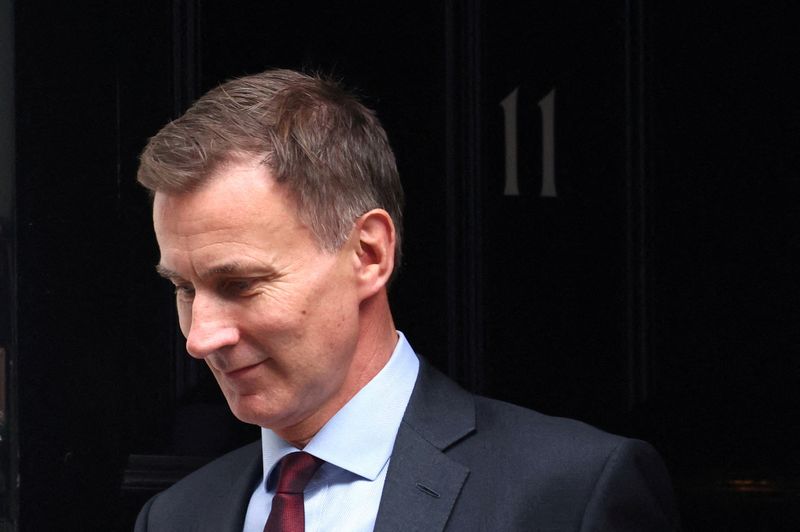
© Reuters. FILE PHOTO: FILE PHOTO: British Chancellor of the Exchequer Jeremy Hunt leaves Downing Street in London, Britain, September 13, 2023. REUTERS/Toby Melville/File Photo

LONDON (Reuters) -British finance minister Jeremy Hunt said on Sunday that he would not implement tax cuts that would push up inflation, days before he announces a major budget update that is widely expected to contain tax cuts.

The Sunday Times reported that Hunt was considering cutting income tax or national insurance in his Autumn Statement budget update on Wednesday.

Hunt is due to present his Autumn Statement on Nov. 22, hoping to revive the fortunes of both a stagnant British economy and the governing Conservative Party ahead of an election expected next year.

“The one thing we won’t do is any kind of tax cut that fuels inflation,” Hunt told Sky News.

When asked if he would cut inheritance tax – a move the Sunday Times said could be delayed owing to bad press – Hunt said “everything is on the table” ahead of his statement.

Rachel Reeves, the opposition Labour Party’s finance spokeswoman, said cutting inheritance tax would be the wrong priority in a cost-of-living crisis.

“Lower taxes on working people – if the government can explain where the money is coming from – is something I would support,” Reeves told Sky News.

Hunt’s options are limited after heavy state spending on the COVID-19 pandemic and last year’s surge in energy prices. Public debt now stands close to 100% of economic output, more than three times its size 20 years ago.

Still, official forecasts due next Wednesday are expected to show Hunt has more room for giveaways before running into trouble with fiscal rules than in his annual budget published in March.

Hunt said the only way to bring personal taxes down was to spend public money more efficiently.

“I want to bring down our tax burden, I think it’s important for a productive, dynamic, fizzing economy that you motivate people to do the work, take the risks that we need,” he said.

5 Strategies for International Digital Marketing

0
5 Strategies for International Digital Marketing

Digital marketing uses online technology to promote products and services. It involves producing materials to be distributed across multiple online channels to garner attention for your business. These online channels include email, websites, blogs, social media and games, as well as audio and video streaming. 

Digital marketing is inherently an international advertising strategy, since there are few restrictions in distributing digital marketing content to audiences worldwide. Physical geographic borders generally aren’t a factor online. Still, you should develop a specific plan to ensure your marketing efforts succeed.

Editor’s note: Looking for the right online marketing services for your business? Fill out the below questionnaire to have our vendor partners contact you about your needs.

5 steps for executing an international digital marketing strategy

Below are the steps every business owner should take when pursuing an international digital marketing campaign. While it’s possible to rush out online ads or social media to reach out to prospective customers in other countries, the results may not be optimal if you don’t do the following.

1. Find the most effective methods.

Your first step is to choose the most appropriate digital marketing strategies for your needs. There are many possible methods, and the effectiveness of each one depends on what you’re trying to achieve. However, two methods are considered fundamental, meaning they should always be employed regardless of the type of business you’re running. These are search engine optimization and social media marketing.

Search engine optimization (SEO) is a must for all businesses that seek to establish an online presence. It’s not just about topping the rankings for search engine results. It’s essentially about putting up the right information about your company online to inform both search engines and human viewers about what you’re offering.

Social media marketing is also considered fundamental, given the role it plays in the consumer market. Almost every potential customer has a social media account these days, so it’s an excellent platform for delivering your marketing messages. Other methods to consider include content marketing, email marketing, video advertising and affiliate marketing. [Find out why every brand should have a YouTube channel.]

When getting started with SEO, focus on high-volume keywords that are easy to rank for.

2. Establish the scope.

Don’t try to reach all or too many international markets at the same time. Going international with your digital marketing campaign doesn’t mean you have to simultaneously target all or most countries. Identify the top markets that will most likely give you the new customers you need, then focus your marketing on them. Realize that targeting numerous markets at the same time is going to be extremely costly and risky.

If you want your international digital marketing efforts to succeed, you can’t just throw out a one-size-fits-all campaign. Different countries or regions require different localization projects and teams. Likewise, they most likely need custom marketing strategies that appeal to different cultures. Digital marketing campaigns that work in Scandinavian countries, for example, are unlikely to work in China or Indonesia. [Read related article: International Business Etiquette from Around the World.]

It is advisable to start small, then expand as you see fit. Study your options to determine the next moves for your product expansion. Let the success of your initial promotional campaigns guide you to the next target countries or regions gradually. If your marketing efforts don’t seem to pay off in Asian markets, for instance, maybe you need to focus your efforts in more receptive places.

3. Develop flexibility and scalability.

Create an adaptable digital marketing strategy. The international market is never homogenous. That’s why you need to customize your approaches depending on the situation on the ground. Additionally, your plans must adapt to changes or unexpected developments. What do you do, for example, if the government in your target market releases a statement that the main ingredient of the mosquito repellent solution you’re marketing is ineffective? You would need to swiftly react by citing other authoritative research or advisories to counter the local government’s assertion.

Moreover, your marketing plan needs to be scalable depending on the conditions of the market. Avoid creating a plan that is too anchored on certain personalities, places, pop culture references or competing products. Make it easy to expand your plan by not necessitating major changes in your product pitch or the functions of the people involved in implementing the plan.

4. Build relationships.

Emphasize customer connections. International digital marketing may sound like an enormous and generalized venture, but it should feel as intimate as possible. Your goal is to make customers feel special so they are compelled to buy your product or subscribe to your service.

Be responsive to inquiries and always aim to improve your customer service. Address complaints or questions as soon as possible. If you’re trying to attract new consumers, don’t make them feel taken for granted or like one of many people your business deals with impersonally. Invest in a multilingual customer service team. Customers are more likely to buy something that’s pitched in their language, and prospective customers develop a more positive first impression when their inquiries are addressed in their mother tongue.

5. Monitor and evaluate.

Document the implementation of your international marketing plan and measure its performance. Keep up with everything that is happening with the plan. Record your progress and assess whether or not your efforts have achieved what they were meant to. Develop performance metrics and evaluate whether your business is getting something out of the endeavor.

The money you spend on online ads, social media promotions and other forms of digital marketing should translate to something palpable. That could be in the form of increased brand awareness or a bump in sales. Based on the results, either maintain or tweak your strategy, and continue to revisit it periodically to ensure your methods continue to pay off. You’ll also want to keep up with digital marketing trends to maximize the opportunities to reach customers.

Regardless of whether you’re targeting domestic or global markets, you need to define your target audience and know what you want to achieve. From there, you can build the specific strategy that will help you accomplish your goals.

Shekel resumes strong gains – Globes

0
Shekel resumes strong gains – Globes

The shekel has resumed its strong gains against foreign currencies. Earlier today, the Bank of Israel set the representative shekel-dollar rate down 1.35% from Thursday, at NIS 3.728/$, and the representative shekel-euro rate was set 1.333% lower at NIS 4.048/€. In futures contracts this afternoon, the shekel-dollar rate was down a further 0.14% at NIS 3.723/$ and the shekel-euro rate was down a further 0.05% at NIS 4.046/€.

The shekel is now trading at rates against the dollar last seen in August, long before the war. The shekel has gained 8% against the US dollar since the start of November and 5% against the euro. Why is this happening?

Mizrahi Tefahot chief market analyst Ronen Menachem tells “Globes” that the strengthening of the shekel against the dollar and euro is due to recent economic data from Israel and the US.

In Israel, Menachem explains, inflation and GDP data published in the past two days “were not were not sufficiently lukewarm to create an understanding in the market that the Bank of Israel is moving towards cutting interest rates soon.” In this context, Menachem also notes what the Governor said at the end of last week that the bank continues to focus on inflation and preventing excessive depreciation of the shekel.

But the main strengthening of the Israeli currency stems from the weakness of the US dollar. This is mainly due to reasons external to the Israeli market. On Tuesday, inflation data in the US was published, which indicated a further decrease in inflation in the country and a convergence towards the Federal Reserve’s inflation target. The decrease in inflation led the markets to price the expected interest rate cut by the Federal Reserve already in the first half of 2024 and has caused the dollar to weaken against major currencies in the world, and also against the shekel.

Menachem adds that the stock rises on Wall Street this week have also contributed to the change in foreign currency values. “There is an effect of the price increases on Wall Street on the market. There is a positive connection between the US market and the strengthening of the shekel (even if it is less strong than before). Over the last week, there was an increase in the stock indices in the US (especially Nasdaq) and part of this was translated into the strengthening of the shekel.”

The final factor is that the Bank of Israel is prepared to sell foreign currency as part of its plan to prevent the depreciation of the currency during the war and stabilize the market. Menachem points out that the market does not know when the bank decides to intervene in the market, if at all: “We do not know the mix of purchases and sales of foreign currency by a Bank Israel, so it can also be part of the equation in the foreign exchange movements this week.”


The volume of foreign exchange sales this month will be revealed only at the beginning of December, when the Bank of Israel will publish the foreign exchange balances in its possession. In October, the Bank of Israel sold $8.21 billion in foreign currency, out of up to $30 billion that it has allocated to moderate the shekel depreciation because of the war.

Published by Globes, Israel business news – en.globes.co.il – on November 17, 2023.

© Copyright of Globes Publisher Itonut (1983) Ltd., 2023.


Is it time to re-imagine Black Friday in the African context?

0
Is it time to re-imagine Black Friday in the African context?

American novelist, Herman Melville once wrote: “It is better to fail in originality than to succeed in imitation.” This quote felt apt as we review consumer habits and the annual Black Friday and Cyber Monday trade events.

While it is always interesting to evaluate some of the data trends originating from Covid-19 and the work-from-home trend that then moved into a post-Covid economic recovery environment, we are still grappling with the question: Are these consumer events actually suitable for the African context?

ADVERTISEMENT

CONTINUE READING BELOW

Naturally, it is easy to assume that anything which benefits the consumer should be viewed as a win; however, when we start to unpack this question further, a few real questions arise.

How healthy is the African consumer?

The first and most obvious starting point is the financial health of the average consumer on the African continent. The past 12 to 18 months have been characterised by rising inflation, fuel and electricity prices, as well as policymakers responding with interest rate increases as a result. This has placed immense strain on indebted consumers.

Each quarter, Credit Bureau TransUnion releases its Consumer Pulse survey, which analyses the health of consumer data. For the third quarter of 2023, it noted that the financial status of South African households was not uniform. Approximately one-third (34%) of families reported an increase in their incomes, and almost a quarter of them faced a decline. Nonetheless, the majority (72%) of people remained optimistic about their future incomes, expecting an increase in the coming year. As interest rate increases are being matched with rising costs of living across the spectrum, the last quarter of the year could be tight as consumers start to show signs of financial stress.

In light of increasing financial pressure, consumers are changing the way they shop for fast-moving consumer goods, with 34% buying whatever brand is on promotion and 46% focusing on essentials, according to data from market researchers NIQ. The data also shows that about 40% of South African consumers are shopping at discount stores more often.

In a bid to entice consumers and retain their market share, retailers are under enormous pressure to keep offering discounts throughout the year rather than focus on specific trade events. This means that in South Africa, discounting has become the norm rather than the exception.

While we want to see the middle class developing, is it about enticing them with discounts while they are under financial pressure, or is it about changing the retail experience in a more sustainable manner?

Are retailers innovative enough?

The second point is retailer innovation. In many ways, South African and African e-commerce and retail operators have attempted to imitate their US and European counterparts; however, there has been a persistent view that many of their offerings have been underwhelming in terms of discounts and specials.

While the ubiquitous scooter driver with fast-food deliveries is becoming a regular sight on South African roads, consumer participation in Africa is further stunted due to last-mile delivery challenges, with many retailers still focused on in-store activations and metros. This is where innovators such as Jumia have managed to carve out big portions of the African market – including Kenya – where they have utilised a 40 000-strong arsenal of consultants to educate consumers about opportunities related to the platform.

What are retailers doing to help struggling consumers?

Retailers are now offering different payment options to alleviate pressure on the consumer. The third trend that we are following with interest is the buy-now-pay-later (BNPL) model, which has gained traction across the continent. In South Africa, e-commerce giant Homechoice has pivoted into a full-blown financial services business with its PayJustNow businesses, securing over 900 000 customers in less than two years. In Kenya, Safaricom has expanded its financial services offering by incorporating BNPL, and Jumia is piloting an offering in Egypt to grow its market share.

Will already struggling consumers really pay more for socially conscious products?

ADVERTISEMENT

CONTINUE READING BELOW

Lastly, the concept of social and ethical selling, where consumers are prepared to pay up for products believed to be produced in a more ethical or socially conscious environment, is growing in interest. With US giant Amazon moving into South Africa, there is a perceived threat to existing players in the market as many of the smaller local retailers have the opportunity to access a global marketplace for their products – particularly if they can highlight the story behind the products they have developed and how their production and purchase benefits local entrepreneurs.

So, is Black Friday actually suitable for the African context? To answer this question, we must look at this trade event pre- and post-Covid-19.

Black Friday Pre-Covid-19:

Black Friday was largely an in-store event which exhibited similar characteristics to Black Fridays in the USA and Asia, i.e. people standing in long queues to purchase goods that were significantly discounted. Pre-Covid, South African retailers, in particular, were able to offer significant discounting as a means to clear stock ahead of the December festive season trading period. Pre-Covid, Black Friday in South Africa was very similar to Black Friday in the USA, Asia, and Europe in that it was considered one of the busiest shopping days in South Africa, with sales showing impressive growth.

 Black Friday post Covid-19:

Social distancing and lockdown restrictions meant that South African retailers had to change their approach to Black Friday, turning the event from a one-day in-store shopping experience into a month-long campaign which is now largely online. In fact, Black Friday in South Africa has evolved into “Black November”, diluting the original concept and potential value for consumers.

Furthermore, with data showing a consumer who is ailing and at risk, consumer spending behaviour has changed significantly. Retailers have responded to this by continuously offering discounts throughout the year. This has resulted in much shallower discounts being offered by retailers during Black Friday/Cyber Monday post covid, relative to the pre-covid era and despite consumers calling for the same significant discounts that were observed pre-Covid and in the USA, Asia, and Europe for the same event.

Similar or more impressive discounts are not always commercially viable for South African retailers, especially given the significant change in the consumer and economic landscape. With this backdrop, South African retailers are at a pivotal point, having to ask themselves whether Black Friday still makes sense to promote.

It might be time for retailers to start reimagining this so-called Black Friday in the African context and lead by differentiation of strategy or to simply opt out of this event.

Chipo Masawi-Butayi is coverage banker: Consumer Goods & Services at Absa CIB and Pauline Manyoki is product manager at Absa Bank Kenya.  

OpenAI Fires Controversial CEO Sam Altman

0
OpenAI Fires Controversial CEO Sam Altman

Sam Altman used to be the face of the AI tech boom, but now he’s like many that AI has affected—unemployed.

Earlier today, OpenAI, the company behind the popular chatbot ChatGPT, announced the firing of its influential CEO and founder. The surprising decision came after an Open investigation found that Altman was not entirely open with the board of directors.

“Mr. Altman’s departure follows a deliberative review process by the board, which concluded that he was not consistently candid in his communications with the board, hindering its ability to exercise its responsibilities,” the company said in a statement. “The board no longer has confidence in his ability to continue leading OpenAI.”

Mira Murati, the current chief technology officer of Open AI, will serve as interim CEO until a permanent successor is selected.

Related: Who is Sam Altman?

What’s next for Altman

The news of Altman’s departure sent shockwaves across the technology industry. At a developer conference last week, Altman unveiled a series of AI tool updates, including a new technology that allows developers to create custom versions of ChatGPT called GPTs.

Now, Altman’s future is unclear.

In a departing tweet on X, Altman expressed his love for his time at OpenAI, teasing that he “would have more to say about what’s next later.”

Former Google CEO, Eric Schmidt, sang Altman’s praises, tweeting: “Sam Altman is a hero of mine. He built a company from nothing to $90 Billion in value, and changed our collective world forever.”

A complex figure

Despite Altman’s advocacy for AI, he is also concerned about its potential risks. In testimony before Congress, Altman had an Oppenheimer moment praising the innovation of the invention he’d help shepherd into the world but also warning of its destructive power.

“My worst fears are that we—the field, the technology, the industry—cause significant harm to the world. I think that can happen in a lot of different ways,” he said.

Future of OpenAI

Altman’s exit has raised questions about OpenAI’s future direction. Some tech leaders, including Elon Musk, have called for more caution in AI development due to the potential risks it poses. While Altman’s departure may signal a shift in OpenAI’s approach to self-regulation, analysts are curious to see how the company’s next generation of leaders will navigate the fast-paced innovation culture and meet the expectations of regulators and society.

As OpenAI moves forward with new leadership, the AI industry will be watching closely to see how the company continues to innovate and maintain its position as a leader in artificial intelligence.

Wowcher faces court threat over ‘misleading’ sales practices

0
Wowcher faces court threat over ‘misleading’ sales practices

Wowcher, the online retail and experiences platform, has been warned it could face court action unless it changes customer sales practices.

The Competition and Markets Authority (CMA) launched a review of its operations in March as part of a wider probe into pressure-selling tactics used by retailers online.

The investigation, the regulator said, had found several areas of concern including hidden charges and the use of a pre-ticked box to enrol consumers into VIP memberships on Wowcher’s site.

The main gripe, however, seems to centre on its use of timers.

“Wowcher’s website features extensive use of countdown clocks and marketing claims such as ‘Running out!’ or ‘In high demand!’ which create an impression of urgency and influence shoppers as they are making their purchasing decisions,” a statement said.

“The CMA has found evidence that these claims risk giving the misleading impression that products will increase in price or will not be available, when this is often not the case.

“Such claims, especially when used with countdown clocks, can put pressure on shoppers to buy quickly for fear of missing out, leading to rushed purchases.”

The watchdog said it had written to Wowcher to outline the ways in which it could formally address the findings.

“Wowcher now has the opportunity to respond and avoid court action by signing undertakings to change its online sales practices,” the regulator added.

The company responded: “Wowcher’s mission has always been to help save our customers money with the best, exclusive offers from thousands of our merchants across the UK.

“This has never been more important than in this challenging economic environment.

“The aim of our marketing claims is always to provide accurate and useful information to our customers when they are browsing our website.

“We look forward to continuing to engage with the CMA on this matter.”

Crude oil bounces as further OPEC+ production cuts said to be on the table (NYSEARCA:USO)

0
Crude oil bounces as further OPEC+ production cuts said to be on the table (NYSEARCA:USO)

SlavkoSereda/iStock via Getty Images

Crude oil rebounded Friday from four-month lows hit in the previous session, as traders see a growing likelihood that OPEC and its allies will work to stop the nearly 20% plunge in prices since late September.

Reuters and Financial Times

The Most Essential Digital Marketing Strategies in Real Estate

0
The Most Essential Digital Marketing Strategies in Real Estate

Mark Hickman, Director of Digital Strategy at ONE Sotheby’s International Realty

The Most Essential Digital Marketing Strategies in Real Estate
Mark Hickman, Director of Digital Strategy at ONE Sotheby’s International Realty

In my role with the brokerage, I handle many high-level digital strategies and performance marketing campaigns on Google and Meta. I also optimize our website for SEO, work with an automated digital ad platform called “Boost” and help update our expansion efforts on Google Business and Apple Maps. These are just a few of my many tasks at ONE, and I am inspired by our Leadership Team and roster of Associates every day.

In thinking about today’s competitive real estate market, digital marketing is crucial for real estate agents to stand out and connect with potential clients. I constantly get asked by agents how they can grow their business, attract buyers and sellers, and promote a listing.

With more than 95% of home buyers and sellers going “online” to research properties and find agents, having a strong digital presence is essential.

Here are a few key strategies that real estate agents must embrace to successfully market themselves digitally; note there are more, but having these are a must.

Build a Professional Website:

A well-designed website is the foundation of your digital presence, view it as the nucleus of your digital ecosystem. Your website should be user-friendly, mobile-responsive, and contain essential information about you, your services, and the local real estate market. Make sure to include high-quality images, detailed property listings, and client testimonials. Additionally, consider starting a blog to showcase your expertise in the local market and provide valuable information to potential clients.

Optimize for Search Engines (SEO):

Search engine optimization (SEO) is crucial for real estate agents. By optimizing your website for search engines like Google, and Bing, you can increase your visibility in search results when potential clients look for real estate services in your area. Having an affiliation with a global brokerage like Sotheby’s will already allow your website to rank high, because of the authority the brokerage has with Google, but if you are not with a large company, you can still find ways to improve. Focus on using relevant keywords in your content, meta descriptions, and titles.

Local SEO is also essential, as many clients search for real estate agents near them. Make sure to include your location in your website’s content and claim your Google My Business listing. I would also encourage testing out Google’s Local Service Ads.

Leverage social media:

Social media platforms are dynamic tools for real estate agents to connect with clients and build their brand. Create profiles on platforms like Facebook, Instagram, LinkedIn, and TikTok. Share compelling content, including property listings, market updates, and informative articles. Engage with your audience by responding to comments and messages promptly, something we call “community management” in the industry. Paid advertising on social media can also help

you target specific cities, audiences, and increase your reach. To do this on Meta, make sure you connect your Instagram account with a Facebook Business Account.

Create Compelling Content:

Content marketing is a powerful way to showcase your expertise and connect with potential clients. Consider creating informative blog posts, videos, and infographics that address common questions and concerns in the real estate market. Offer tips for buying or selling a home, explain the mortgage process, or provide insights into your local community. By offering valuable content, you position yourself as a trusted resource and attract potential clients looking for your expertise. Plus, video content is having a moment right now, with statistics showing that buyers who watch a video are more likely to click and fill out a lead capture form, which increases conversions (leads).

Email Marketing:

Email marketing is a cost-effective way to stay in touch with past and potential clients. Build and maintain a mailing list and send regular newsletters with updates on the local real estate market, new listings, and tips for buyers and sellers. Personalize your emails to make clients feel valued and connected. Additionally, consider sending automated follow-up emails to nurture leads and keep them engaged.

In conclusion, the digital landscape has transformed the way real estate industry connects with clients. To succeed in this competitive industry, real estate agents must embrace digital marketing strategies to grow their sphere and improve their business. By implementing these essential strategies, an agent can position themselves as a knowledgeable and trusted real estate professional in the eyes of potential clients, ultimately achieving success in the digital age.