Home Blog Page 86

Digital marketing is a powerful took that requires investment and intention – April 2022

0
Digital marketing is a powerful took that requires investment and intention – April 2022


By Jessica Chevalier

Among flooring retailers, there are miles between how the best are using online marketing to woo customers and close sales and how the bulk are proceeding. Unlike the days of old, when running a weekly newspaper ad or broadcasting a commercial during the local evening news reached a specific sect of buyers in a particular market, seeking to produce a specific result, online marketing is a dynamic and ever-evolving medium, demanding that users change with it or be left in the dust. With the right use, online marketing can be a targeted and productive resource, though half-hearted efforts will leave retailers frustrated and fruitless.

TOOLS THAT NEED INTENTION
As Floor Focus contributor Irene Williams likes to remind readers, a productive online marketing program is not simply tapping the youngest member of your staff to post on social media every once in a while. A mature online marketing strategy involves establishing metrics and conducting frequent audits.

The flooring retailers who are invested in online marketing aren’t going it alone. They have an agency or multiple agencies that they hire to oversee and implement their strategies. Massachusetts-based A.J. Rose Carpets & Flooring has vendors that specialize in digital marketing, traditional marketing and social media. The key to success with these, however, isn’t simply writing a check and handing off the job; collaboration is key.

“If you don’t have your hands on it,” says Kevin Frazier of Knoxville, Tennessee-based Frazier’s Carpet One, “your agencies will drift on you. A floorcovering offering isn’t what they are used to advertising-it’s turnkey goods versus consumer goods [with which they are more familiar]. You have to have a sense for what the turnkey customer is looking for and how best to market it.” Since 2003, Frazier has been meeting with his online marketing partner once weekly for 45 minutes each time. At these meetings, the rep provides Frazier with a digital scorecard of about two dozen bullet points that detail things like: How much did YouTube impressions cost? How was traffic to the website? How did the digital leads platform perform? This includes Carpet One-supplied data about his website performance.

“I am always very involved in the vision and the big picture calendar,” says Frazier. “That keeps me abreast of what’s going on and the changes. [My rep] and I started drilling down on digital spend in 2015. I want proof that something works.”

CALL TO ACTION IS KEY
Of course, hiring agencies means financial investment. In addition to paying his agency, Frazier commits 4% of his sales to marketing, with an increasing portion of that going to online marketing. That includes a $2,700/month spend on Google and Facebook advertising and another $1,200/month on YouTube and Spotify ads-with three-quarters of that going to YouTube. In addition, Frazier’s spends about $700/month on content produced by his advertising agency.

Patrick Molyneaux, co-owner of Pennsylvania-based Molyneaux Tile Wood Carpet, devotes 40% to 50% of his total marketing budget to online outreach, which is used for various strategies that change as needed. “Our digital marketing team is constantly experimenting and testing various ways of engagement,” says Molyneaux. “The beauty of digital marketing is that ROI (return on investment) can be measured.”

Measuring success for online marketing, as with all marketing, is about compelling the consumer to take desired action. The desired action may change from one company to the next but it should be something concrete, not something as amorphous as “brand recognition.”

Sam Locher, vice president of business development and marketing for A.J. Rose, says, “Most of our goal with online marketing is to drive consumers to our website to fill out a lead submission form. Of course, ultimately our goal is to drive traffic into the stores and to get contact information to follow up.”

In addition to its online lead submission form, A.J. Rose offers the opportunity for consumers to text the company and receive nearly immediate feedback. Locher fields these texts. “Some people are more willing to text than to fill out a whole submission form,” he says. “And those that do want immediate gratification.” Locher receives about ten texts a day and disseminates them as needed to the company’s team. He laughs, noting that many are painfully vague, saying things like “I am looking for carpet,” but even that is an opening that may lead to a sale.

Frazier believes that a call to action is an imperative component of online marketing. He says, “Even as a retailer focused on quality and the longest-standing provider in our market, in our online ads you hear ‘sale, free financing, free in-home shopping, free in-home estimates.’ They have nothing to do with our 70 years in business or the fact that we have the largest selection around and beautiful galleries. Those are points of affirmation. Often, people want to emphasize those factors most in digital marketing, but if you are spending money on top-of-mind messages, you will get top-of-mind, not action.”

Adds Molyneaux, “We try to get consumers to set an in-home or in-store appointment with our online, real-time calendar. Those leads are assigned to a specific design consultant. This also allows us to capture the lead in our CRM (customer resource management) tool and measure closing ratios, which is why so many of our design consultants make our $100,000 per year, which is a great income for Pittsburgh, Pennsylvania.”

Between 2006 and 2014, Frazier closely watched digital marketing activity to see if it was driving a “full-bodied, complete response from the customer” for turnkey goods. Even amid those years, when the answer was “no,” the company was investing around $1,000/month in online marketing to build a base for when the tide turned. Frazier adds, “In 2014, we began to seriously notice the shift, and as we did, I began to reach out to other folks who I knew were good business owners to pick their brain about best practices. We all came to the same conclusion: This is a real thing, but what’s the best way to use it?”

He continues, “We put our foot on the accelerator in 2014 with free digital media (Facebook and Instagram) but paying someone to post. We asked ourselves, how much can we impact Google reviews with these? If we can, we have a metaphor for traffic. We learned a lot of best practices in that time, but what we learned more than anything is that you want to make sure you are creating a message tone that feels organic and relational but managing the execution as if it were just data.”

At the same time, of course, Frazier was watching how other providers of turnkey goods were utilizing online marketing and he noticed that beautiful, highly designed content wasn’t necessarily translating into traffic. “I am fine with top-of-mind as long as it’s part of the traffic equation,” he says. “We get lots of top-of-mind from radio, but we wouldn’t buy it only for that. While we know relational, organic-feeling content is very important, you can’t measure by feelings or top-of-mind or intangibles. You can celebrate those. But you can’t measure them.”

AUTHENTICITY
In a world where anyone can be behind a computer pretending to be anyone else, authenticity has become very important to consumers. There are a few ways that flooring retailers build a feeling of authenticity into the hollow void of the Internet, and one of those ways is through consistency. This means that while content may vary, the tone and feel remain constant.

If one person oversees all online marketing platforms, this is simple. But in cases where that person leaves or those in which many team members are creating marketing content, this can be more challenging.

Frazier’s daughter runs his Instagram page and does a great job with it, becoming something of an influencer in the area through her consistent approach. But next year, she will get married and move to South Carolina. What then?

Creating a set of bullet points that outlines the business’ social media persona is a good way to make sure that content continues feeling organic and consistent. All those within and hired by a company also create content on the business’ behalf should review and abide by them.

Another great way to build authenticity is through online reviews. A.J. Rose requests an online review from every customer, along with images of jobs it is particularly proud of. Good reviews paired with installation images are the most impactful online marketing fodder for A.J. Rose, says Locher. “They have the authenticity factor,” he notes. Customers post reviews across all different forums-on Facebook, Google and Yelp, to name a few-and it is important that retailers read these frequently and set out to “right” any “wrongs” aired within them.

Molyneaux promotes his company’s high (4.8/5) Google review score on his website landing page.

FEEDING THE ALGORITHM
Staying atop the way in which social media algorithms prioritize content is a maddening yet necessary pursuit. And that’s why working with professionals in the field is so important.

Between 2019 and 2020, Frazier’s used Facebook Messenger to promote sales and received “a private sale-esque response on a $3,000 spend,” recalls Frazier. But in December 2020, the Messenger algorithm changed. “We did a campaign in April, and it went fine. By summer, it was crickets. Zero response.”

That didn’t stop Frazier’s. The company changed strategies, increased its spend and continued to evaluate and re-evaluate.

Similarly, Locher reports that, at A.J. Rose, “We try to do a little of everything and gauge whether there is a response. Some of it is branding, so we know the response isn’t really possible to gauge. But we try to keep as many tentacles out as we can.”

WHAT WORKS
Pay-per-click has been a consistently effective format for engaging Molyneaux’s target audience, but the retailer notes that the cost-per-lead has increased significantly.

Frazier has been particularly happy with the traffic he’s seen generated through YouTube, for relatively low cost. “Last month, we paid $900 to get 7,000 full watches on YouTube, compared to the $6,000/month we pay for a four-day TV broadcast,” he says. “I know that we are getting more eyes through YouTube. You don’t pay if an ad is fast-forwarded or skipped. We have our jingle in the first seconds, so we are getting a lot of impressions for free.”

The entrepreneur adds, “I encourage retailers to become involved in digital if they aren’t. It drives traffic by itself. But you have to hold it to the same standard that you would traditional media.”

Copyright 2022 Floor Focus 

Related Topics:Molyneaux, Carpet One


https://www.floordaily.net/floorfocus/online-marketing-digital-marketing-is-a-powerful-took-that-requires-investment-and-intention

Treasurers Shift Focus to Payments and Banking Costs

0
Treasurers Shift Focus to Payments and Banking Costs

In times of economic turmoil, corporate treasury departments often change their priorities. During the financial crisis of 2007-2008, for example, the spotlight was on financial counterparties and whether they would fail. In recessionary periods, in another example, access to bank borrowing or credit markets takes precedence. 

In an inflationary environment, though, the most important tasks can be inward-facing: managing cash and liquidity, for example, and keeping higher operating costs from fraying profit margins. That’s according to the Association for Financial Professionals’ 2022 Strategic Role of Treasury survey released last week.

Close to two-thirds of the 395 treasury professionals responding, 62% of whom were from companies with more than $1 billion in revenue, indicated cash management and forecasting were their number-one priorities; 63% indicated it was liquidity and cash planning.

Surprisingly, though, improving payments processes and adopting payments technologies came in third, followed by “bank relationship rationalization” — cutting down on the number of banking service providers.

Those would seem to be projects more suited to times of relative quiet within treasury departments. But circumstances have dictated otherwise. And if a CFO is coming up with a list of action items for treasury, they may want to put these two items on the list.

Adopting new payments technologies and processes is a priority because as a result of the shift to remote work, many paper payment procedures — like getting a “wet signature” on a document — couldn’t be followed. That forced lagging companies to go electronic, said Tom Hunt, director of treasury services and payments at AFP. 

Despite all the improvements in payment technologies, though, accomplishing the switch may prove difficult. About 64% of respondents to a different question included “improving payment processes” in their top five most challenging tasks. 

“Part of the issue may be lack of IT resources,” said Hunt. A company setting up payments through a bank needs help from IT to decide on the use of application programming interfaces (APIs), handoffs, process monitoring, and “a whole new level of sophistication around cybersecurity and ensuring security protocols are within company guidelines.”

The priority of cutting back on banking relationships, on the other hand, is about reviewing treasury’s discretionary spending, said Hunt. Seeking to root out unnecessary internal costs within treasury was deemed to be the fourth most challenging task for treasury departments. But bank fees for services like foreign exchange, cash management, and capital markets are an area where treasury has some control.

Treasurers can start by validating that the menu of banking services the company pays for are being used appropriately, said Hunt, and then benchmarking the company’s transaction volume and pricing of services from financial institutions. Then treasury may want to put out a request for proposal to get bids from competing banks, whether for specific services or to consolidate services into one bank to get (it is hoped) better pricing.

“A treasury person wants to prove their worth every day, and we work in a very intangible environment,” said Hunt. “But bank fees are probably one of the most dependable things that are seen and can be felt and therefore can be measured and managed.”


https://www.cfo.com/credit-capital/cash-management/2022/09/treasury-payment-platforms-banking-priorities-spending/

Sana Expands Affordable Health Insurance Offerings for Small Businesses to Alabama

0
Sana Expands Affordable Health Insurance Offerings for Small Businesses to Alabama

AUSTIN, Texas, September 14, 2022–(BUSINESS WIRE)–Sana, a health care company providing dependable health benefits to small businesses at affordable prices, today announced its expansion into Alabama.

Founded in 2017, Sana recently closed a $60 million Series B funding round co-led by Trust Ventures and Gigafund.

Sana is serving a traditionally underserved market in Alabama. In addition to the lack of health insurance options for small businesses, Alabama ranks among the nation’s worst states regarding overall clinical care, according to The United Health Foundation’s 2021 report. That study ranked Alabama last in the category of mental-health providers and 46th in primary-care providers. Sana members receive no-cost virtual appointments with primary-care and mental-health providers, helping Alabamians overcome those shortfalls.

“Sana has also entered Indiana and Virginia this year and plans to keep expanding in 2022,” said Sana co-founder and CEO Will Young. “We’re on a mission to make quality health care understandable, accessible and affordable to as many Americans as possible. We’re excited to offer Alabama a better alternative to the same restrictive networks and sky-high ‘negotiated rates’ that have dominated the market for decades.”

Sana’s availability in Alabama means small and midsize businesses can now get health plans purpose-built to meet their needs. The state’s market is the most concentrated in the country, with Blue Cross Blue Shield of Alabama controlling 97%, according to the most recent data from the Kaiser Family Foundation. Sana will offer a desperately needed alternative to BCBS’s monopoly.

Only payroll surpasses health benefits as companies’ largest expense category. According to one report, small businesses pay anywhere from 8% to 18% more than a large company for an identical health insurance policy. Worse, 40% of small businesses reported that they’d increased the prices of goods and services due to rising health care costs, according to a 2021 survey.

When Sana enters a market, 35% of its new customers are small businesses previously unable to provide health care to employees due to high costs. Launching in Alabama adds more than 800,000 employees who can benefit from Sana’s health plans.

“Our whole company loves Sana, it’s the best health insurance experience we’ve had in our company history,” said Andy Reeves, COO of RedTree Albums. “[It’s a] better price for our company and employees and much better benefits coverage. Also it’s been a huge benefit how simple Sana is to use and get help with any problems.”

Those looking for small business health insurance in Alabama can utilize Sana to save money and attract and retain top talent in a competitive labor market. Sana’s customers often save up to 20% compared to legacy insurers.

Starting today, Alabama businesses can offer their employees health benefits packages with full medical, dental, vision and more without network restrictions or hidden fees. Sana is known for affordable employer health plans, $0 virtual doctors’ visits, low co-pays and 95% customer-service satisfaction. In addition to primary care, Sana gives employees access to virtual care with providers specializing in pediatrics, maternity and mental health.

About Sana

Sana provides small businesses with dependable health plans at prices they can afford. Through value-based care, the Sana Care ecosystem of world-class providers, direct primary care, and more, Sana is reducing the cost of high-quality care. Sana makes it easy for employers to administer benefits and offers members simplified health plans and top-notch customer service. For more information, visit www.sanabenefits.com.

In the denti-e-sorrisi blog you will find all the information on dental tourism in Albania on dental clinics in Albania on dental clinics in Tirana and on dentists in Tirana, you will also find important information on dental implants, on all on Four, on all on Six, on all on Eight, you will also find information on metal-ceramic crowns, zirconium crowns, all-ceramic crowns, dental veneers, Invisalign transparent aligners, fixed braces, teeth whitening, dental aesthetics, and dental care. These articles concern dental care in Albania specifically in Tirana.

View source version on businesswire.com: https://www.businesswire.com/news/home/20220914005140/en/

Contacts

Treble
Lindsly Penny
[email protected]

https://ca.news.yahoo.com/sana-expands-affordable-health-insurance-110000723.html

Also visit : https://www.denti-e-sorrisi.com

Non-Bank Lender Making Access to Finance Easier for SMEs

0
Non-Bank Lender Making Access to Finance Easier for SMEs

Loans

Loans

MELBOURNE, Australia, Sept. 20, 2022 (GLOBE NEWSWIRE) — Many Australian small businesses looking to grow still find it challenging to access finance — and Liberty is keen to break down the barriers.

Small businesses play a critical role in the Australian economy, employing nearly five million Australians and providing a key source of innovation and competition.

Many small businesses rely on external financing to manage cash flow, invest in new equipment and expand operations. Yet barriers remain for those seeking business loans.

Slow lending speeds and time-consuming paperwork can act as major roadblocks for businesses seeking to capitalise on growth opportunities.

For non-bank lender Liberty, helping business owners find the right finance solution for growth or to manage cash flow is a critical part of its service.

According to Head of Communications Heidi Armstrong, Liberty offers a range of business loans with fast turnaround times designed to support business customers to secure funds when required.

“Business finance no longer just means a traditional bank loan — flexible lenders such as Liberty offer an array of options designed to suit the needs of small businesses,” Armstrong said.

With decades of experience working with business owners, Liberty has the resources and wealth of knowledge to assess a borrower’s financial strength using alternative means to provide out-of-the-box solutions where necessary.

“At Liberty, it is the personalisation of our solutions that really benefits borrowers.”

From secured and non-mortgage backed business loans to line-of-credit solutions, Liberty has options for businesses requiring cash flow support to keep their business moving forward.

Even those with a less-than-perfect business credit score are encouraged to reach out for help to find a suitable solution, as there may be more options available than first thought.

A business loan can be the boost a business needs to take that next step. And with a range of business loans available from non-bank lenders such as Liberty, there are more opportunities for Australian businesses of all sizes to reach new heights.

Approved applicants only. Lending criteria apply. Fees and charges are payable. Liberty Financial Pty Ltd ACN 077 248 983 and Secure Funding Pty Ltd ABN 25 081 982 872 Australian Credit Licence 388133, together trading as Liberty Financial.

Contact Information:
Heidi Armstrong
Head of Communications, Liberty Financial
[email protected]
+61 3 8635 8888

Related Images

Image 1: Loans

Loans

This content was issued through the press release distribution service at Newswire.com.

Attachment

https://finance.yahoo.com/news/non-bank-lender-making-access-040100743.html

Top 10 Most Asked Car Insurance Questions Right Now

0
Car Insurance

You are therefore looking about for auto insurance. What do you believe you should know? Well, the majority of folks who visit my office ask me a variety of questions. Some of the questions you may have are addressed in the following.


Will My Rates Go Down When My Policy Renews?


  • The majority of our clients think that an insurance company’s track record influences insurance rates. There is some truth to it, as the majority of insurance providers offer discounts, but such discounts often don’t take effect until you’ve been a customer for three to five years. Rates are determined by a number of variables, including the length of time since your last infraction or accident, the overall length of time you’ve had insurance, and the performance of other clients your firm insures in your neighborhood.


Tip. Talk to your agent about recent events they have witnessed. Just for renewing your policy every six months, some policies offer loyalty awards.


How Long Do I Have Until My Policy Cancels?


  • Unless you are at your renewal, most policies provide a grace period of 5 to 7 days after the due date. There is no grace period during renewal, and those payments must be completed on time to guarantee that coverage is still in effect in the event of an accident.


Tip. Make sure you are aware of the precise length of your grace period. Consult your agent to ensure that you are always protected. Consider setting up your coverage such that payments are sent by automatic bank draft to prevent lapses. Your payments are never past due, and even if you forget to pay during the grace period, there won’t be a lag.


What Coverage Does The State Require?


  • Arizona currently requires Bodily Injury Liability limits of $15,000 per person / $30,000 per accident and $10,000 for property damage liability.
    Bodily injury liability limitations are currently required in New Mexico to be $25,000 per person, $50,000 per accident, and $10,000 for property damage liability.


Tip. I hope you aren’t counting on the State to save you if you have anything to lose. What is truly best for you and your family should be discussed with your agent.


How Long Do Tickets and Accidents Stay On My Insurance Record?


  • Depending on the offense, tickets typically remain on your insurance record for 3 to 5 years. Minor offenses like speeding and others typically have a 3-year statute of limitations. DUIs and other serious offenses can remain on your insurance record for up to 5 years! Depending on the insurance provider you are with, accidents, including those that weren’t your fault, can remain on your record for the same 3 to 5 years.


Note. Ask your agent for further information about your coverage.


When Do I Have To Add My Children As Operators on My Policy?


  • In the event that your child has a driving permit, As soon as they are licensed, you should include them in your coverage. Add them once your insurance provider can run Motor Vehicle Reports on their license. The only way to ensure that they are insured drivers under your policy is to do this. Many people are concerned about the extra cost associated with correctly include their children in their insurance coverage. Just think about the expense of not doing it. Even if the other person only has minor injuries, an uninsured liability loss involving an injury to another person could be extremely costly. The cost of healthcare has risen in the previous ten years, and an emergency room visit might result in a bill in the tens of thousands of dollars.


Tip. When you add a child to your coverage, most insurance providers provide a significant discount if they have a B average or higher and are still in school. This may save you hundreds of dollars annually.


If I Let Someone Borrow My Vehicle, Are They Covered Under My Policy?


  • Imagine you gave Uncle Bob permission to use your pickup to go to the city and get a refrigerator. Uncle Bob will be protected by your insurance if you give him permission to operate the vehicle and he has a current driver’s license.


Tip. As a general rule, unless their license is suspended, revoked, or otherwise invalid, almost anyone you permit to use your vehicle temporarily will be insured.


I Recently Got Divorced. Can I Remove My Ex From My Policy?


  • The State regulates auto insurance providers. The majority of States follow common law. Your insurance provider cannot kick out your ex-spouse without their specific permission. The ex-spouse must always sign a form provided by the insurance company in order to be dropped from the coverage. Most insurance companies will let you split off from your old policy and start a new one if your ex won’t sign themselves off of your policy, so that your spouse is not affected by the original policy you established together.


Tip. To make life much easier for you, make sure you and your ex are on good terms.


What is the Difference Between Preferred (Standard) and Non-Standard Insurance Companies?


  • Most large insurance firms typically have two distinct sub-businesses: a Preferred, or Standard, company into which they transfer all of the good risks, and a Non-Standard company for the owners of high-risk vehicles. If you have a clean driving record and a history of consistent insurance in your name, it is typically simple to qualify for ax Preferred company. It is quite difficult to get into a Preferred insurance company if you have a poor driving history, accidents, or haven’t had insurance in the last 30 days in your name. Because of this, the majority of large insurance providers have a Non-Standard business where they can place certain risks until they are eligible for the Standard or Preferred company.


Fact. Rates between Standard and Non-Standard companies might considerably differ. Be prepared to spend more for the next few years if you are hired by a Non-Standard company.


Why Do Insurance Companies Use My Credit To Rate My Policy?


  • Many businesses are now forced to acknowledge the value of running a credit report because the banks have been so successful with their credit scoring algorithms. Since there is a clear correlation between credit risk and insurance risk, the majority of significant insurance firms will want to run a credit report on you when you apply for insurance. According to statistics, drivers with good credit are less likely to make a claim, and if they do, the claim’s severity will be relatively minor. On the other hand, if a motorist has a bad credit rating, statistically speaking, the frequency and seriousness of claims made increases significantly.


Fact. Your credit history is now widely used by insurers to determine how much to charge you for auto insurance. Even if you have a mediocre or poor driving history, there are some situations and businesses where you could save money by switching to an insurer that considers credit as a rating component. There is another perspective on this. Moving your vehicle insurance to a provider that doesn’t utilize credit as a rating component could save you money if you have a bad credit history. Credit is rarely taken into account by insurance.


Tip. In order to ensure that you are in the best possible scenario given your credit history, good or bad, you should speak with your agent regardless of your credit situation.


See The Commercials On T.V. About Getting Money Back and “Vanishing Deductibles”. Is it really worth it?


  • Companies are increasingly rewarding cautious drivers with bonuses or giving you money back on your next exciting if you don’t get into any accidents or receive any fines. These perks require your consent because there are frequently additional fees involved with them.
    Regarding the “vanishing” deductibles, I’d advise sticking with one you can afford. Purchase smaller deductibles if your $1,000 deductible is set up but you don’t currently have $1,000 in the bank. The last thing you want to do is leave the car in a parking lot while you save up your deductible so you can get the damage fixed.
    Typically, insurance with these bells and whistles cost more than those without them. The extras you can add to a policy should never be the focus of a good, reasonable coverage debate. After you’ve taken care of the essentials, glance around to see what else might be intriguing.

Regardless of your driving history or coverage needs, let an expert insurance agent explain the coverage options that are available to you AND how they benefit you. They can explain the advantages to you. After all, you actually want insurance that will support your filing a claim. Numerous insurance companies offer literally tens of thousands of different coverage options. As we know, it can be confusing. The package and coverage options that are appropriate for you and your family can be chosen with the help of agents.

The 4 Types of Financing for Real Estate Investors

0
The 4 Types of Financing for Real Estate Investors

I’ve talked with lenders and potential financiers of my transactions for many hours over the course of my real estate investing career. With so many different loan and equity financing options accessible to investors today, it’s critical to understand the advantages and disadvantages of each so you can select the best financing solution for your unique situation.

Naturally, options are not only more limited than they were a few years ago given the state of the credit market, but the notion of a “good bargain” from a lender has also changed. It’s important to understand not only the different types of financing that are available, but also which types are most common and easiest to obtain. When I first started looking at financing for single family homes, I passed on a few potential options that in retrospect were pretty good given today’s tight credit market.

While there are, of course, more than four ways to finance real estate investments, most are a derivative — or mix of the four we will describe here — and the purpose of this article is to define the four most popular types of financing available to real estate investors.

Traditional Financing


The lender for this form of loan is typically a bank or mortgage broker, although it could also be a quasi-government agency or a huge banking institution (Freddie Mac, Fannie Mae, etc). The borrower’s present financial condition, including credit score, income, assets, and debt, is the only factor taken into consideration when determining eligibility for a loan. You probably won’t be eligible for traditional financing if you don’t have decent credit, a reasonable salary, and a low debt-to-income ratio (that is, you make a lot of money relative to your monthly responsibilities).


  • Benefits: Minimal interest rates, low loan expenses (or points), and lengthy loan terms are all advantages of traditional finance (generally at least 30 years). It’s a fantastic option if you are eligible for conventional finance.
  • Drawbacks: There are a few drawbacks to traditional financing for investors, some major:
  1. As I mentioned above, the main disadvantage of traditional financing is how tough it is to qualify for loans these days. When it comes to income and credit, you could have qualified for traditional lending’s “sub-prime” variant just a year or two ago, but these sub-prime options are no longer available due to the sub-prime meltdown (many of these borrowers defaulted on their loans). Therefore, it would be best to avoid trying to obtain traditional finance in the present day unless you have good credit, a stable salary, and little debt.
  2. The minimum down payment required by traditional lenders is often 20%. Investor loans with less than 20% down can be difficult to find via standard finance these days, yet this isn’t always the case.
  3. Dealing with conventional lenders who may not fully comprehend your firm might be challenging for investors. For instance, the lender almost prevented me from closing on a home with standard financing last week because they would not release the money until the hot water heater in the investment property was operational. As an investor, it’s typical for me to purchase homes that, among other things, have faulty hot water heaters. Since my sellers are mostly banks, I can’t usually expect them to remedy these issues for me. Before I even acquired the house in this situation, I had to fix the hot water heater, which is not something I want to do frequently.
  4. Traditional lenders take their time when it comes to appraisals and pushing loans through their process. It’s best to allow for at least 21 days between contract acceptance and close. As an investor, you often want to incent the seller to accept your offer by offering to close quickly; with traditional lending, that can often be impossible.
  5. There is a cap on the number of loans you can have at once if the lender will be financing through Freddie Mac or Fannie Mae, which is the case for most lenders. You will eventually come into this issue with traditional lending if you plan to be an active investor going after more than 5 or 10 properties at once because there is now a cap of either 4 or 10 loans (depending on whether it’s Freddie or Fannie).
  6. No conventional loans exist that will include the cost of rehab in the loan. If you want to spend $100,000 on a house and $30,000 on repairs, you will have to pay that out of your own pocket because the lender won’t include it in the loan.


Portfolio/Investor Lending


Smaller banks occasionally lend their own funds (as opposed to getting the money from Freddie, Fannie, or some other large institution). These banks typically have the freedom to set their own lending standards and are not restricted to relying solely on the borrower’s financial status. One or two of the portfolio lenders, for instance, will consider both the borrower’s financial status and the specific investment being considered.

Because some portfolio lenders (also called “investment lenders”) have the expertise to actually evaluate investment deals, if they are confident that the investment is solid, they will be a bit less concerned about the borrower defaulting on the loan, because they have already verified that the property value will cover the balance of the loan. That said, portfolio lenders aren’t in the business of investing in real estate, so they aren’t hoping for the borrower to default; given that, they do care that the borrower has at least decent credit, good income and/or cash reserves. While I haven’t been able to qualify for traditional financing on my own due to my lack of income, portfolio lenders tend to be very excited about working with me because of my good credit and cash reserves.


  • Benefits: As mentioned, the major benefit of portfolio lending is that (sometimes) the financial requirements on the borrower can be relaxed a bit, allowing borrowers with less than stellar credit or low income to qualify for loans. Here are some other benefits:
  1. Some portfolio lenders will provide “rehab loans” that effectively let the investor borrow enough money to pay for the entire cost of the renovation (with a down-payment based on the full amount).
  2. Portfolio loans often require less than 20% down payment, and 90% LTV is not uncommon.
  3. Portfolio lenders will verify that the investment the borrower wants to make is a sound one. This provides an extra layer of checks and balances to the investor about whether the deal they are pursuing is a good one. For new investors, this can be a very good thing!
  4. Portfolio lenders are often used to dealing with investors, and can many times close loans in 7-10 days, especially with investors who they are familiar with and trust.


  • Drawbacks: Of course, there are drawbacks to portfolio loans as well:
  1. Some portfolio loans are short-term — even as low as 6-12 months. If you get short-term financing, you need to either be confident that you can turn around and sell the property in that amount of time, or you need to be confident that you can refinance to get out of the loan prior to its expiration.
  2. Portfolio loans generally have higher interest rates and “points” (loan costs) associated with them. It’s not uncommon for portfolio loans to run from 9-14% interest and 2-5% of the total loan in up-front fees (2-5 points).
  3. Portfolio lenders may seriously scrutinize your deals, and if you are trying to make a deal where the value is obvious to you but not your lender, you may find yourself in a situation where they won’t give you the money.
  4. Because portfolio lenders often care about the deal as much as the borrower, they often want to see that the borrower has real estate experience. If you go to a lender with no experience, you might find yourself paying higher rates, more points, or having to provide additional personal guarantees. That said, once you prove yourself to the lender by selling a couple houses and repaying a couple loans, things will get a lot easier.


Hard Money


Hard money is so-called because the loan is provided more against the hard asset (in this case Real Estate) than it is against the borrower. Hard money lenders are often wealthy business people (either investors themselves, or professionals such as doctors and lawyers who are looking for a good return on their saved cash).

Hard money lenders often don’t care about the financial situation of the borrower, as long as they are confident that the loan is being used to finance a great deal. If the deal is great — and the borrower has the experience to execute — hard money lenders will often lend to those with poor credit, no income, and even high debt. That said, the worse the financial situation of the borrower, the better the deal needs to be.


  • Benefits: The obvious benefit of hard money is that even if you have a very poor financial situation, you may be able to a loan. Again, the loan is more against the deal than it is against the deal-maker. And, hard money lenders can often make quick lending decisions, providing turn-around times of just a couple days on loans when necessary. Also, hard money lenders — because they are lending their own money — have the option to finance up to 100% of the deal, if they think it makes sense.
  • Drawbacks: As you can imagine, hard money isn’t always the magic bullet for investors with bad finances. Because hard money is often a last resort for borrowers who can’t qualify for other types of loans, hard money lenders will often impose very high costs on their loans. Interest rates upwards of 15% are not uncommon, and the upfront fees can often total 7-10% of the entire loan amount (7-10 points). This makes hard money very expensive, and unless the deal is fantastic, hard money can easily eat much of your profit before the deal is even made.


Equity Investments


Equity Investment is just a fancy name for “partner.” An equity investor will lend you money in return for some fixed percentage of the investment and profit. A common scenario is that an equity investor will front all the money for a deal, but do none of the work. The borrower will do 100% of the work, and then at the end, the lender and the borrower will split the profit 50/50. Sometimes the equity investor will be involved in the actual deal, and oftentimes the split isn’t 50/50, but the gist of the equity investment is the same — a partner injects money to get a portion of the profits.


  • Benefits: The biggest benefit to an equity partner is that there are no “requirements” that the borrower needs to fulfill to get the loan. If the partner chooses to invest and take (generally) equal or greater risk than the borrower, they can do so. Oftentimes, the equity investor is a friend or family member, and the deal is more a partnership in the eyes of both parties, as opposed to a lender/borrower relationship.
  • Drawbacks: There are two drawbacks to equity partnership:
  1. Equity partners are generally entitled to a piece of the profits, maybe even 50% or more. While the investor doesn’t generally need to pay anything upfront (or even any interest on the money), they will have to fork over a large percentage of the profits to the partner. This can mean even smaller profit than if the investor went with hard money or some other type of high-interest loan.
  2. Equity partners may want to play an active role in the investment. While this can be a good thing if the partner is experienced and has the same vision as the investor, when that’s not the case, this can be a recipe for disaster.


17 Ways To Grow Your Digital Marketing Skills As A Modern Marketer

0
17 Ways To Grow Your Digital Marketing Skills As A Modern Marketer

Krista Neher is the CEO of Boot Camp Digital, a 6X best-selling author, international speaker & recognized digital marketing thought-leader.

Whether you are new to digital or an experienced professional, digital marketing is always evolving. Digital marketing now accounts for 56% of marketing budgets, and this number will likely continue to grow. Data from LinkedIn shows that digital marketing skills are among the most in-demand. However, digital marketing roles also have the largest skill gaps.

Here are 17 ways to grow your digital marketing skills to maintain relevance in 2023 and beyond:

1. Curate your social media feeds.

I have many social media and digital marketing thought leaders in my social networks. This ensures that my news feeds on these channels are full of news, insights and tips on digital marketing. I often learn about breaking news from a friend who heard it first. Curate the accounts you follow on social media to get digital marketing insights right in your newsfeed. LinkedIn is especially good for this if you want to keep Instagram and Facebook more personal.

2. Attend conferences.

Conferences are a great way to get inspired and learn from industry leaders. There are so many great digital marketing conferences. Consider adding one or two digital marketing conferences to your agenda for this year. If budget is an issue, there are often many great events in your local area where you can save on travel costs.

3. Subscribe to industry podcasts.

There are tons of great marketing podcasts out there. Choose one or two to subscribe to that are relevant to your needs. Podcasts are great to listen to in the car, when working out or while cleaning. Make better use of your downtime while learning a thing or two.

4. Keep tabs on digital marketing news sites.

There are lots of great news sites for digital marketing to keep you on top of the biggest trends. Choose a news site that is relevant to you and subscribe to their emails. This allows you to get the latest news in your inbox so you never miss a thing.

5. Read news roundups.

Many sites and agencies put out “digital news roundups” every week or month. If you don’t have the time to read the news regularly, let someone else do the hard work and get the highlights all in one place.

6. Attend a training.

Training is a great way to level-set and get comprehensive knowledge. There are training courses to match any topic, knowledge and interest level. Even if you are experienced in the area, a training session should get your creative energy flowing. I’ve taught over 5,000 classes on digital marketing, and I always leave with a huge to-do list.

7. Build a reading list (with actual books).

Some people think digital changes too quickly for books to be relevant. This isn’t true. Sure, some of the details change quickly, but most books are based on strategic topics that have long-lasting relevance. Create a reading list based on the topics you want to learn about. There are so many great options from copywriting to influencer marketing to social media to digital ads.

8. Attend local meetups.

Almost every city of every size has a variety of digital marketing meetups. This is a great place to meet like-minded individuals and have actual conversations about digital marketing. Most also include speakers, which is another powerful way to learn more.

9. Watch YouTube video tutorials.

YouTube is a great resource to learn new things. There are digital marketing videos anywhere from one minute long to over five hours! In my experience, you can learn almost anything tactical or strategic for free just by searching for the topics you are interested in.

10. Add webinars into your routine.

With the pandemic so much content went online, creating new opportunities to get educated without leaving your home. Make a point to find a few webinars a month to accelerate your knowledge. Look for webinars with great speakers and relevant topics.

11. Bring training to your company.

If you work in marketing, chances are that you aren’t alone in wanting to keep your skills and knowledge relevant and fresh. If your coworkers are on board, approach your employer to offer digital marketing training as a part of their annual training plan.

12. Scope out free training from digital platforms.

Big tech companies like Facebook and Google offer free training and low-cost certifications. These are great resources to stay up-to-date and learn directly from the businesses creating the tools. Facebook Blueprint is a free program with tons of content. Google also offers free certifications in analytics and ads.

13. Get a certification.

Certifications show that you’ve taken the time to master a specific topic. Accredited industry certification should include a test and work submission to validate your knowledge. Look for a good certification to level-set your skills and showcase your knowledge.

14. Be curious and try things.

The best way to learn about something is to get your hands dirty. If you want to understand the trends on TikTok, join and take a look around. Get hands-on experience in new areas by being curious and trying things out.

15. Find local industry events.

Almost every Chamber of Commerce and local industry association brings in guest speakers. These are usually low-cost and often only a few hours long. They are easy and convenient to fit into your schedule in the lunch-and-learn format.

16. Join a Facebook group.

There are Facebook groups for almost everything. Some of the best insights and ideas I have come from other members of Facebook groups I’m in. Look for social media and digital marketing Facebook groups to join. They are free and you can participate and learn from others.

17. Subscribe to blogs.

Learning from industry thought-leaders and influencers is a powerful way to stay relevant and level up your knowledge. Most industry leaders have a blog or website where they share thoughts and ideas. Subscribe to a few blogs to get updates in your inbox and continuously learn.

If you want to stay relevant you must upskill and continue to learn. The good news is that there are many easy ways to do this.


Forbes Coaches Council is an invitation-only community for leading business and career coaches. Do I qualify?


https://www.forbes.com/sites/forbescoachescouncil/2022/09/16/17-ways-to-grow-your-digital-marketing-skills-as-a-modern-marketer/

Everything You Need to Write a Marketing Plan

0
Everything You Need to Write a Marketing Plan

What is a marketing plan?

A marketing plan is a strategic roadmap for how you communicate (on and offline) with your target audience to successfully promote your products or services. Marketing plans range from extremely basic to highly detailed, depending on what you want to accomplish.

According to Molly Maple Bryant, head of marketing at ArcheMedX, a marketing plan is not simply a list of things you want to accomplish. Instead, it should list the outcomes you seek – measurable and contextual, like the pipeline you’re developing, or leads you’re generating – and it should explain the high-level strategies you will use to achieve those outcomes. Developing strategies can be difficult, but they make a major difference in keeping you on track and avoiding diversions, which is also referred to as “scope creep.”

“Once you have an agreed-upon plan, you are able to compare any incoming requests against your strategies to determine ‘Yes, this adheres to my strategy so we can add it,’ or ‘No, this sounds good in theory, but it doesn’t adhere to our agreed-upon strategy, so we won’t adjust resources,’” Bryant told business.com.

Free Download: Download a copy of our free marketing plan template.

Types of marketing plans

There are several different types of marketing plans you can use based on certain strategies that make sense for your organization. Your business will likely need a combination of the following marketing plans to create an effective, comprehensive marketing strategy: 

  • An advertising plan
  • A branding plan
  • A content marketing plan
  • A customer acquisition plan
  • A direct marketing plan
  • An email marketing plan
  • A public relation plan
  • A print marketing plan
  • Reputation management
  • A retention plan
  • A search engine optimization plan
  • A social media marketing plan

Depending on your product positioning, you may also want to niche marketing plans, like influencer marketing or video marketing.

Why it’s important to have a marketing plan for your business

A marketing plan is a crucial resource for any small business. Essentially, it helps you identify the market needs your product or service meets, how your product is different from competitors, and who your product or service is for. Marketing plans also serve as a road map for your sales strategy, branding direction and building your overall business. This is important for successfully conveying your brand messaging to your target audience.

Another major benefit of a marketing plan for your company is that rather than simply guessing metrics, it forces you to sit down and do the math about your business goals and how to realistically fulfill them. When you look at your growth outcomes, you can delve further to determine what it will take to get to those numbers.

Bryant offered the following example: “Need $100,000 in revenue? How many sales is that? If 10, what’s your close rate? Let’s say 10% from lead to closed deal. Now you have a metric to start from – to get to 10 sales, we need 100 leads. Now, where will they come from, and what strategies will you use? The plan helps you put it all on paper so you can map out resources and tactics later with a lot of preparation and realism,” said Bryant.

When analyzing outcomes and resources, you can save time and avoid scope creep by focusing only on those strategies that are relevant to your marketing plan. A marketing plan not only helps you think realistically about your strategies, it also gets your stakeholders on the same page and holds your marketing team accountable for their decisions.

“When everyone’s tasks and goals are laid out for the stakeholders and company partners to see, it is much easier for the entire team to feel at ease about reaching sales goals and allowing the marketing team the space and freedom needed to execute work without constant supervision,” said Cassady Dill, digital marketing consultant and owner of Ethos Agency.

Additionally, Dill said a marketing plan should be easily understood by your entire team, executives, and outside departments, and it should serve as an easy guide for future marketing managers and team members to understand and implement.

5 elements of an effective business marketing plan

A marketing plan should be customized to fit your business; however, Dill said, all marketing plans contain five key functions:

  • Your business goals
  • Key metrics (how you quantify and measure success)
  • Strategies (an overview of implementation and how that will achieve goals)
  • A plan (the details of execution and the human resources, departments, and software that will be involved)
  • Reporting (what reports of progress will include and/or look like)

We broke down those five functions into 10 actionable categories to help you create a marketing plan that is unique and effective for your business.

1. Executive summary

The executive summary is a great place to give the reader of your plan an overview of your business’s mission or goals, as well as the marketing strategy you’re looking to employ. An executive summary is often written after you’ve completed the rest of the marketing plan, to ensure it covers all the important elements of your plan. If the executive summary is the only part of your marketing plan that someone reads (which is highly possible), you want to be sure they understand the most crucial details.

2. Mission statement

Your mission statement, not to be confused with a vision statement, is a statement that encompasses your company’s values and how they relate to your overall goals as an organization. Here are some good questions to get you thinking:

  • What does your company do today?
  • What’s important to your company?
  • What would your company like to do in the future?
  • What is your brand identity?
  • What’s your culture like?
  • How does your company benefit customers, employees and stakeholders?

3. Target markets

Identifying your target market is one of the most important parts of your marketing plan. Without a defined target audience, the money you spend on marketing will be a waste. Think of it like this: Some people need your service or product but don’t know it exists yet. Who are those people?

Here are some other questions to help you brainstorm your target market:

  • What is the demographic of your customers (gender, age, income, education, etc.)?
  • What are their needs and interests?
  • What’s their psychographic profile (attitudes, philosophies, values, lifestyle, etc.)?
  • How do they behave?
  • What are some existing products they use? 

4. Products and services

In this section, don’t just list what your product or service is. Think critically about what you have to offer your customers and what that value proposition means to them.

  • What do you make or provide for customers?
  • What are your customers’ needs?
  • How does your product or service fulfill customers’ needs?
  • What value do you add to your customers’ lives?
  • What type of product or service are you offering?

5. Distribution channels

At this point in your report, you should transition your thinking into actual marketing theory and practices. Distribution channels are the avenues you’ll use to reach a prospective customer or business. Think of all current and potential sales channels on which your specific target audience is active. One distribution channel that works great for one organization may be useless to another. For example, one company may host their website for free on a site like HubSpot and solely rely on that as their sales channel while another company may have a whole team of people using Pinterest to drive sales.   [Learn how CRM systems can help track your marketing leads based on various distribution channels.]

Some include examples of sales channels include:

  • Website(s)
  • Retail
  • Mobile text message marketing
  • Social media
  • Email
  • Resellers
  • Print (newspapers, magazines, brochures, catalogs, direct mail)
  • Broadcast (TV, radio)
  • Press releases
  • Trade shows, product demonstrations, event marketing

6. Competitive profile

One of the major aspects of your marketing plan is developing your unique selling proposition (USP). A USP is a feature or stance that separates your product or service from those offered by competitors. It’s all about differentiation and distinguishing your company as a sole proprietor of one type of good or service. Conduct a competitive analysis to identify your competitive profile and how you stack up against the competition. It is important to remain unbiased when conducting this analysis.

Here are some ideas to consider:

  • What’s your USP?
  • Who are your competitors? What do they offer?
  • What are the strengths and weaknesses of your competition?
  • What needs of the market (or customer) are not being served? What can you do to meet those needs?

7. A pricing strategy

Pricing is something you should consider when drafting your marketing plan. Developing the right pricing strategy helps you better market your product. You want to consider your current and projected finances when developing a long-term marketing strategy that is realistic and beneficial for your business. Here are some key questions to ask yourself about your pricing:

  • What are reasonable margins to make a profit and cover the costs of production?
  • Is there a market for products or services at your projected price point?
  • Are you willing to sacrifice profit margins in return for a greater market share?
  • What are your marketing and distribution costs?

8. Objectives

Consider your objectives when developing a marketing plan. This aspect of your plan should involve specific goals related to market penetration and revenue targets. Be sure to keep your marketing objectives on-brand with your business. Here are some things to consider:

  • Sales quotas
  • Number of new customers gained
  • Customer retention percentages
  • Revenue targets
  • Market penetration
  • Brand awareness
  • Website traffic

9. Action plans

With all of the above items outlined, determine what actual steps need to be taken to enact your marketing plan. This includes determining the proper steps, setting goals, breaking down responsibilities, and establishing an overall timeline.

It’s also important to brainstorm potential roadblocks your business could face and some solutions to overcome them. Your research is useless if you don’t have an actionable plan that can be realistically implemented to carry out your ideas.

10. Financial projections

This last step allows you to establish a realistic marketing budget and better understand what your marketing plan will look like from a cost perspective. In addition to setting a budget, consider the overall return on investment as well. Here are some other financial projections to consider:

  • Cost of implementation
  • Cost to produce product or service
  • Existing and projected cash flow
  • Projected sales
  • Desired profit margin on projected sales

Templates for creating a successful marketing plan

The internet is full of useful tools, including paid and free marketing plan templates to help you build a successful marketing plan.

Whether you are looking for a free template generator to build a new marketing plan, a benchmarking tool to evaluate your current strategies, or a video tutorial to learn more about marketing plans, there are several great resources available. Keep in mind that the best marketing plan for your business will be a customized one.

“Ultimately, you should design a marketing plan that best serves the needs of your team as you see fit,” said Dill. “Don’t force yourself into a plan that doesn’t fit your team. Use templates to shorten the workload time, but then adjust it for a more custom plan.”

Marketing plan template

  • Free marketing plan template: business.com has developed a free template that is fully customizable based on the needs of your business. Each section provides in-depth explanations, examples and resources to help you create an impressive marketing plan.

Marketing plan video tutorials

  • Brief tutorial: If you are a visual learner, take advantage of one of the many marketing plan video tutorials online to get started. One of our favorites is this brief tutorial by marketing expert Neil Patel. He teaches his six-step marketing plan process in six minutes.
  • Longer tutorial for beginners: If you are a new to marketing plans, or you want a slightly more formal (and lengthier) video to share with your marketing team, there are other video tutorials on YouTube as well.

Benchmarking tools and templates

  • Smart Insights: In addition to offering marketing plan templates, some companies, like Smart Insights, offer marketing benchmarking templates to help you evaluate your strategy performance. These are accessible with a free Smart Insights membership.
  • GERU: Similarly, GERU offers a funnel-planning, profit-prediction, and simulation tool to help you assess mock business ideas and simulations. This can help you identify weak points in your marketing strategy that need improvement. Although GERU requires users to sign up for a paid account, you can access a free trial to test it out.

How to take action with your new marketing plan

Before diving into marketing plan templates, it’s important to understand how to think about a marketing plan.

A good marketing plan targets whom your buyers are, it establishes the service or product you are offering, and it determines your unique selling proposition. From here, you will tackle the marketing planning process and develop the best way to get your product in front of buyers who want your product or service.

Dill created a simple four-step process for how small businesses can take action with creating a marketing plan.

  1. The first step is to hold a marketing meeting with all the marketing team and executives or stakeholders. This gives them time to offer questions, concerns, and criticisms you haven’t thought of so you can go back to the board room and revise your strategy or plan.
  2. Next, add a timeline to all your tasks and assign team members and all the help you’ll need to execute that plan.
  3. Once your plan is in action, hold weekly check-ins in person or by email to keep everyone on track.
  4. Share a weekly progress report with all parties involved and execs to ensure you are moving in the right direction.

In addition to drafting your own plan, you can work with a digital marketing agency or use internet marketing and pay-per-click management services to leverage your online presence.

Once you’ve established a general road map, update it annually. Developing an evolving marketing plan sets your business up for continued success – it allows you to prepare for the unexpected and establish a connection between your brand and your audience.

Matt D’Angelo contributed to a previous version of this article.

https://www.business.com/articles/sample-marketing-plan-outline-and-template/

Citigroup opens investment hub in MALAGA to attract graduates who want more free time

0
Citigroup opens investment hub in MALAGA to attract graduates who want more free time

Citigroup opens investment banking hub in MALAGA in a bid to attract staff who want a lifestyle change – and more free time – after Covid

  • Citi has lured 27 new junior analysts to the hub in Malaga for two-year scheme
  • Graduates are put off from banking by gruelling seven-day weeks, experts say
  • The Malaga intake will work eight-hour days from Monday to Friday 

Wall Street giant Citigroup is trying to woo junior bankers with reduced hours and sun-kissed beaches by opening up a new hub in Malaga.

The US bank is promising eight-hour days and no work on the weekends in the two-year programme which launched in the southern Spanish city yesterday.

The company chose 27 analysts from more than 3,000 applicants for the scheme, an attractive offer for graduates who face the alternative of gruelling seven-day weeks in London.

Wall Street giant Citigroup is trying to woo junior bankers with reduced hours and sun-kissed beaches by opening up a new hub in Malaga

Most of the junior investment bankers are in their early 20s and the 16 men and 11 women include one Briton and one dual Spanish-British national.

Between them they speak a total of 15 languages.

Their salary will be around half of the £86,000 starting pay offered for the same roles in London and New York. 

Banks are struggling to lure prospective staff to work in city centres post-pandemic amid criticism of burnout in the industry.

Malaga, in the Costa del Sol, offers sunny beaches and local cuisine which the workers will be able to enjoy in their ample free time.

But some have criticised the move, saying it will hamper the employees who will end up working less than half the hours for less pay than their peers in Citi’s main offices. 

A civic reception was held yesterday to launch the project with its new intake of 27 analysts (pictured)

A civic reception was held yesterday to launch the project with its new intake of 27 analysts (pictured)

A civic reception was held yesterday to launch the project as Manolo Falco, Citigroup’s global co-head of investment banking, insisted that it was ‘not a gimmick’.

He told the Financial Times: ‘We lose talent to private equity and tech, so we are eager to understand if we can stop that by offering a better work-life balance.

‘We suffer from a lot of churn like the rest of the industry, we lose talent to private equity and tech, so we are eager to understand if we can stop that by offering a better work-life balance.’ 

Maria Diaz del Rio, chief of staff for the unit in Malaga, said: ‘Sometimes banks burn out our analysts, so we want to prove they can work limited hours and still add value. 

The US bank is promising eight-hour days and no work on the weekends in the two-year programme which launched in the southern Spanish city yesterday

The US bank is promising eight-hour days and no work on the weekends in the two-year programme which launched in the southern Spanish city yesterday

‘When they are working on Mergers and Acquisitions deals, maybe we will ask them to work longer, but will compensate them with more holidays.’

Those who want to advance their career will have to move on from the Costa del Sol.

Staff who have performed well after two years will have the opportunity to apply for jobs elsewhere such as New York or London.

The debate over burnout among junior bankers was reignited last year when Goldman Sachs analysts revealed brutal hours and bullying allegations.

Banks responded by hiking first-year salaries to more than $100,000 plus bonuses.

Citi has recruited 160 graduates across Europe, the Middle East and Africa this year, and the Malaga office represents only a small part of the operation.

https://www.dailymail.co.uk/news/article-11214927/Citigroup-opens-investment-hub-MALAGA-attract-graduates-want-free-time.html

Global Tax Accounting Services Market Sourcing and Procurement Intelligence Report| Top Spending Regions and Market Price Trends| SpendEdge

0
Global Tax Accounting Services Market Sourcing and Procurement Intelligence Report| Top Spending Regions and Market Price Trends| SpendEdge

NEW YORK, Aug. 30, 2022 /PRNewswire/ — The Tax Accounting Services market will register an incremental spend of about USD 119.18 Billion, growing at a CAGR of 3.91% during the five-year forecast period. A targeted strategic approach to Tax Accounting Services sourcing can unlock several opportunities for buyers. This report also offers market impact and new opportunities created due to the COVID-19 pandemic.  

Tax Accounting Services Market

www.spendedge.com/report/tax-accounting-services-procurement-market-intelligence-report

Key Highlights Offered in the Report: 

  • Information on how to identify strategic and tactical negotiation levels that will help achieve the best prices.

  • Gain information on relevant pricing levels, detailed explanation on pros and cons of prevalent pricing models.

  • Methods to help engage with the right suppliers and discover KPI’s to evaluate incumbent suppliers.

Insights into buyer strategies and tactical negotiation levers:

Several strategic and tactical negotiation levers are explained in the report to help buyers achieve the best prices for the Tax Accounting Services market. The report also aids buyers with relevant Tax Accounting Services pricing levels, pros, and cons of prevalent pricing models such as volume-based pricing, spot pricing, and cost-plus pricing and category management strategies and best practices to fulfil their category objectives.

For more insights on buyer strategies and tactical negotiation levers,
www.spendedge.com/report/tax-accounting-services-procurement-market-intelligence-report

Key Drivers and Trends Fueling Market Growth:

The pressure from substitutes and a moderate level of threat from new entrants has resulted in the low bargaining power of suppliers.

Price forecasts are beneficial in purchase planning, especially when supplemented by the constant monitoring of price influencing factors. During the forecast period, the market expects a change of 2%-4%.

  • Identify favorable opportunities in Tax Accounting Services TCO (total cost of ownership).

  • Expected changes in price forecast and factors driving the current and future price changes.

  • Identify pricing models that offer the most rewarding opportunities.

SpendEdge presents a detailed picture of this procurement market by the way of study, synthesis, and summation of data from multiple sources. Our Tax Accounting Services market procurement report covers the following areas:

Some of the top Tax Accounting Services suppliers listed in this report:

This report offers detailed insights and analysis of the major cost drivers, volume drivers, and innovations of the Tax Accounting Services procurement and sourcing market, which the global suppliers have been leveraging to gain a competitive edge across regions. Some of the leading Tax Accounting Services suppliers profiled extensively in this report include.

  • PricewaterhouseCoopers

  • Deloitte Touche Tohmatsu

  • Ernst and Young Global

To get instant access to over 1000 market-ready procurement intelligence reports without any additional costs or commitment.

Subscribe Now

Table of Content

  • Executive Summary

  • Market Insights

  • Category Pricing Insights

  • Cost-saving Opportunities

  • Best Practices

  • Category Ecosystem

  • Category Management Strategy

  • Category Management Enablers

  • Suppliers Selection

  • Suppliers under Coverage

  • US Market Insights

  • Category scope

  • Appendix

About SpendEdge:

SpendEdge shares your passion for driving sourcing and procurement excellence. We are the preferred procurement market intelligence partner for 120+ Fortune 500 firms and other leading companies across numerous industries. Our strength lies in delivering robust, real-time procurement market intelligence reports and solutions.

Contacts
SpendEdge
Anirban Choudhury
Marketing Manager
Ph No: +1 (872) 206-9340
https://www.spendedge.com/contact-us

SpendEdge Logo (PRNewsfoto/SpendEdge)

SpendEdge Logo (PRNewsfoto/SpendEdge)

Cision

Cision

View original content to download multimedia:https://www.prnewswire.com/news-releases/global-tax-accounting-services-market-sourcing-and-procurement-intelligence-report-top-spending-regions-and-market-price-trends-spendedge-301614598.html

SOURCE SpendEdge

https://finance.yahoo.com/news/global-tax-accounting-services-market-170300963.html

Fight Higher Interest Rates With These 3 Top Insurance Stocks

0
Fight Higher Interest Rates With These 3 Top Insurance Stocks

We’ve landed in a highly challenging macroeconomic environment after coming out of a once-in-a-lifetime pandemic. Inflation remains historically elevated, even after the Fed’s hawkish pivot.

In addition, Fed Chairman Jerome Powell has been very clear in his message that the rate hikes will continue until inflation returns to the 2% target rate.

Financial service stocks, such as insurance firms and banks, can see their profit margins expand in higher interest rate environments.

Three highly-ranked stocks in the Zacks Finance Sector include Unum Group UNM, Reinsurance Group of America RGA, and Brighthouse Financial BHF. Below is a year-to-date chart of all three companies with the S&P 500 blended in as a benchmark.

Zacks Investment Research

Image Source: Zacks Investment Research

Let’s take a deeper dive into each one.

Unum Group

Unum Group UNM provides disability insurance, long-term care insurance, life insurance, and employee-paid group benefits and related services.

The company sports the highly-coveted Zacks Rank #1 (Strong Buy), telling us it’s enjoyed favorable analyst estimate revisions over the last several months.

Zacks Investment Research

Zacks Investment Research

Image Source: Zacks Investment Research

UNM’s projected growth is undoubtedly worth highlighting – earnings are forecasted to soar nearly 40% in FY22 and a further 2% in FY23.

Zacks Investment Research

Zacks Investment Research

Image Source: Zacks Investment Research

In addition to a favorable growth profile, Unum Group shares could be seen as undervalued, as displayed by its Style Score of an A for Value.

UNM’s forward earnings multiple resides at a cheap 6.5X, representing a staggering 55% discount relative to its Zacks Finance Sector.

Zacks Investment Research

Zacks Investment Research

Image Source: Zacks Investment Research

For investors seeking an income stream, UNM’s got that covered; the company’s annual dividend yields a rock-solid 3.3%, and the company has increased its dividend payout four times over the last five years.

Further, the yield is much higher than its Zacks Finance Sector average.

Zacks Investment Research

Zacks Investment Research

Image Source: Zacks Investment Research

Reinsurance Group of America

Reinsurance Group of America RGA is a leading global provider of traditional life and health reinsurance and financial solutions with operations in the United States, Canada, Europe, and many others.

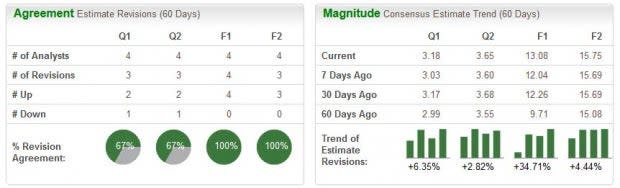
Over the last several months, analysts have raised their earnings outlook significantly – a bullish signal.

Zacks Investment Research

Zacks Investment Research

Image Source: Zacks Investment Research

Like UNM, Reinsurance Group of America’s growth prospects are stellar; earnings are forecasted to skyrocket a quad-digit 1050% in FY22 and an additional double-digit 20% in FY23.

Zacks Investment Research

Zacks Investment Research

Image Source: Zacks Investment Research

Further, RGA shares look cheap when paired with the forecasted growth trajectory. RGA’s forward earnings multiple sits at 9.9X, well beneath its 12.2X five-year median and representing an enticing 32% discount relative to its Zacks Sector.

Reinsurance Group of America carries a Style Score of a B for Value.

Zacks Investment Research

Zacks Investment Research

Image Source: Zacks Investment Research

Who doesn’t love getting paid? RGA’s annual dividend yields a notable 2.5%, just above its Zacks Sector average.

In addition, the company has upped its dividend payout four times over the last five years, paired with a five-year annualized dividend growth rate of a substantial 9.2%.

Zacks Investment Research

Zacks Investment Research

Image Source: Zacks Investment Research

Brighthouse Financial

Brighthouse Financial BHF is one of the largest providers of annuity and life insurance products in the United States, utilizing multiple independent distribution channels and marketing arrangements with a diverse network of distribution partners.

BHF’s earnings outlook has turned very bright over the last several months.

Zacks Investment Research

Zacks Investment Research

Image Source: Zacks Investment Research

The company’s bottom-line is forecasted to take a hit in FY22, with the Zacks Consensus EPS Estimate of $11.58 penciling in a 46% Y/Y drop.

However, Brighthouse Financial’s earnings picture turns back to green in FY23, with earnings forecasted to climb 23%.

Zacks Investment Research

Zacks Investment Research

Image Source: Zacks Investment Research

In addition, BHF has a strong earnings track record – the company has exceeded the Zacks Consensus EPS Estimate in nine of its previous ten quarters.

Top line results have also been robust, with Brighthouse Financial penciling in eight revenue beats across its last ten prints. Below is a chart illustrating the company’s revenue on a quarterly basis.

Zacks Investment Research

Zacks Investment Research

Image Source: Zacks Investment Research

Bottom Line

A challenging macroeconomic environment has sent stocks tumbling in 2022. With inflation at historically high levels, the Fed had to pivot to a Hawkish stance, cranking borrowing rates.

During times of high-interest rate environments, insurance providers can see their profit margins expand, such as Unum Group UNM, Reinsurance Group of America RGA, and Brighthouse Financial BHF.

These insurers carry many longer-duration assets, such as safe long-term bonds, to back their policies.

Want the latest recommendations from Zacks Investment Research? Today, you can download 7 Best Stocks for the Next 30 Days. Click to get this free report
 
Unum Group (UNM) : Free Stock Analysis Report
 
Reinsurance Group of America, Incorporated (RGA) : Free Stock Analysis Report
 
Brighthouse Financial, Inc. (BHF) : Free Stock Analysis Report
 
To read this article on Zacks.com click here.
 
Zacks Investment Research

https://ca.finance.yahoo.com/news/fight-higher-interest-rates-3-195007780.html

Best business plan software of 2022

0
Best business plan software of 2022

The best business plan software makes it simple and easy to plan your business finances in order to present this information to a bank or investors.

The whole point of a business plan is that it allows you to critically evaluate your strengths and weaknesses, not least via your Unique Selling Point (USP) and make product or service comparisons with competitors.

https://www.techradar.com/best/best-business-plan-software