Home Blog Page 84

Vash Media Inc. Guides Thought Leaders and Industry Experts in Building a Captivating Digital Presence Online

0
Vash Media Inc. Guides Thought Leaders and Industry Experts in Building a Captivating Digital Presence Online

Building an impactful digital presence requires more than just talent. Consistency and knowledge of the dynamics of social media are essential if your company wants to be seen and heard online. From establishing a heart-tugging brand to content creation to digital marketing, communication, and advertising there is a reason successful companies rely on dedicated digital media teams. “Success is a team sport. No one should be doing it alone,” says Aanchal Vash, the force behind Vash Media Inc.

Vash Media Inc. is a full-service digital marketing agency known for offering meticulous services including a range of media solutions to rebrand, establish a digital presence, and grow by leaps and bounds. This global agency was conceived in 2011 when Aanchal was inspired to help budding entrepreneurs and thought leaders build strong digital brands. She shares, “I have been a child of personal development and grew up realizing our purpose in life is to be of service… add value to people’s lives and help carry humanity forward. I wanted to set myself up to be able to help people who are change-makers with creating strong and powerful brands they felt proud of.”
Vash Media Inc. focuses on helping clients reach their goals through establishing an online presence that spans the world.

This dedicated and passionate team has helped hundreds of clients build powerful brands by creating and executing successful media strategies. As a results-oriented agency, it has enabled clients to gain influence in the digital space and, with its stellar brand positioning strategies, led them to become the go-to authority of their industries.

To make the most impact, Vash Media Inc. offers four packages that establish and maintain a brand’s unique voice in the sea of competitors driving them to stand out and shine. The real difference is working with a team who puts their client’s needs and goals first. Their customer support is top notch, making them a team to work with for life.

Set Up My Digital Presence

Set Up My Digital Presence package is for start-ups and newbies in the business world looking to create a powerful brand across all mediums. The services include logo creation, mood board, color palette, brand typography, and social media marketing across LinkedIn, Instagram, Facebook, YouTube, Twitter, and Pinterest. It offers a complete list of services for a month that is bound to create an impactful digital presence for brands.

Rebrand My Digital Presence

Sometimes, businesses have a digital presence but cannot convert that into profits. This is where rebranding can help develop a strong brand foothold and help you stand out. The second package offers just that. The services it includes are logo recreation, industry reach, and social media marketing analysis based on research and determining high-yielding ways of marketing. This is the best package for those who are sick and tired of their brand image that is not earning any profits. More services are also included, which can be viewed here.

Grow My Digital Presence

The third package, Grow My Digital Presence, brings everything you need to keep glowing as a brand and show up consistently online. It is a marketing dream for many. A thoughtfully curated annual program that maintains and ensures brand consistency, it includes monthly meetings to cover the content for each month, marketing posters and videos, etc.

Coach Me Instead

The last package, Coach Me Instead, is a unique service that Vash Media Inc offers. Despite being a market leader, the agency reiterates the owner’s vision, who believes in going above and beyond to lift people and encourage them to be the best versions of themselves. This package offers just that- a complete coaching session by the exceptional Aanchal Vash on building and maintaining your own digital presence.

The Vision

Brand positioning and digital presence help businesses position their brand, product, and identity out in the market. Vash Media Inc, under the leadership of visionary Aanchal Vash, has emerged as a market leader over the years. They have revolutionized the world of digital marketing by helping clients set up their digital presence and manage it by creating content, exciting campaigns, and building their unique visibility.

It is the vision that weaves it all together so beautifully. In Aanchal’s own words, “From setting brands to content creation to digital marketing, communication, and advertising. I wanted to see people succeed and be happy with their web presence. Today under Vash Media Inc, I continue this vision and am more empowered to help thought leaders and experts be successful online. Success is a team sport. No one should be doing it alone.”

Her latest book, ‘Ongoing Success and Wellbeing: A Daily Guide to Cultivate Fulfillment in the Pursuit of Achievement,’ has become an instant best-seller on Amazon and is a monumental guide to discover the purpose of life and experiencing success and wellbeing simultaneously.

https://www.ibtimes.sg/vash-media-inc-guides-thought-leaders-industry-experts-building-captivating-digital-presence-66853

A Step-by-Step Guide to Starting a Business

0
A Step-by-Step Guide to Starting a Business


  • You want to make sure you prepare thoroughly before starting a business, but realize that things will almost certainly go awry. To run a successful business, you must adapt to changing situations.
  • Conducting in-depth market research on your field and the demographics of your potential clientele is an important part of crafting a business plan. This involves running surveys, holding focus groups, and researching SEO and public data.
  • Before you start selling your product or service, you need to build up your brand and get a following of people who are ready to jump when you open your doors for business.
  • This article is for entrepreneurs who want to learn the basics steps of starting a new business.

Tasks like naming the business and creating a logo are obvious, but what about the less-heralded, equally important steps? Whether it’s determining your business structure or crafting a detailed marketing strategy, the workload can quickly pile up. Rather than spinning your wheels and guessing at where to start, follow this 10-step checklist to transform your business from a lightbulb above your head to a real entity.

How to start a small business

  1. Refine your idea
  2. Write a business plan
  3. Assess your finances
  4. Determine your legal business structure
  5. Register with the government and IRS
  6. Purchase an insurance policy
  7. Build your team
  8. Choose your vendors
  9. Brand yourself and advertise
  10. Grow your business

1. Refine your idea.

If you’re thinking about starting a business, you likely already have an idea of what you want to sell online, or at least the market you want to enter. Do a quick search for existing companies in your chosen industry. Learn what current brand leaders are doing and figure out how you can do it better. If you think your business can deliver something other companies don’t (or deliver the same thing, only faster and cheaper), or you’ve got a solid idea and are ready to create a business plan. 

Define your “why.”

“In the words of Simon Sinek, ‘always start with why,’” Glenn Gutek, CEO of Awake Consulting and Coaching, told Business News Daily. “It is good to know why you are launching your business. In this process, it may be wise to differentiate between [whether] the business serves a personal why or a marketplace why. When your why is focused on meeting a need in the marketplace, the scope of your business will always be larger than a business that is designed to serve a personal need.” 

Consider franchising.

Another option is to open a franchise of an established company. The concept, brand following and business model are already in place; all you need is a good location and the means to fund your operation.

Brainstorm your business name.

Regardless of which option you choose, it’s vital to understand the reasoning behind your idea. Stephanie Desaulniers, owner of Business by Dezign and former director of operations and women’s business programs at Covation Center, cautions entrepreneurs against writing a business plan or brainstorming a business name before nailing down the idea’s value.

Clarify your target customers.

Desaulniers said too often people jump into launching their business without spending time to think about who their customers will be and why would want to buy from them or hire them.

“You need to clarify why you want to work with these customers – do you have a passion for making people’s lives easier?” Desaulniers said. “Or enjoy creating art to bring color to their world? Identifying these answers helps clarify your mission. Third, you want to define how you will provide this value to your customers and how to communicate that value in a way that they are willing to pay.” 

TipTIP: To refine your business idea, identify your “why,” your target customers and your business name.

During the ideation phase, you need to iron out the major details. If the idea isn’t something you’re passionate about or if there’s not a market for your creation, it might be time to brainstorm other ideas.

2. Write a business plan.

write a business plan

Once you have your idea in place, you need to ask yourself a few important questions: What is the purpose of your business? Who are you selling to? What are your end goals? How will you finance your startup costs? These questions can be answered in a well-written business plan. 

A lot of mistakes are made by new businesses rushing into things without pondering these aspects of the business. You need to find your target customer base. Who is going to buy your product or service? If you can’t find evidence that there’s a demand for your idea, then what would be the point? 

TipFree download: Here is our business plan template you can use to plan and grow your business.

Conduct market research.

Conducting thorough market research on your field and demographics of potential clientele is an important part of crafting a business plan. This involves conducting surveys, holding focus groups, and researching SEO and public data. 

Market research helps you understand your target customer – their needs, preferences and behavior – as well as your industry and competitors. Many small business professionals recommend gathering demographic information and conducting a competitive analysis to better understand opportunities and limitations within your market. 

The best small businesses have products or services that are differentiated from the competition. This has a significant impact on your competitive landscape and allows you to convey unique value to potential customers.

Consider an exit strategy.

It’s also a good idea to consider an exit strategy as you compile your business plan. Generating some idea of how you’ll eventually exit the business forces you to look to the future. 

“Too often, new entrepreneurs are so excited about their business and so sure everyone everywhere will be a customer that they give very little, if any, time to show the plan on leaving the business,” said Josh Tolley, CEO of both Shyft Capital and Kavana. 

“When you board an airplane, what is the first thing they show you? How to get off of it. When you go to a movie, what do they point out before the feature begins to play? Where the exits are. Your first week of kindergarten, they line up all the kids and teach them fire drills to exit the building. Too many times I have witnessed business leaders that don’t have three or four predetermined exit routes. This has led to lower company value and even destroyed family relationships.” 

A business plan helps you figure out where your company is going, how it will overcome any potential difficulties and what you need to sustain it. When you’re ready to put pen to paper, these free templates can help.

3. Assess your finances.

Assess your finances

Starting any business has a price, so you need to determine how you’re going to cover those costs. Do you have the means to fund your startup, or will you need to borrow money? If you’re planning to leave your current job to focus on your business, do you have money put away to support yourself until you make a profit? It’s best to find out how much your startup costs will be. 

Many startups fail because they run out of money before turning a profit. It’s never a bad idea to overestimate the amount of startup capital you need, as it can be a while before the business begins to bring in sustainable revenue. 

Perform a break-even analysis.

One way you can determine how much money you need is to perform a break-even analysis. This is an essential element of financial planning that helps business owners determine when their company, product or service will be profitable. 

The formula is simple:

  • Fixed Costs ÷ (Average Price – Variable Costs) = Break-Even Point

Every entrepreneur should use this formula as a tool because it informs you about the minimum performance your business must achieve to avoid losing money. Furthermore, it helps you understand exactly where your profits come from, so you can set production goals accordingly. 

Here are the three most common reasons to conduct a break-even analysis: 

  1. Determine profitability. This is generally every business owner’s highest interest.

    Ask yourself: How much revenue do I need to generate to cover all my expenses? Which products or services turn a profit, and which ones are sold at a loss?

  2. Price a product or service. When most people think about pricing, they consider how much their product costs to create and how competitors are pricing their products.

    Ask yourself: What are the fixed rates, what are the variable costs, and what is the total cost? What is the cost of any physical goods? What is the cost of labor?

  3. Analyze the data. What volumes of goods or services do you have to sell to be profitable?

    Ask yourself: How can I reduce my overall fixed costs? How can I reduce the variable costs per unit? How can I improve sales? 

Watch your expenses.

Don’t overspend when starting a business. Understand the types of purchases that make sense for your business and avoid overspending on fancy new equipment that won’t help you reach your business goals. Monitor your business expenses to ensure you are staying on track.

“A lot of startups tend to spend money on unnecessary things,” said Jean Paldan, founder and CEO of Rare Form New Media. “We worked with a startup that had two employees but spent a huge amount on office space that would fit 20 people. They also leased a professional high-end printer that was more suited for a team of 100; it had key cards to track who was printing what and when. Spend as little as possible when you start, and only on the things that are essential for the business to grow and be a success. Luxuries can come when you’re established.”   

Consider your funding options.

Startup capital for your business can come from various means. The best way to acquire funding for your business depends on several factors, including creditworthiness, the amount needed and available options.

  1. Business loans. If you need financial assistance, a commercial loan through a bank is a good starting point, although these are often difficult to secure. If you are unable to take out a bank loan, you can apply for a small business loan through the U.S. Small Business Administration (SBA) or an alternative lender. [Read related article: Best Alternative Small Business Loans]


  2. Business grants. Business grants are similar to loans; however, they do not need to be paid back. Business grants are typically very competitive, and come with stipulations that the business must meet to be considered. When trying to secure a small business grant, look for ones that are uniquely specific to your situation. Options include minority-owned business grants, grants for women-owned businesses and government grants.
  3. Investors. Startups requiring significant funding upfront may want to bring on an investor. Investors can provide several million dollars or more to a fledgling company, with the expectation that the backers will have a hands-on role in running your business.
  4. Crowdfunding. Alternatively, you could launch an equity crowdfunding campaign to raise smaller amounts of money from multiple backers. Crowdfunding has helped numerous companies in recent years, and there are dozens of reliable crowdfunding platforms designed for different types of businesses. 

You can learn more about each of these capital sources and more in our guide to startup finance options. 

Editor’s note: Looking for a small business loan? Fill out the questionnaire below to have our vendor partners contact you about your needs.

Choose the right business bank.

When you’re choosing a business bank, size matters. Marcus Anwar, co-founder of OhMy Canada, recommends smaller community banks because they are in tune with the local market conditions and will work with you based on your overall business profile and character. 

“They’re unlike big banks that look at your credit score and will be more selective to loan money to small businesses,” Anwar said. “Not only that, but small banks want to build a personal relationship with you and ultimately help you if you run into problems and miss a payment. Another good thing about smaller banks is that decisions are made at the branch level, which can be much quicker than big banks, where decisions are made at a higher level.” 

Anwar believes that you should ask yourself these questions when choosing a bank for your business: 

  • What is important to me?
  • Do I want to build a close relationship with a bank that’s willing to help me in any way possible?
  • Do I want to be just another bank account, like big banks will view me as? 

Ultimately, the right bank for your business comes down to your needs. Writing down your banking needs can help narrow your focus to what you should be looking for. Schedule meetings with various banks and ask questions about how they work with small businesses to find the best bank for your business. [Read related article: Business Bank Account Checklist: Documents You’ll Need]

Key takeawayKey takeaway: Financially, you will want to perform a break-even analysis, consider your expenses and funding options, and choose the right bank for your business.

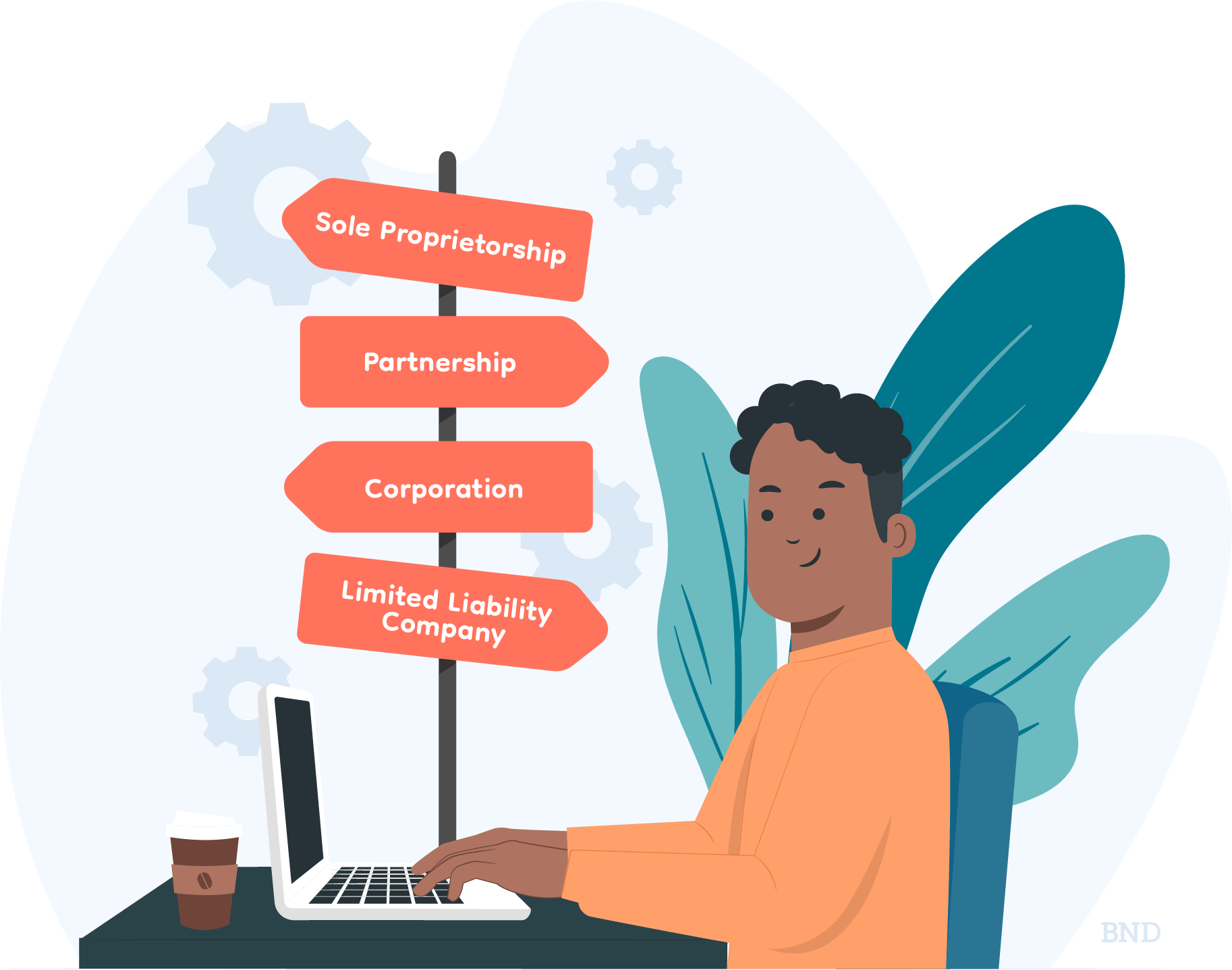
legal business structure

Before you can register your company, you need to decide what kind of entity it is. Your business structure legally affects everything from how you file your taxes to your personal liability if something goes wrong. 

  • Sole proprietorship. If you own the business entirely by yourself and plan to be responsible for all debts and obligations, you can register for a sole proprietorship. Be warned that this route can directly affect your personal credit.
  • Partnership. Alternatively, a business partnership, as its name implies, means that two or more people are held personally liable as business owners. You don’t have to go it alone if you can find a business partner with complementary skills to your own. It’s usually a good idea to add someone into the mix to help your business flourish. 
  • Corporation. If you want to separate your personal liability from your company’s liability, you may want to consider forming one of several types of corporations (e.g., S corporation, C corporation or B corporation). Although each type of corporation is subject to different guidelines, this legal structure generally makes a business a separate entity from its owners, and, therefore, corporations can own property, assume liability, pay taxes, enter contracts, sue and be sued like any other individual. “Corporations, especially C corporations, are especially suitable for new businesses that plan on ‘going public’ or seeking funding from venture capitalists in the near future,” said Deryck Jordan, managing attorney at Jordan Counsel.
  • Limited liability company. One of the most common structures for small businesses is the limited liability company (LLC). This hybrid structure has the legal protections of a corporation while allowing for the tax benefits of a partnership. 

Ultimately, it is up to you to determine which type of entity is best for your current needs and future business goals. It’s important to learn about the various legal business structures available. If you’re struggling to make up your mind, it’s not a bad idea to discuss the decision with a business or legal advisor.

Did you KnowDid You Know: You need to choose a legal structure for your business, such as a sole proprietorship, partnership, corporation or LLC.

5. Register with the government and IRS.

register your business

You will need to acquire a variety of business licenses before you can legally operate your business. For example, you need to register your business with federal, state and local governments. There are several documents you must prepare before registering.

Articles of incorporation and operating agreements

To become an officially recognized business entity, you must register with the government. Corporations need an “articles of incorporation” document, which includes your business name, business purpose, corporate structure, stock details and other information about your company. Similarly, some LLCs will need to create an operating agreement.

Doing business as (DBA)

If you don’t have articles of incorporation or an operating agreement, you will need to register your business name, which can be your legal name, a fictitious DBA name (if you are the sole proprietor), or the name you’ve come up with for your company. You may also want to take steps to trademark your business name for extra legal protection. 

Most states require you to get a DBA. If you’re in a general partnership or a proprietorship operating under a fictitious name, you may need to apply for a DBA certificate. It’s best to contact or visit your local county clerk’s office and ask about specific requirements and fees. Generally, there is a registration fee involved. 

Employer identification number (EIN)

After you register your business, you may need to get an employer identification number from the IRS. While this is not required for sole proprietorships with no employees, you may want to apply for one anyway to keep your personal and business taxes separate, or simply to save yourself the trouble later if you decide to hire someone. The IRS has provided a checklist to determine whether you will require an EIN to run your business. If you do need an EIN, you can register online for free. 

Income tax forms

You also need to file certain forms to fulfill your federal and state income tax obligations. The forms you need are determined by your business structure. You will need to check your state’s website for information on state-specific and local tax obligations. 

“You might be tempted to wing it with a PayPal account and social media platform, but if you start with a proper foundation, your business will have fewer hiccups to worry about in the long run,” said Natalie Pierre-Louis, licensed attorney and owner of NPL Consulting. 

Federal, state, and local licenses and permits

Some businesses may also require federal, state or local licenses and permits to operate. The best place to obtain a business license is at your local city hall. You can then use the SBA’s database to search for licensing requirements by state and business type. 

Businesses and independent contractors in certain trades are required to carry professional licenses. One example of a professional business license is a commercial driver’s license (CDL). Individuals with a CDL are allowed to operate certain types of vehicles, such as buses, tank trucks and tractor-trailers. A CDL is divided into three classes: Class A, Class B and Class C. 

You should also check with your city and state to find out if you need a seller’s permit that authorizes your business to collect sales tax from your customers. A seller’s permit goes by numerous names, including resale permit, resell permit, permit license, reseller permit, resale ID, state tax ID number, reseller number, reseller license permit or certificate of authority. 

It’s important to note that these requirements and names vary from state to state. You can register for a seller’s permit through the state government website of the state(s) you’re doing business in. 

Jordan says that not all businesses need to collect sales tax (or obtain a seller’s permit).

“For example, New York sales tax generally is not required for the sale of most services (such as professional services, education, and capital improvements to real estate), medicine or food for home consumption,” Jordan said. “So, for example, if your business only sells medicine, you do not need a New York seller’s permit. But New York sales tax must be collected in conjunction with the sale of new tangible personal goods, utilities, telephone service, hotel stays, and food and beverages (in restaurants).”

Key takeawayKey takeaway: Register key documents like articles of incorporation or an operating agreement, a DBA, an EIN, income tax forms, and other applicable licenses and permits.

6. Purchase an insurance policy.
purchase business insurance

It might slip your mind as something you’ll “get around to” eventually, but purchasing the right insurance for your business is an important step to take before you officially launch. Dealing with incidents such as property damage, theft or even a customer lawsuit can be costly, and you need to be sure that you’re properly protected. 

Although you should consider several types of business insurance, there are a few basic insurance plans that most small businesses can benefit from. For example, if your business will have employees, you will at least need to purchase workers’ compensation and unemployment insurance.

You may also need other types of coverage, depending on your location and industry, but most small businesses are advised to purchase general liability (GL) insurance, or a business owner’s policy. GL covers property damage, bodily injury, and personal injury to yourself or a third party.

If your business provides a service, you may also want to consider professional liability insurance. It covers you if you do something wrong or neglect to do something you should have done while operating your business.

7. Build your team.

build your team

Unless you’re planning to be your only employee, you’re going to need to recruit and hire a great team to get your company off the ground. Joe Zawadzki, CEO and founder of MediaMath, said entrepreneurs need to give the “people” element of their businesses the same attention they give their products. 

“Your product is built by people,” Zawadzki said. “Identifying your founding team, understanding what gaps exist, and [determining] how and when you will address them should be top priority. Figuring out how the team will work together … is equally important. Defining roles and responsibility, division of labor, how to give feedback, or how to work together when not everyone is in the same room will save you a lot of headaches down the line.”

8. Choose your vendors.

choose your vendors

Running a business can be overwhelming, and you and your team probably aren’t going to be able to do it all on your own. That’s where third-party vendors come in. Companies in every industry from HR to business phone systems exist to partner with you and help you run your business better. 

When you’re searching for B2B partners, you’ll have to choose carefully. These companies will have access to vital and potentially sensitive business data, so it’s critical to find someone you can trust. In our guide to choosing business partners, our expert sources recommend asking potential vendors about their experience in your industry, their track record with existing clients and what kind of growth they’ve helped other clients achieve. 

Not every business will need the same type of vendors, but there are common products and services that almost every business will need. Consider the following functions that are a neccessity for any type of business.

Taking payments from customers: Offering multiple payment options will ensure you can make a sale in whatever format is easiest for target customer. You’ll need to compare options are find the right credit card processing provider to ensure you’re getting the best rate for your type of business.

Managing finances: Many business owners can manager their own accounting functions when starting their business, but as your business grows you can save time by hiring an accountant, or comparing accounting software providers.

9. Brand yourself and advertise.

brand yourself

Before you start selling your product or service, you need to build up your brand and get a following of people ready to jump when you open your literal or figurative doors for business.

  • Company website. Take your reputation online and build a company website. Many customers turn to the internet to learn about a business, and a website is digital proof that your small business exists. It is also a great way to interact with current and potential customers.
  • Social media. Use social media to spread the word about your new business, perhaps as a promotional tool to offer coupons and discounts to followers once you launch. The best social media platforms to utilize will depend on your target audience.
  • CRM. The best CRM software solutions allow you to store customer data to to improve how you market to them. A well-thought-out email marketing campaign can do wonders for reaching customers and communicating with your audience. To be successful, you will want to strategically build your email marketing contact list.
  • Logo. Create a logo that can help people easily identify your brand, and be consistent in using it across all of your platforms.

Also, keep these digital assets up to date with relevant, interesting content about your business and industry. According to Ruthann Bowen, chief marketing officer at EastCamp Creative, too many startups have the wrong mindset about their websites. 

“The issue is they see their website as a cost, not an investment,” Bowen said. “In today’s digital age, that’s a huge mistake. The small business owners who understand how critical it is to have a great online presence will have a leg up on starting out strong.”  

Creating a marketing plan that goes beyond your launch is essential to building a clientele by continually getting the word out about your business. This process, especially in the beginning, is just as important as providing a quality product or service. 

Ask customers to opt in to your marketing communications.  

As you build your brand, ask your customers and potential customers for permission to communicate with them. The easiest way to do this is by using opt-in forms. These are “forms of consent” given by web users, authorizing you to contact them with further information about your business, according to Dan Edmonson, founder and CEO of Dronegenuity. 

“These types of forms usually pertain to email communication and are often used in e-commerce to request permission to send newsletters, marketing material, product sales, etc. to customers,” Edmonson said. “Folks get so many throwaway emails and other messages these days that, by getting them to opt in to your services in a transparent way, you begin to build trust with your customers.” 

Opt-in forms are a great starting point for building trust and respect with potential customers. Even more importantly, these forms are required by law. The CAN-SPAM Act of 2003 sets requirements for commercial email by the Federal Trade Commission. This law doesn’t just apply to bulk email; it covers all commercial messages, which the law defines as “any electronic mail message the primary purpose of which is the commercial advertisement or promotion of a commercial product or service.” Each email in violation of this law is subject to fines of more than $40,000.

TipTIP: Create a strategic marketing campaign that combines various marketing channels, like a company website, social media, email newsletters and opt-in forms.

10. Grow your business.

grow your business

Your launch and first sales are only the beginning of your task as an entrepreneur. To make a profit and stay afloat, you always need to be growing your business. It’s going to take time and effort, but you’ll get out of your business what you put into it. 

Collaborating with more established brands in your industry is a great way to achieve growth. Reach out to other companies and ask for some promotion in exchange for a free product sample or service. Partner with a charity organization, and volunteer some of your time or products to get your name out there. 

While these tips will help launch your business and get you set to grow, there’s never a perfect plan. You want to make sure you prepare thoroughly for starting a business, but things will almost certainly go awry. To run a successful business, you must adapt to changing situations. 

TipFree download: We’ve created a sales plan template you can use to scale customer acquisition.

“Be prepared to adjust,” said Stephanie Murray, founder of Fiddlestix Party + Supply. “There’s a saying in the military that ‘no plan survives the first contact,’ meaning that you can have the best plan in the world, but as soon as it’s in action, things change, and you have to be ready and willing to adapt and problem-solve quickly. As an entrepreneur, your value lies in solving problems, whether that is your product or service solving problems for other people or you solving problems within your organization.” 

FAQs about starting a business

How can I start my own business with no money?

You can launch a successful business without any startup funds. Work on a business idea that builds on your skill set to offer something new and innovative to the market. While developing a new business, keep working in your current position (or “day job”) to reduce the financial risk.

Once you’ve developed your business idea and you’re ready to start on a business plan, you’ll need to get creative with funding. You can raise money through investments by pitching your idea to financial backers. You could also gather funding through crowdsourcing platforms like Kickstarter, or set aside a certain amount of money from your weekly earnings to put toward a new business. Finally, you can seek out loan options from banks and other financial institutions as a way to get your company up and running.

What is the easiest business to start?

The easiest business to start is one that requires little to no financial investment upfront, nor should it require extensive training to learn the business. One of the easiest types of new business to launch is a dropshipping company. Dropshipping requires no inventory management, saving you the hassle of buying, storing and tracking stock. Instead, another company will fulfill your customer orders at your behest. This company will manage the inventory, package goods, and ship out your business orders. To get started, you can create an online store by selecting curated products from the catalog available through partners.

When is the best time to start a business?

Each person’s ideal timeline for starting a new business will be different. First and foremost, you should start a business when you have enough time to devote your attention to the launch. If you have a seasonal product or service, then you want to start your business a quarter before your predicted busy time of the year. For nonseasonal companies, spring and fall are popular times of years to launch. Winter is the least popular launch season, because many new owners prefer to have their LLC or corporation approved for a new fiscal year.

Skye Schooley contributed to the reporting and writing in this article. Source interviews were conducted for a previous version of this article.


 

https://www.businessnewsdaily.com/4686-how-to-start-a-business.html

Raunchy banking drama Industry is the real Sex and the City 

0
Raunchy banking drama Industry is the real Sex and the City 

Greed is still good. You may have thought the mantra of the Thatcher era’s City bankers had fallen out of fashion, but the BBC’s 2020 drama Industry proved otherwise. The lockdown hit about a group of young financial whizz kids was shocking in its depiction of the backstabbing required to get ahead in the cut-throat world of high finance… and of the depraved after-hours antics of the bankers.

The trading floor of Industry’s fictional bank Pierpoint & Co was an uber-toxic place in which colleagues were shockingly nasty to each other, and their daytime financial machinations were followed at night by hard partying involving Champagne, cocaine, pills and random sex. As one critic put it, they were ‘banking all day and banging all night’.

Now Industry is back for series two, as are many of its hedonistic characters. The action is focused mainly on Harper Stern (played by Myha’la Herrold), a smart but insecure American who harbours secrets about her past. 

She is managed by the vicious and unpredictable Eric Tao (Ken Leung), another American who’s reinvented himself in London. Harper’s closest confidante is Yasmin Kara-Hanani (Marisa Abela), a posh graduate whose manager Kenny Kilbane (Conor MacNeill) joyfully humiliates her in front of colleagues.

Greed is still good. You may have thought the mantra of the Thatcher era’s City bankers had fallen out of fashion, but the BBC ’s 2020 drama Industry proved otherwise

And the bizarre thing is, it’s all true. Co-creators and writers Mickey Down and Konrad Kay, who both worked as City bankers before going into television, insist that the cruel world of Pierpoint & Co comes straight from their own experiences. ‘Everything is obviously dialled up to 11 for the drama because we’re making a TV show,’ explains Konrad. ‘But the general tenor of the way people talk to each other is very, very true to life.

‘When Eric goes mental at Harper in the office, I’d see versions of that happen all the time when I was at Morgan Stanley,’ he adds. ‘And the toxic relationship between Kenny and Yasmin… I saw that play out every day. I was involved in one of those relationships. I was beneath someone who treated me in a pretty appalling way. It’s definitely very prevalent.’

Yet it shows how some young graduates are willing to put up with disgraceful treatment in a pressure-cooker environment in order to make bags of money, and how unapologetic they are about their aspirations to get rich. Again, Konrad says it’s absolutely true. 

‘I think, culturally, it’s weirdly becoming more appropriate again not to play down what motivates you. We’re swinging back to people not having to hide the fact they want to be successful, they want to be rich.’

As series two opens, working from home during the pandemic has just ended and Harper, Yasmin and their fellow graduate Robert (Harry Lawtey) are back on the trading floor (Industry’s look is all sharp angles and glass-sided buildings, but while some exteriors were shot in London, the frenzied trading floor is a set at Cardiff’s Great Point Seren Studios). 

Tensions rise as the traders are told the London and New York teams have been pitted against each other in a fight for survival, and new character Danny Van Deventer (Alex Alomar Akpobome) from the New York office has been installed to monitor London’s progress.

Animosity still fizzes between Harper and Yasmin after Harper double-crossed her friend at the end of series one when she got someone sacked to save Eric’s career. ‘The feud is very petty,’ says Myha’la Herrold. ‘But they have no option but to cross paths and that makes it even more stressful being in the same environment together. Each tries to make a connection but the other person is never at the right place – until they finally decide to be honest with each other.’

Harper’s chief relationship is with Eric, played by Star Wars and Lost actor Ken Leung. He’s a fabulously filter-free financial predator, and Ken credits Girls creator Lena Dunham, who directed the Industry pilot, with giving him the courage to make Eric so outrageous. 

‘She set a tone where I felt like I could try anything,’ he says. ‘It became a bit, “Let me do something wacky just to make Lena laugh.” It felt like a bunch of friends getting together and playing with the circumstances. Like the carpet in the trading room was red, and that gave me this image of sharks on the trading floor.’

The metaphor is an apposite one, as a compelling part of Industry is that Harper, Eric, Yasmin and Kenny are self-centred and largely unsympathetic characters whose relationships with others are purely transactional. 

But their avarice and ruthlessness ring true, which is a pivotal part of the show’s unique selling point. ‘Banking is a very hard-edged world and when you buy into it you need to be a fairly hard-edged person,’ says writer Mickey Down. ‘So the broad message of season two is, “Are you willing to give up your ability to make long-lasting, loving relationships in order to be a success and make money?” If you reduce it down, it’s the cost of ambition.’

Industry has a sizeable ensemble cast. Transparent star Jay Duplass joins the show as Jesse Bloom, an eccentric hedge fund billionaire whose business Harper becomes very eager to secure. Newcomer Indy Lewis plays Venetia Berens, a recruit whose confidence Yasmin finds threatening, and The Ipcress File’s Katrine De Candole is Celeste Pacquet, a manager who takes a shine to Yasmin.

Harper’s closest confidante is Yasmin Kara-Hanani (Marisa Abela, pictured), a posh graduate whose manager Kenny Kilbane (Conor MacNeill) joyfully humiliates her in front of colleagues

Harper’s closest confidante is Yasmin Kara-Hanani (Marisa Abela, pictured), a posh graduate whose manager Kenny Kilbane (Conor MacNeill) joyfully humiliates her in front of colleagues

The show’s executive producer Jami O’Brien says that expanding the cast for season two allowed them to open up Industry’s world. ‘If season one was partly about these young graduates getting their feet wet at Pierpoint, we wanted to challenge that by seeing them taking on their own clients. 

Opening that world is maybe just a little more fun. We love Eric and Harper, but we thought, “Wouldn’t it be interesting if that relationship was challenged? Who else is out there for Harper to hang out with, and how will that influence her?”’

And with such a high-pressure environment in the office, the financiers continue to let off steam at night with wild forays into sex and drugs. 

The graphic sex scenes will no doubt garner lots of attention, but despite the abandon with which the characters enjoy flings, filming was carefully staged with an intimacy co-ordinator to ensure that the cast felt comfortable. ‘It’s like choreographing a stunt scene in a way, so hopefully everybody feels safe and there are no surprises,’ says Jami.

Industry also carefully balances the male and female nudity (there was a male full-frontal last time) to ensure that the women don’t feel exploited. ‘The only nudity in the pilot was male,’ says Konrad Kay. 

‘I’m very proud of the sex scenes in season two. Someone used the word “full-on” about season one, so in season two we tried to make them more character-led, more intimate, more romantic. Hopefully we succeeded. I think there’s actually more sex in season two, but it’s far more interesting sex.’

German-French actress Katrine De Candole admits that she was worried about the X-rated scenes when she signed up to play Celeste. ‘I’d had so many warnings that it would be raunchy, and in the end I was like, “That was it?”’ she laughs. ‘It was a lot less raunchy than I expected.’

She found snorting fake cocaine trickier, though. ‘Somebody said it was milk powder and it was disgusting,’ she says. ‘I was trying to get away with not doing it for as long as possible, because when you do it a lot it gets quite clogged up in there.’

But it’s all part of a day’s – and night’s – work for the hedonistic young bankers willing to betray anyone who gets in the way of their big money deals in the cut-throat world of Pierpoint & Co.

Industry, Tuesday, 10.40pm, BBC1.

https://www.dailymail.co.uk/femail/article-11231929/Raunchy-banking-drama-Industry-real-Sex-City.html

Road Accident Fund’s accounting blunder ‘of Steinhoff proportions’ slammed by MPs

0
Road Accident Fund’s accounting blunder ‘of Steinhoff proportions’ slammed by MPs
A 16-member senior team from the ailing Road Accident Fund (RAF) came under fire from members of the Standing Committee on Public Accounts (Scopa) for insisting on continued court action against the Auditor-General (AGSA) and the disclaimer opinion that it failed to interdict. The RAF board, representatives from the AGSA, the Office of the Accountant-General at National Treasury, and the Accounting Standards Board (ASB) appeared before Scopa on Tuesday. The RAF, an entity within the Department of Transport, is yet to table its annual report before Parliament. Using dubious accounting to ‘hide liabilities’ The entity took the AGSA to court…


https://www.citizen.co.za/news/south-africa/parliament/road-accident-funds-accounting-blunder-of-steinhoff-proportions-slammed-by-mps/

Pakistan will ‘absolutely not’ default on debts despite floods: Finance Minister

0
Pakistan will ‘absolutely not’ default on debts despite floods: Finance Minister

By Gibran Naiyyar Peshimam

ISLAMABAD (Reuters) – Pakistan will “absolutely not” default on debt obligations despite catastrophic floods, the finance minister said on Sunday, signalling there would be no major deviation from reforms designed to stabilise a struggling economy.

Floods have affected 33 million Pakistanis, inflicted billions of dollars in damage, and killed over 1,500 people – creating concern that Pakistan will not meet debts.

“The path to stability was narrow, given the challenging environment, and it has become narrower still,” Finance Minister Miftah Ismail told Reuters at his office.

“But if we continue to take prudent decisions – and we will – then we’re not going to default. Absolutely not.”

Pakistan was able to bring an International Monetary Fund (IMF) programme back on track after months of delay, thanks to tough policy decisions. But the positive sentiment was short- lived before the catastrophic rainfall hit.

Despite the disaster, Ismail said that most stabilisation policies and targets were still on track, including increasing dwindling foreign exchange reserves.

Central bank reserves stand at $8.6 billion, despite the influx of $1.12 billion in IMF funding in late August, which are only enough for about a month of imports. The end-year target was to increase the buffer up to 2.2 months.

He said Pakistan will still be able to increase reserves by up to $4 billion, even if the floods hurt the current account balance by $4 billion in more imports, such as cotton, and a negative impact on exports.

However, he estimated the current account deficit will not increase by more than $2 billion following the floods.

“Yes, there has been substantial loss to the very poorest people and their lives will never be made whole again. But in terms of servicing our external and local debt, and being micro- macro-economically stable, those things are under control.”

DECEMBER PAYMENT TO BE MET

He said global markets were “jittery” about Pakistan, given the economy had suffered at least $18 billion in losses after the floods, which could go as high as $30 billion.

“Yes, our credit default risk has gone up, our bond prices have fallen. But…I think within 15 to 20 days, the market will normalise, and I think will understand that Pakistan is committed to being prudent.”

Pakistan’s next big payment – $1 billion in international bonds – is due in December, and Ismail said that payment would “absolutely” be met.

The IMF said on Sunday that it will work with the international community to support Pakistan’s relief and reconstruction efforts and the endeavour to ensure sustainability and stability.

Ismail said external financing sources were secured, including over $4 billion from the Asian Development Bank (ADB), Asian Infrastructure Investment Bank and World Bank.

This includes $1.5 billion next month from ADB under the Countercyclical Support Facility – a budget support instrument.

The minister also said about $5 billion in investments from Qatar, the UAE and Saudi Arabia would materialise in the current financial year.

The three announced interest in investing in Pakistan earlier this year, but no timelines or exact plans have been reported yet.

He said $1 billion in UAE investment will “definitely materialise” in the next couple of months in the form of purchases in the Pakistan stock market.

Some $3 billion in Qatari investment pledges will all come within the financial year to June 2023, he added.

“They’re looking at the three airports in Pakistan, Karachi, Lahore and Islamabad … long-term leases. They’re also looking at buying two plants that run on LNG (liquefied natural gas)… those I think will probably happen this calendar year,” he said.

He said if the $3 billion figure was not reached as the financial year closed, the remaining amount would go into the stock market.

He also said Saudi Arabia’s crown prince had assured Prime Minister Shehbaz Sharif that Riyadh would invest $1 billion before December.

Pakistan’s central bank announced on Sunday that Saudi Arabia’s development authority had also extended a deposit of $3 billion, to mature in December, by one year.

He said a legal instrument was going to be signed soon with a “friendly country” to activate a $1 billion deferred payment facility for oil.

(Reporting by Gibran Peshimam; Editing by Andrew Cawthorne)

https://news.yahoo.com/pakistan-absolutely-not-default-debts-155845802.html

How Different Industries Use Digital Marketing For Growth

0
How Different Industries Use Digital Marketing For Growth

The most obvious ingredient of ensuring company success is ensuring a personalized and extraordinary customer experience.

And numerous methods exist to improve it without bombarding the user with pointless advertisements.

Using the most recent technologies and trends, modern marketers seek to teach, educate, or amuse their audience. Marketing teams can no longer rely solely on one web channel. Each sub-department must apply a distinct sort of digital marketing, which calls for qualified individuals. Here are some industries that benefit from digital marketing.

Healthcare

Do you know that almost 72-77% of people look up the symptoms on Google when feeling unwell or off? It makes sense to reach out to possible customers and make money off of this problem by using digital marketing strategies like blogs, quizzes, and online portals.

A person is more likely to trust healthcare practitioners in person if they can build trust with them online. So make use of the wonderful benefits of the digital age.

The health sector, including hospitals and pharma manufacturing companies, allocates a substantial amount to content marketing and understands the importance of high-quality SEO content. Medical companies invest in producing high-quality material to address all of their users’ questions to suit their needs.

Food Sector

Food has become more than a necessity, it has become a passion and obsession for people nowadays. They feel emotionally connected to certain foods and the companies that produce them. Recipe card sharing is not the only practice in the food sector. People don’t read about food, sadly. They see Instagram videos. They watch instructional films before beginning any cooking task.

This is understandable, given the number of YouTube channels devoted to it and the number of views they receive. Before eating dinner out, people take images of their meals to share on their social media pages. Dining provides aesthetically appealing visual material to draw customers conducting an internet search for restaurants.

Retail

The next category is retail, which has undergone significant transformation in recent years. Retailers now have easy access to new customers because of digital marketing. For instance, social media marketing and paid search are two excellent channels for firms to reach a wider audience of consumers.

An optimized SEO strategy, however, is what drives even more visitors to the website. It turns out that during the past five years, Google has begun to value unique and worthwhile content on every website, particularly those in the retail industry.

Marketers once had to entice customers to go to actual stores. Today, we observe the geographic reach of digital marketing growing. Precision targeting and personalization are crucial, and the retail sector is a pioneer in this regard.

Nutrition & Fitness

Fitness businesses make significant investments in social media advertising to sell their goods and services, developing numerous campaigns directed at individuals with various fitness objectives.

Brands utilize influencers to produce highly actionable content to draw in youthful audiences. People use social media to flaunt their fit bodies, so encouraging them to share their transformations can motivate potential audience members to follow you.

Education

Lastly, people are highly serious about their schooling. They don’t want to accept the status quo; they demand the best. However, not everyone has a clear idea of their life’s true calling.

The education sector offers online consultations to aid students in choosing the best career route. The education sector makes significant investments in creating information outside of the curriculum to educate users.

They use social media channels to draw potential participants to their academic programs. For the majority of institutions of higher learning, LinkedIn works well. To increase their reach, well-known colleges collaborate with online learning environments. For instance, the Indian ed-tech startup upGrad aims to upskill students so they are prepared for future jobs.


https://bmmagazine.co.uk/business/how-different-industries-use-digital-marketing-for-growth/

Trump’s Former Accounting Firm Now Turning Over His Financial Records To Congress: Report

0
Trump’s Former Accounting Firm Now Turning Over His Financial Records To Congress: Report

Donald Trump’s former longtime accounting firm has begun turning over financial records to Congress as part of lawmakers’ investigation into the former president’s business practices, The New York Times reported Saturday.

Mazars USA cut ties with Trump and his businesses in February after the firm said it could no longer stand behind financial information that had been provided by Trump and his operations. Consequently, financial statements Mazars prepared for Trump from mid-2011 to mid-2020 “should no longer be relied upon,” the company warned.

The House Oversight Committee has received a first batch of documents from Mazars following a legal settlement regarding various financial information from 2014 to 2018, the Times reported.

More documents are expected to be provided in the near future, according to the newspaper.

“They have sent us a number of documents. We’re reviewing them,” committee Chair Carolyn Maloney (D-N.Y.) told the Times Saturday. “Mazars is being very cooperative,” she added.

The lawmaker declined to offer any other specifics.

The committee will use the information in its investigation of allegations of conflict of interest when Trump was in office, and any possible violations of the Constitution’s emoluments clause. The clause prohibits federal officials from receiving payments or significantly valuable gifts from foreign governments.

Financial records that must be turned over to Congress under the settlement include any document that indicates false or undisclosed information about Trump or his companies’ assets, income or liabilities.

Documents from 2016 to 2018 related to the Old Post Office Building, which the former president converted into the Trump International Hotel, must also be provided under terms of the settlement. The hotel, once termed the “epicenter” of corruption by a local watchdog, was frequented by politicians — both domestic and foreign — while Trump was in office.

In addition, Mazars must turn over records from 2017 and 2018 related to relationships between Trump’s businesses and foreign nations.

Mazars cut ties with Trump amid an investigation by New York Attorney General Letitia James into allegations that the Trump Organization has inflated the value of assets to obtain bank loans, while undervaluing properties when it came time to pay taxes.

After Mazars ended its relationship with Trump, he claimed the accounting firm had been “broken by radical leftist racist prosecutors,” but offered no credible details.

Trump battled Congress in court to keep the financial documents secret, but the Oversight Committee announced a settlement of the litigation Sept. 1.

“After numerous court victories, I am pleased that my Committee has now reached an agreement to obtain key financial documents that former President Trump fought for years to hide from Congress,” Maloney said in a statement after settlement.

“These documents will inform the committee’s efforts to get to the bottom of former President Trump’s egregious conduct and ensure that future presidents do not abuse their position of power for personal gain,” the statement added.

This article originally appeared on HuffPost and has been updated.

Related…

https://ca.news.yahoo.com/trumps-former-accounting-firm-now-034816390.html

Transparency, technology help secure best insurance rates

0
Transparency, technology help secure best insurance rates

Transparency — along with safety-related investments in technology and personnel — continue to emerge as the keys to help fleets secure favorable insurance rates. But Brandon Guiliani, Seubert & Associates’ transportation practice leader, urges carriers to act on such matters months before their policies are up for renewal.

“Put proactive coaching steps in place,” he said during a webinar hosted by the Truckload Carriers Association (TCA). “Nuclear verdicts are on the rise. Give yourself 12 months to put key ingredients in place. It gives you time to evaluate an insurance carrier.”

(Photo: TCA)

It’s more important than ever. Fleets are facing challenges that include rising insurance rates, decreasing insurance availability, and unpredictable costs, said Idelic founder and chief innovation officer Hayden Cardiff, who moderated the discussion.

Safety cultures

If fleets do not use the data they have, plaintiff attorneys will use it against them when a claim arises, Guiliani added, noting that available technology provides loads of useful information to set drivers on the proper path.

Gary Flaherty, Nationwide senior vice-president – commercial auto E&S, noted that insurers explore fleet safety cultures as well as driver and vehicle files. It’s why things like optimized routes are becoming evermore important to those behind the insurance policies.

Those fleets that are rapidly growing will need to show they have the capacity — as well as the right people and technology — to handle the growth, Flaherty said.

Approaching claims

When claims do occur, Cardiff said fleets need to know who will be handling the files.

Guiliani, for example, said fleets should evaluate the insurance carrier’s expertise around trucking-related claims claims.

Fleets, meanwhile, will also be scrutinized when it comes to the ways they approach claims. Whether it is a minor or major crash, insurers want to see signs that steps are being taken to minimize losses.

Every driver-related violation could lead to bigger problems in the future, after all. It’s why Guiliani stresses the importance of training or retraining. If someone is involved in a collision, plaintiff attorneys won’t care if it was the first such collision in the past five years. Warning signs need to be identified and addressed.

Trucking companies should approach renewals like preparing for a test, Guiliani advised. When an underwriter asks a broker questions, and answers are ready, the process is easy, he added.

Insurers might assume the worst if a fleet is not transparent, Flaherty said. If a problem or issue is discovered later, it leaves a bad taste and could affect the relationship. And that relationship is a valuable asset.

Transparency, technology help secure best insurance rates

7 Online Marketer Tips to Success

0
Digital Marketer

This essay about Internet marketing could be better off with a brief introduction and a helpful disclaimer. primarily since you ought to be aware of who is speaking and that you should definitely be aware of what you are entering…

Since I’ve started working as a full-time online marketer, I’ve managed to run nine or ten websites on the great world wide web. I have a pretty respectable income, and I love my job. But if you think that all you need to do is throw some material together, upload it to a website, and watch the cash flow, you are regrettably mistaken. Don’t be misled; you can succeed as an online marketer, but it will require a lot of time and effort on your part. We can only write about our own experiences and viewpoints since, in my experience at least, it just doesn’t happen overnight.

10 Tool Digital Marketing Terbaik untuk Para Internet Marketer

Over the years, I have also discovered that getting advice from someone who is already doing what we want to accomplish might be helpful. Therefore, I’ve compiled 7 Tips for Online Marketers Success below.


Knowledge Up

The idea of internet marketing may appear very straightforward at first; all you need to do is post some content or a product on a website to start doingss business. The truth is very different. It can take you years to acquire all the sophisticated strategies and tactics required to succeed in the more cutthroat online market as more businesses and people become aware of its enormous potential. Yes, we have all heard tales of people who have brilliant ideas and suddenly become quite wealthy online. People also win the jackpot, but in order to succeed as an online marketer, you must first become proficient in your field.

You must learn everything you can about internet marketing. There is a multitude of marketing information available online. Read articles and ebooks, take online e-courses, research and analyse effective websites and/or marketers. Just locate it and apply it. I made a ton of mistakes when I initially started learning the ropes, but I was fortunate to meet some successful internet marketers who were already doing what I wanted to do. People like Brad Callens, Neil Shearing, Corey Rudl, Ken Evoy, Marlon Sanders, etc. I instantly made friends with these people and tried to learn as much as I could from them.

The majority of these programs are free because these marketers want to educate you how to sell their products, thus achieving this was neither unusual nor difficult. All of these marketers provide thorough affiliate training programs to explain even the most inexperienced webmaster or marketer the ropes.

This is a pretty easy technique to quickly educate yourself about web marketing. Many of these can drive you crazy, especially if you’re new to this game, but only because they are so extensive and exhaustive – all the material can be a little overwhelming to put it mildly. I personally appreciated the numerous free ebooks supplied through Ken Evoy’s SiteSell program. But if you can go through a few of SiteSell’s free marketing guides and ebooks, you’ll learn the fundamentals needed to advance your career as an online marketer.


Find Your Niche Market or Subject

Finding a good niche market or subject to research and capitalize on online will be your first chore if you don’t already have a product or service you want to advertise online. The best advise is to choose a subject that you are already really interested in, such as a beloved hobby or past time, a field in which you have training, or a subject you have always wanted to research and analyze. You must choose a niche industry or subject that you genuinely enjoy because it will occupy countless hours of your time. The key takeaway is that if you enjoy what you are doing, it won’t feel like labor.

Regardless of the topic you select, you must consider the topic’s commercial viability. In other words, there must be sufficient commercial interest in your market or issue if you wish to succeed. Your product must receive a sufficient number of monthly searches from users to be profitable. To determine the monthly volume of searches for a keyword, use a tool like WorkTracker or Google AdWords Keyword Tool. Keywords are the words or phrases that internet users enter into search engines to locate the content they’re looking for. To make it useful, you must have a ton of relevant, high-quality searchable keywords.

Another Keyword tool I like using is Microsoft’s Detecting Online Commercial Intention, which tells you the probability a certain keyword or site will have enough commercial potential customers who will purchase a product or service. (adlab.msn.com/Online-Commercial-Intention/Default.aspx)


Google Up!

The most significant player on the internet is Google. While you shouldn’t completely disregard other search engines, I would advise you to educate yourself on how Google analyzes and ranks web pages. Your internet business may succeed or fail depending on how well you do in Google’s top 5 results for your targeted keywords. Obtain those top positions in Google, where the majority of high-quality search traffic on the internet is sent/controlled, and you will be successful.

Google now provides webmasters with a variety of useful tools and has a full section dedicated to helping webmasters with their websites. Google Webmaster Tools is a useful tool that is full with useful information. Use it! A helpful pdf file you may download is Google’s “Search Engine Optimization Starter Guide,” which is another excellent resource if you’re just getting started. Use Google to look it up.

Remember that Google is just like any other firm that provides a product, in this case, their SERPs (Search Engine Results Pages). As a result, the greater the quality of your content and pages, the higher your rankings in Google will be. Experienced webmasters are aware that one of the most crucial factors in achieving high Google results is having high-quality one-way backlinks. But quality is still king; if your content is good, people will bookmark it on all the social media platforms, and relevant websites will link to it. High quality content creation should be your first and primary SEO strategy because this does in fact occur.


Building Your Site

Whatever type of site you’re constructing, you must adhere to a few very basic SEO standards. Make sure both users and search engines can easily navigate through the structure of your website. Maintain a straightforward site hierarchy, with a home page that is the single point of access for all of your sites. Most webmasters only employ the top three layers, which are the homepage, subjects, and subtopics, with no more than three clicks separating each page from the homepage. In order to avoid leaving your visitors hanging, it is also a good idea to include a sitemap link on each page. For further details on how to develop a suitable layout, consult Google’s Starter Guide.

As an online marketer, I personally look for the most popular keywords in my field and then construct sites centered around those words or phrases. By doing this, you can be sure that the people that visit your pages are those you want to. You may connect hundreds of these keyword-rich pages on your website using a thematic structure to make it simple for search engines to identify and rank them.

When picking a domain name, I also attempt to include my major desired term. Because every backlink will have your primary keyword in the URL, this has a significant positive impact on your search engine rankings. This will clearly communicate to search engines what your website is about. A tool like WordPress, which is free blogging software you can use to establish a blog site, is something I would advise using if you are completely new to this. Another choice is to buy or purchase a SiteBuildIt hosting package from SiteSell. This is more than just hosting, though; you can use the entire internet marketing system. You will be guided step-by-step through the entire process of creating and marketing your website or online store.


Promoting Your Site

Although it is perhaps the most difficult aspect of online marketing, this is a requirement for its success. Too many webmasters and marketers create excellent websites, then wait impatiently for the visitors and customers to arrive. It’s a sad fact that you won’t attract much traffic to your website unless you actively advertise it. Of course, there are exceptions; certain websites rapidly draw visitors and amass a ton of backlinks just through word-of-mouth, but in the majority of cases, this doesn’t happen.

Your website and URL need to be regularly promoted. Writing straightforward, practical essays and disseminating them online is one strategy I employ. These articles link back to your website using keywords. A quick and efficient approach to promote your website. Integrating your website with social networking and bookmarking services, such as Twitter, Facebook, MySpace, and YouTube, is another free way to market it. Recently, videos have also become incredibly powerful, and you should use this to your advantage. Using a basic social bookmarking tool like the Addthis Button, which enables your users to bookmark and create backlinks for you, is also effective.

Google appears to be particularly interested in how many social bookmarks and links your site is getting. If genuine web users view your content and bookmark it or promote it to their friends, it is a straightforward way of receiving feedback on its quality. Your material will rank higher in the search engines the more Tweets and Diggs it receives. Additionally, all those links bring in targeted traffic, which is what you want..


Monetizing Your Site

Once you have a constant stream of visitors to your website, there are various ways to monetize or earn money from it. We’re not talking about massive amounts of traffic; a site with just 100 or 200 daily visitors can be quite successful. Personally, I favor affiliate programs that offer residual rewards or have recurring components to their payments. I still receive monthly payments from sales I made five years ago, so all it takes is one sale to make money for years to come. Therefore, if you choose to include affiliate links on your website, attempt to select a business or program that will continue to pay you for as long as the customer you suggested remains a customer.

Additionally, I enjoy promoting expensive affiliate products because of the commissions’ evident advantages. Why promote a $20 product when you can promote a $2000 one? There are various ways to market online, but even if you sell 100s of the $20 item, your position remains the same. In terms of locating affiliate products to advertise, I enjoy use the main affiliate networks like Commission Junction, LinkShare, Shareasale, ClickBank, and Affiliate Window because they are completely professional, handle all of your tracking, and provide helpful advice on internet marketing.

Using Google AdSense is another very easy option to monetise your pages. Although the rewards won’t be as big as when you promote affiliate products, AdSense is an easy and quick way to monetize all of your pages. Aside from the fact that receiving a cheque from Google every month makes me happy, I also find AdSense to be incredibly trustworthy and constant.


Track Everything That Moves

Extensive tracking is a vital component of successful web marketing. You must monitor the sources of your visitors and the search terms they entered to locate your website. and what people do after arriving at your website. For tracking all of my material, I like to use Google Analytics, but I also utilize other hosting stats like Awstats and Webalizer. I also frequently examine the daily visitors and traffic statistics for my website.

All of this tracking lets me know what’s effective and, more crucially, what isn’t. Examine your bounce rate and the average time spent on your site by visitors as these are almost certainly ranking criteria. Additionally, look at how quickly your website loads. Google is rumored to be adding this as another ranking criteria when determining how to rank your pages.

You may find out which keywords are successful and bringing in money by carefully reviewing the data and logs for your website. Then, you just need to adjust your marketing to focus on those profitable keywords or phrases. You will be successful if you continue to grow your rankings for those keywords over time.


Bonus Step: Persistence Brings Home The Bacon

This post wouldn’t be complete without addressing tenacity, another crucial component of online success. Maybe I’m the only one, but it took me almost three years before any of my sites started to become seriously lucrative. Although the majority of marketers and webmasters today achieve financial success considerably more quickly, I still think it takes time to establish a reliable online business. Building up your consumer base and improving your search engine rankings both require time.

I guess what I’m saying is that you’re setting yourself up for disappointment if you expect overnight success. But if you choose a long-term strategy and gradually develop your website and marketing over a period of months, if not years, you will have a considerably higher chance of success. mostly because you’re creating more than simply a website; you’re creating an internet business that will require some time to start and perhaps even more time to succeed. You will succeed if you are persistent.

U.S. Treasury Seeks Comment on Crypto’s Illicit Finance Risks

0
U.S. Treasury Seeks Comment on Crypto’s Illicit Finance Risks

The U.S. Treasury Department is seeking public comment on the possible illicit finance and national security risks posed by the use of digital assets, as part of the agency’s mandate under President Biden’s March executive order to study the development of cryptocurrency.

The request for comment, issued Monday, also asks the public for suggestions to mitigate these risks by the deadline of Nov. 3.

The Treasury, in a version of the request-for-comment document on the Federal Register website, said crypto has been used in sophisticated cybercrime-related financial networks and activity, including through ransomware. The growing use of digital assets has increased the risk of crimes such as money laundering, terrorist financing, fraud, thefts and corruption, according to the document.

Brian Nelson,

the Treasury under secretary for terrorism and financial intelligence, said in a statement Monday that public input will aid the agency in setting controls to hold bad actors accountable and to identify potential gaps in existing enforcement.

Various stakeholders, including crypto industry advocates, members of civil society, traditional financial institutions and crypto firms, are expected to provide comments, according to Alex Zerden, the principal of financial technology and risk advisory firm Capitol Peak Strategies LLC.

“This [commentary process] shows the Treasury is taking public engagement very seriously…from the lens of risk, as opposed to the one of risk and opportunity,” Mr. Zerden, a former Treasury official in the Obama and Trump administrations, said. He added that it would eventually be up to the Treasury in determining how to incorporate the comments it receives into its policy-making process.

Any possible rule-making from the Treasury that takes public input into account could potentially face pushback from the crypto industry. The Treasury’s Financial Crimes Enforcement Network and the Federal Reserve Board in 2020 proposed rules requiring financial institutions and crypto firms to collect and pass along sender and receiver details on crypto transactions of more than $3,000. The plan received thousands of comments from the public, many of them pushing back against the proposed new rules. The controversial idea was paused in January 2021, in part because the Biden administration imposed a regulatory freeze, which is common for incoming administrations. The rules remain in proposal status.

The request for comment comes as the crypto market sees another wave of volatility, adding to calls for greater regulatory oversight. Bitcoin, the world’s largest cryptocurrency by market capitalization, traded at $18,776 earlier Monday, down 4.8% from its late Sunday levels, before recently moving back above $19,000.

The Treasury Department is expected to lay out the risks it perceives cryptocurrencies could pose to consumers and to the financial system in a series of reports that are set to become public this month, The Wall Street Journal previously reported.

The reports, which the Treasury is completing and sending to the White House, will feature Treasury’s analysis of crypto markets, and will each focus on one of four topics—the payment system, consumer protections, illicit finance and financial stability—but is unlikely to offer many specific policy prescriptions.

President Biden’s March executive order on digital assets commissioned the reports, asking other agencies to also produce analysis.

The Biden administration last Friday released a broader set of frameworks from various agencies concerning regulatory approaches to developing the digital currency ecosystem. The Justice Department also said it has tapped more than 150 federal prosecutors across the country to bolster law enforcement’s efforts to combat the rise in crime linked to the use of cryptocurrencies such as bitcoin.

More From Risk & Compliance Journal

Write to Mengqi Sun at [email protected]

Copyright ©2022 Dow Jones & Company, Inc. All Rights Reserved. 87990cbe856818d5eddac44c7b1cdeb8

https://www.wsj.com/articles/u-s-treasury-seeks-comment-on-cryptos-illicit-finance-risks-11663617811

The right lead-generation strategy is crucial to digital marketing success

0
The right lead-generation strategy is crucial to digital marketing success

Marketers often focus most of their attention on design aesthetics, ignoring the many other factors that could turn website visitors into hot prospects. Lead-generation is more important than ever and companies shouldn’t underestimate the power of web-design skills when preparing to invest in a new lead-generation website.

Improving conversion rates sounds straightforward enough but many marketers struggle with the most fundamental aspects of lead generation and lead quality. How do you know what kind of leads you really need? And how do you know if your incoming leads are high-quality?

Lead generation is the process of attracting potential customers to a website and gathering relevant information that can be used to convert interest into sales. In short, it’s the fuel that any sales machine runs on. The right lead generation strategy is the differentiator that separates any company from its competitors, so understanding what makes a strategy effective should be a top priority across every industry.

Marketers need to adapt to new strategies to differentiate themselves from competitors and cater to a new generation of customers. Here are some new lead generation strategies that could help funnel and convert leads into customers.

Create content to attract your audience: Many companies spend most of their time crafting a headline and very little on the actual content. You need to understand what content is going to work for your specific audience. Weak content and good headlines can work short term and generate leads but you should rather think long term and make sure the content is consistent with the quality of everything else you do.

Use digital events to collect quality data: Digital events, such as webinars, concerts and livestreams, are now at an all-time high, enabling marketers to drive traffic to their platforms. These events are a unique way to generate leads and collect quality data. Creating engaging digital experiences meets customers’ needs and captures their attention. Consumers who might otherwise be unwilling to share information are glad to provide an email address and opt in to cookies when they get something in return.

The rapidly changing digital world creates unique new opportunities for digital marketers and it provides an excellent opportunity to gather quality data on potential leads. Salesforce is one example of a company that has enjoyed huge success from its digital events. When their event schedule was uprooted, they adapted quickly and, as a result, their virtual World Tour event brought over 1.2 million views to their social channels. That’s 1.2 million potential leads.

Targeting niche audiences: Casting a wide net catches the most fish but it’s also the most expensive. Identifying a niche audience is a key component of any digital strategy. Targeted marketing is therefore the key to success because online communities are becoming niche spaces.

Offer value to niche customers in terms of insight and advice as this will earn dividends in terms of data and trust. Furthermore, use account-based campaigns to target specific customers with personalised messages. Strengthen your existing connections and pursue new relationships by incorporating account-based campaigns into your digital strategy.

Also, because the walls between personal and professional lives are coming down, many business people are looking for a more personal touch in their digital strategy. People want to feel as if they’re doing business with unique individuals. Don’t be afraid to show off your unique personality through distinctive personal branding and personalised services.

More importantly, use digital video platforms – this allows customers to hear about your company and put a friendly face to it. Capitalise on the popularity of platforms like TikTok and YouTube to offer personable and informative content to your audience. In fact, 86% of digital marketers say video has helped them generate leads.

As personal lives are becoming more profession-centric, professionals are following TikTok creators, joining Facebook groups and subscribing to industry newsletters. Become a voice in those communities or even consider creating your own digital community.

Marketing emails: Once you have a potential customer’s email address, it’s critical that your marketing material stands out from the rest of the hundreds of emails people receive each day. Filling your sales funnel with unconvertible data won’t meet your or your customer’s needs, so converting that data into leads is the key to successful email marketing.

Email marketing continues to have unparalleled return on investment but the saturation of email marketing also presents unique challenges. In addition to standard practices like A/B testing and writing compelling subject lines, here are some ways to leverage your marketing emails to generate leads.

Humans are pattern-recognising machines and it only takes a few milliseconds for people to register a first impression. Unless your emails can be read in a fraction of a second, that means your potential customers are deciding how they feel about your marketing materials before they’ve even read a word on the screen. Avoid generic formatting; make sure the recipients actually read the email.

Use animated gifs – email marketing containing animated gifs has more than double the ROI of that which doesn’t. What static text gains in clarity, it loses in richness. Finding the appropriate balance of catchiness and usefulness means marketers should consider using gifs in their marketing emails.

Personalise the experience – use dynamic content to tailor your email marketing to individual leads. Remember that people want to have their needs met, and if your marketing can speak to those specific needs, your product will sell itself.

Bring visitors back to your site by retargeting: Retargeting enables marketers to speak to visitors who have left the site. The first thing you must make sure to do is drop a retargeting cookie. Tools like Adroll are very simple to set up and use. It covers both web retargeting and Facebook retargeting. You can also do web retargeting in your Google AdWords account.

The useful thing about retargeting is that you can show different ads based on what pages people saw on your site. For example, if they went to the checkout page but didn’t buy, you can target them with ads that show them a whitepaper that talks about cost saving. If they browsed the site generally and viewed 5 pages on the site, you can show them an ad that lands them on general educational content.

If someone downloaded a PDF aimed at finance companies, you can show them ads around how the product works well for finance companies. Or if someone starts a free trial, you can target them during the 14-day free trial period with content aimed at getting them to convert to being a paying customer.

Offer a live chat service: Live chat services are becoming more sophisticated and most consumers expect them when visiting a site. It could be a major lead generator, so companies should install a live chat tool on the pages where customers need the most assistance or information. It also allows marketers to collect and log insight on their product needs.

One can integrate the customer service team with the live chat feature, ensuring that every visitor has their needs addressed, no matter where the conversation goes.

Unlock your digital potential: Seek out companies that have a range of products and plans to empower you to provide winning digital experiences to your potential leads and help you take your customer’s digital experience to the next level.

Nick Durrant is the chief executive of Bluegrass Digital, a provider of digital solutions for business.

The views expressed are those of the author and do not reflect the official policy or position of the Mail & Guardian.

The right lead-generation strategy is crucial to digital marketing success

Residents oppose plan to reopen Vergason Avenue in Norwich to business park traffic

0
Residents oppose plan to reopen Vergason Avenue in Norwich to business park traffic

Sep. 20—NORWICH — Several residents of Vergason Avenue appealed to the City Council Monday to cancel an experiment to reopen a long-closed intersection with Connecticut Avenue that would connect the residential road to the Norwich business park.

The city Public Works Department presented the idea to the City Council in August to remove, on a trial basis, a barrier at the end of Connecticut Avenue that blocks through traffic from the business park to Vergason Avenue. At the time, Public Works Director Patrick McLaughlin said the move would ease snow removal on the narrow, hilly Vergason Avenue.

Public Works officials presented an update on the issue to the City Council Public Works and Capital Improvements Committee prior to the council meeting Monday.

City Engineer Brian Long said Tuesday the department plans to take traffic counts for one week to measure current traffic on Vergason Avenue, then remove the gate at Connecticut Avenue and take traffic counts for several weeks to assess any change in use.

Long said he expects it would take a while before drivers realize the road is open, so the testing would be for an extended time after reopening the road.

The council has not voted on any proposal to permanently open the Connecticut-Vergason gate. Long said the department planned to go ahead with the temporary opening and would only seek council approval if a plan to permanently open the road is proposed.

Mayor Peter Nystrom, however, on Tuesday said he believes any reopening, even a temporary one, would need council approval. Nystrom said he wants to know if Public Works plans to cut back brush on the narrow road and improve sight lines before reopening the road.

Several Vergason Avenue residents who spoke during public comment Monday objected to opening the connection to the business park. They cited safety concerns, increased traffic and speeding. The City Council closed the road in 1986 to steer business traffic to lower Connecticut Avenue and a traffic light at the West Town Street intersection at the park entrance.

Residents said in some spots, the road it too narrow for a car and a school bus to pass in opposite directions. Residents say they know the road and the blind spots, but new drivers getting out of work looking for a quicker route to West Town Street would not be familiar with the hazardous spots.

“It’s a road that has many children,” said Earl Colella of 130 Vergason Avenue. “A lot of people walk up and down that road. The road is very narrow. There are a couple of points in the road where you cannot get two cars through. Somebody has to stop.”

He said opening the road would increase the chance of a child or pet getting hit by a car. He said before the city could reopen the road, it would need to paint yellow stripe down the center to delineate the lanes and the road would have to be widened in spots. Colella said he goes to the VFW post on Connecticut Avenue and to the Veterans Rally Point on Stott Avenue, so opening the road would be more convenient for him, but he still opposed the move.

Jim Langan of 185 Vergason Avenue, said the road was closed in 1986, “for very well thought out reasons,” because of accidents and hazards. He said if it would help the city to plow snow, Public Works Department could install a larger gate that could be opened in winter for pending storms.

Rebecca Pryor of 58 Vergason Avenue, said she was speaking for herself and several neighbors who oppose the road reopening.

“We have a very narrow road, there’s a lot of curves, it’s hard enough to see pulling out of my driveway, I always have to be very cautious,” she said. “To have more through traffic, I feel, is dangerous.”

[email protected]

https://news.yahoo.com/residents-oppose-plan-reopen-vergason-003500175.html