Home Blog Page 6

GOP Attempts To Amend New Cannabis Law In Ohio Meet Resistance From Democratic House Member

0
GOP Attempts To Amend New Cannabis Law In Ohio Meet Resistance From Democratic House Member

Despite the incessant nitpicking on the part of Ohio’s Republican leadership, which is seeking changes to the Nov. 7 voter-approved initiative that legalized adult-use cannabis, one Cleveland representative has stepped up to question what many are calling anti-democratic procedures. 

Republican Governor Mike DeWine and Ohio Senate president Matt Huffman are seeking, among other changes, to redirect the usage of the hundreds of millions likely to be raised by excise taxes. One example that is raising the most dissent is the Republicans’ insistence on utilizing cannabis revenue for law enforcement rather than the agreed-upon social equity program and community reinvestment that earmarked tax dollars to support individuals who have been “disproportionately affected by past marijuana-related law enforcement.”

Enter Juanita Brent

Ohio Rep. Juanita Brent (D-Cleve) underscored the importance of having people who were directly impacted by cannabis prohibition participate in the legal marketplace and have seats at the table, as the Republican leadership moves ahead with its changes.

“If you’ve been criminalized by cannabis, the best thing you can do is come back into the field,” Brent told The Statehouse News Bureau.

Brent also pointed out that it is equally important that those involved in amending the initiative, known as Issue 2, are not outright anti-cannabis crusaders, which alas seems to be the case in Ohio.

Why Are Prohibitionists Making These Decisions?

“Ohioans have to remember that the people who are trying to be the loudest at the [statehouse] are people who were anti-cannabis,” Brent said. “We cannot have anti-cannabis people leading on what’s going to happen with cannabis. We need people who are involved. We need people who have been doing the work. We need people who have been advocating.”

Social equity provisions, by the way, are built into every legal marijuana program across the U.S. as a way to deal with well-documented racial disparities in marijuana arrests.

Another of Brent’s priorities is that the legislature outline a more defined pathway to recreational marijuana jobs. 

“We need to build more cultivators because there is going to be a lot of demand. We can have dispensaries that we want in the state, but if we don’t have cultivators there will be an increase in price,” she said.

GOP Lawmakers Running Out The Clock Before Dec. 7 Deadline 

Republican lawmakers have said they are planning to publicize their policy changes to Issue 2, Huffman said last week, although he did not give details on the exact proposals or a timeline. 

Huffman famously implied last week that Ohioans had not understood that the social equity elements in the new legalization law were prioritizing people affected by past cannabis-related enforcement.


The threatened strike by United Auto Workers nears deadline : NPR

0
The threatened strike by United Auto Workers nears deadline : NPR

The Big 3 automakers and members of the United Auto Workers scramble to settle on a new contract by 11:59 p.m. ET Thursday, or face a major strike.


STEVE INSKEEP, HOST:

OK, here we are. It’s Thursday, and automakers, along with the United Auto Workers, have until 11:59 tonight to settle on a new contract or autoworkers say they will strike. Here’s NPR’s Andrea Hsu.

ANDREA HSU, BYLINE: First of all, not all 150,000 autoworkers would go on strike at once. Instead, at 10 p.m. tonight, if there’s no deal, UAW President Shawn Fain says he’ll announce which plants will strike first. Then in coming days, depending on how talks are going, the union may call on more to join.

(SOUNDBITE OF ARCHIVED RECORDING)

SHAWN FAIN: This is going to create confusion for the companies. It’s going to keep them guessing on what might happen next. And it’s going to turbocharge the power of our negotiators.

HSU: Four years ago, autoworkers walked out at GM. But this time, Fain says, they’re doing something different.

(SOUNDBITE OF ARCHIVED RECORDING)

FAIN: For the first time in our history, we may strike all three of the Big Three at once.

HSU: Now, there’s still time to come to a deal. But as of last night, the two sides were still very far apart. Take wages – the UAW has called for wage increases of 40% over four years. The Big Three are nowhere close to that. Ford’s latest proposal is a 20% increase over 4 1/2 years. GM and Stellantis have offered a little less than that. Fain told workers, we are seeing movement.

(SOUNDBITE OF ARCHIVED RECORDING)

FAIN: But they’re still not willing to agree on the kinds of raise that will make up for inflation on top of decades of falling wages.

HSU: And when it comes to the UAW’s other demands, including the return of pensions and retiree health care, Fain says the companies have not budged. Now, the automakers point out the raises they’ve offered are the largest by far in decades. In fact, Ford CEO Jim Farley told reporters at the Detroit Auto Show, together, it’s the most generous offer in 80 years.

(SOUNDBITE OF ARCHIVED RECORDING)

JIM FARLEY: Pay increases. Elimination of tiers. Inflation protection. Five weeks of vacation. Seventeen paid holidays.

HSU: And in a statement last night, Ford said it was putting 100% of its energy into reaching an agreement.

(SOUNDBITE OF ARCHIVED RECORDING)

FARLEY: But there is a limit because we have to protect for the future investments. And the profitability of the company funds those.

HSU: As for how long a strike might last, that’s anyone’s guess, but it’ll go on for at least a day. Fain said if no deal is reached by tonight, there will be no bargaining tomorrow. Instead, he’ll be at a mass rally with Senator Bernie Sanders in downtown Detroit.

Andrea Hsu, NPR News.

(SOUNDBITE OF MUSIC)

Copyright © 2023 NPR. All rights reserved. Visit our website terms of use and permissions pages at www.npr.org for further information.

NPR transcripts are created on a rush deadline by an NPR contractor. This text may not be in its final form and may be updated or revised in the future. Accuracy and availability may vary. The authoritative record of NPR’s programming is the audio record.

Salt in Batteries: Shift May Herald Another Shakeup

0
Salt in Batteries: Shift May Herald Another Shakeup

Battery giants are starting to put their money on new sodium-based technology, a sign that there could be yet another shakeup in the industry that’s crucial for the energy transition.

Article content

(Bloomberg) — Battery giants are starting to put their money on new sodium-based technology, a sign that there could be yet another shakeup in the industry that’s crucial for the energy transition.

Sodium — found in rock salts and brines around the globe — has the potential to make inroads into energy storage and electric vehicles because it’s cheaper and far more abundant than lithium, which currently dominates batteries. But while chemically and structurally similar, sodium has yet to be used on a large scale, partly due to the better range and performance of similarly sized lithium cells.

Advertisement 2

Article content

Article content

That could be about to change. In the past week, Sweden’s Northvolt AB said it made a breakthrough with the technology, while Chinese EV maker BYD Co. signed a deal to build a $1.4 billion sodium-ion battery plant. China’s CATL already said in April that its sodium-based batteries will be used in some vehicles from this year.

“It’s serious investment,” said Rory McNulty, senior research analyst at Benchmark Mineral Intelligence. “It’s creating a confidence boost with them saying we are here to continue scaling capacity to commercialize this technology.”

If sodium products do prove successful, they could curb lithium consumption. It’s also a reminder of the perils of trying to forecast metals usage in a constantly evolving industry as companies seek cheaper and more efficient cells.

While sodium-ion batteries’ low energy density means they’re unsuitable for larger EVs, they could increasingly be used instead of lithium in lower-end, shorter-range vehicles — or for power-grid energy storage, where size isn’t such an issue.

BloombergNEF has said that sodium should cut about 272,000 tons of lithium demand by 2035, or more than 1 million tons if lithium supplies can’t meet usage. 

Article content

Advertisement 3

Article content

Changes in the metals mix in batteries has upended supply-and-demand outlooks and whipsawed prices. Cobalt and nickel — which just a few years ago were seen facing long-term shortages — have had demand estimates revised by the emergence of cells that don’t use them. 

And the potential for big price swings is particularly evident in lithium.

A buying frenzy sent prices soaring through last year — a spike that prompted battery firms to look at sodium as a cheaper alternative — before plunging as EV demand disappointed and supply prospects improved. 

“Sodium-ion will have a part to play in improving the lithium supply-demand balance,” said Sam Adham, head of battery materials at consultancy CRU Group. “It will dampen those really severe swings in lithium prices.”

Even with the recent slump in lithium prices, sodium is still a cheaper option. If the market does grow, it could potentially echo the rise of lithium-ion phosphate (LFP) cells that have been preferred to higher-performing products due to their lower cost.

Its clearest potential advantage is in storing excess electricity for grids, something that’s becoming more important as the world shifts away from fossil fuels. There, battery performance is less relevant than a low cost.

Advertisement 4

Article content

Sodium’s success will also rest on improving cells’ cycle life — how many times they can be charged and discharged before needing to be replaced. Sodium cells currently average 5,000 cycles, compared with about 7,500 for the most cost-effective lithium products. 

The big question is being able to do that, and if it works then there could be more demand from the energy storage sector, said Rystad Energy analyst Duo Fu.

For now, the developing sodium-based cell sector looks like it will be dominated by Chinese producers, who control most of the lithium battery production due to the large size of their operations that keeps costs down. That should give them an advantage over European and American rivals.

European and American manufacturers “have far less experience in producing sodium or lithium batteries at mass scale,” CRU’s Adham said. “You’re able to be cost competitive in reality through economies of scale.” 

Article content

Dow Jones Futures: Market Rally Looks Great, But Beware This; 8 Stocks Near Buy Points

0
Dow Jones Futures: Market Rally Looks Great, But Beware This; 8 Stocks Near Buy Points

Dow Jones futures will open Sunday evening, along with S&P 500 futures and Nasdaq futures.


X


The stock market rally had decent gains in the holiday-shortened week. The major indexes have had a huge November so far, approaching their 2023 highs. Many leading stocks are extended, but there are some buying opportunities and setups to watch.

However, the market fear gauge is at its lowest levels since before the Covid crash. That’s a reason to be worried.

Stocks To Watch

Nvidia (NVDA) fell from record highs this past week, but remains in a buy zone following earnings and some China concerns. Amazon.com (AMZN) is also holding in a buy zone as the holiday season officially gets underway.

Novo Nordisk (NVO) broke out on Friday, while Affirm Holdings (AFRM) reclaimed a buy point.

Taiwan Semiconductor (TSM), which makes chips for Nvidia, Apple (AAPL) and many others, is just below a buy point. Warren Buffett-backed Nu Holdings (NU) is moving back toward a buy point.

Booking Holdings (BKNG) and Carpenter Technology (CRS) also are setting up.

Nvidia, Novo Nordisk and AMZN stock are in the IBD Leaderboard lineup, with BKNG stock on the Leaderboard watchlist. Nvidia stock, Novo Nordisk and Carpenter Technology are on the IBD 50.

The video embedded in the article highlighted the market’s weekly action and analyzed NVO stock, Taiwan Semiconductor and First Citizens Bancshares (FCNCA).

Dow Jones Futures Today

Dow Jones futures open at 6 p.m. ET, along with S&P 500 futures and Nasdaq 100 futures.

Remember that overnight action in Dow futures and elsewhere doesn’t necessarily translate into actual trading in the next regular stock market session.


Join IBD experts as they analyze leading stocks and the market on IBD Live


Stock Market Rally

The stock market rally had a solid performance in a holiday-shortened trading week.

The Dow Jones Industrial Average rose 1.3% in last week’s stock market trading. The S&P 500 index advanced 1%. The Nasdaq composite advanced 0.9%.

So far this month, the Dow is up 7.1%, the S&P 500 8.7% and the Nasdaq 10.9%. All the major indexes have cleared several key levels with little resistance. The summer 2023 highs offer the next big hurdle.

The Nasdaq 100, up 0.9% last week, set a 2023 high on Wednesday.

Meanwhile, the small-cap Russell 2000 advanced 0.5% for the week, slightly below the 200-day moving average.

The 10-year Treasury yield rose 4 basis points to 4.48%, rebounding Friday from two-month lows.

U.S. crude oil futures dipped 0.7% to $75.54 a barrel last week, amid some big intraday swings. It was the fifth straight weekly decline.

Market Fear Fades

Right now, the market rally is looking healthy, with a number of reasons to feel bullish. Perhaps the biggest concern is the lack of market fear. The CBOE Volatility Index, or VIX, fell sharply last week, the fifth straight weekly decline. The market fear gauge finished Friday at the lowest levels since January 2020.

Excessive bullishness or complacency could foreshadow some sort of pullback. So do other measures signaling the market is getting overbought.

But a pullback doesn’t have to happen right away and it wouldn’t have to be sharp or last long.

The VIX and other psychological gauges are secondary market indicators. The major indexes and leading stocks are the primary indicators.

ETFs

Among growth ETFs, the iShares Expanded Tech-Software Sector ETF (IGV) gained 1.8% to its best levels in nearly two years. The VanEck Vectors Semiconductor ETF (SMH) fell 0.5% after hitting record highs earlier in the week. Nvidia and TSM stock are major SMH holdings.

Reflecting more-speculative story stocks, ARK Innovation ETF (ARKK) gained 2.7% last week and ARK Genomics ETF (ARKG) rose 1.6%.

SPDR S&P Metals & Mining ETF (XME) climbed 1.85% last week to just below a seven-month best. The SPDR S&P Homebuilders ETF (XHB) dipped 0.2% but is still up 14.8% this month. The Energy Select SPDR ETF (XLE) edged up 0.3%. The Health Care Select Sector SPDR Fund (XLV) gained 2.25%, reclaiming its 200-day line.

The Industrial Select Sector SPDR Fund (XLI) advanced 0.7% and the Financial Select SPDR ETF (XLF) added 0.9%, the fourth straight weekly gains for both.


Five Best Chinese Stocks To Watch Now


Stocks In Buy Zones

Nvidia stock hit a record 505.48 on Monday, but fell 3.1% to 477.49 for the week. That’s just above a 476.09 buy point from a double-bottom base. The 21-day line is just below that level. Investors could buy NVDA stock here, or wait to see if it shows renewed strength.

Nvidia earnings crushed views with a 593% per share spike vs. a year earlier. Sales leapt 206%. The AI chip leader also guided revenue well above consensus for Q4, but the $20 billion target was below some whisper numbers. Nvidia did say U.S. export curbs on advanced chips will hurt sales this quarter. On Friday, Reuters reported that Nvidia is delaying an AI chip for China into early next year.

NVO stock rose 2.3% on Friday and 4.15% for the week to 105.60, clearing a 104 flat-base buy point. Novo Nordisk’s weight-loss drug Wegovy will enter Japan in February, while also planning expansions to several other markets next year.

Amazon stock rose 1.1% to 146.74 for the week, reclaiming a 145.86 consolidation buy point, according to MarketSmith analysis. Black Friday kicked off the official holiday shopping season, but gift buying has been going for weeks.

Affirm stock popped 5.9% last week to 26.25, reclaiming a 25.63 cup-base buy point on Friday. AFRM stock has been moving above and below the buy point since its fiscal Q1 earnings on Nov. 8. Revenue growth is picking up with the buy now, pay later specialist set to turn profitable in fiscal 2024. BNPL orders are up sharply this holiday season.

Stocks Near Buy Points

Taiwan Semiconductor stock has a 100.70 cup-with-handle buy point. Shares fell 1.7% to 97.88 last week. Earlier this month, TSM stock jumped as the foundry giant reported October revenue rose vs. a year earlier, fueled by AI chips from the likes of Nvidia. That signals a long-awaited business turnaround is underway for Taiwan Semi.

BKNG stock is setting up in a consolidation, with a new handle offering a 3,207.32 buy point. Shares of the online travel site dipped 0.6% to 3,115.59 for the week.

CRS stock has a 71.30 buy point from a short cup-with-handle base. Carpenter Technology edged up 0.3% to 68.56 for the week.

NU stock rose 1.5% to 8.19 this past week, nearly reclaiming an 8.29 buy point. Shares tumbled from a 52-week high following Q3 results that showed huge EPS growth but didn’t wow vs. expectations. But Nu Holdings rebounded from near the 50-day line. Warren Buffett’s Berkshire Hathaway (BRKB) has owned a stake for about two years, and started buying it around Nu’s December 2021 IPO.


Time The Market With IBD’s ETF Market Strategy


What To Do Now

The market rally continues to act well, entering a power trend on Nov. 20. Investors can still add exposure.

Buying opportunities aren’t as plentiful, with many leaders already extended. Some stocks are setting up, but are they leftovers at this point? Do you target stocks that are just breaking out, perhaps with weaker relative strength, or wait to see if the rally’s leaders offer new chances to buy?

Various indicators suggest the odds of a market pullback are rising. But a modest pullback would probably be constructive, letting stocks forge handles and other entries.

Keep working on watchlists. Cast that wide net to capture emerging leadership while also focusing in on a select number that you’re seriously considering buying.

Earnings season isn’t over. Zscaler (ZS), CrowdStrike (CRWD), UiPath (PATH), Samsara (IOT), Elastic (ESTC), Workday (WDAY), PDD Holdings (PDD) and Salesforce.com (CRM) are just some of the notable names on tap this coming week.

Read The Big Picture every day to stay in sync with the market direction and leading stocks and sectors.

Please follow Ed Carson on X/Twitter at @IBD_ECarson, Threads at @edcarson1971 and Bluesky at @edcarson.bsky.social for stock market updates and more.

YOU MIGHT ALSO LIKE:

Want To Get Quick Profits And Avoid Big Losses? Try SwingTrader

Best Growth Stocks To Buy And Watch

IBD Digital: Unlock IBD’s Premium Stock Lists, Tools And Analysis Today

Five S&P 500 Stocks Near Buy Points

The Fed Broke The Budget. Buckle Up For What Comes Next

Foremost Lithium Engages Outside the Box Capital for Digital Marketing Services

0
Foremost Lithium Engages Outside the Box Capital for Digital Marketing Services

Article content

VANCOUVER, British Columbia, Nov. 13, 2023 (GLOBE NEWSWIRE) — Foremost Lithium Resource & Technology Ltd. (NASDAQ: FMST) (CSE: FAT) (“Foremost Lithium”, “Foremost” or the “Company”), a North American hard-rock lithium exploration company, today announced that it has entered into a marketing and distribution services agreement (the “Marketing Agreement”) with an arm’s length marketing firm, Outside The Box Capital Inc. (“OTBC”) of Oakville Ontario, to provide marketing services, including digital marketing services through various social media channels to broaden media distribution awareness about the Company.

Article content

OTBC will also feature Foremost Lithium in different influencer-based videos and highlight videos surrounding recent Company news via platforms including Reddit, Discord, Telegram, Twitter and StockTwits. In addition, OTBC will spread Company insights and announcements to new communities with hopes of attracting new investors and other interested parties for the Company, through various social media platforms. The marketing services provided by OTBC is expected to create increased Company awareness and investor engagement amongst its current and prospective shareholders.

Article content

The Marketing Agreement will have a term of six months starting on November 13, 2023, and Foremost will pay OTBC a cash fee of US$100,000 plus applicable taxes and also grant to OTBC 36,000 stock options having an exercise price of CAD$3.65 per common share and an expiry date of one year from the date of grant. The stock options shall be subject to the terms and conditions of the Company’s current stock option plan. OTBC does not currently own any shares of the Company as of the date hereof and has no direct relationship with the Company other than as set out in this press release.

Article content

For further information please contact:

Company
Jason Barnard, President and CEO
+1 (604) 330-8067
[email protected]

Investor Relations
Michael Kim or Brooks Hamilton
MZ North America
+1 (737) 289-0835
[email protected]

Outside the Box Capital
Jason Coles, Portfolio Manager
2202 Green Orchard Place
Oakville ON L6H 4V4 Canada
[email protected]
+1 289 259 4455

About Foremost Lithium

Foremost Lithium (NASDAQ: FMST) (CSE: FAT) (FSE: F0R0) (WKN: A3DCC8) is a hard-rock lithium exploration company focused on empowering the North American clean energy economy. Foremost’s strategically located lithium properties extend over 43,000 acres in Snow Lake, Manitoba, and hosts a property in a known active lithium camp situated on over 11,400 acres in Quebec called Lac Simard South.

Foremost’s four flagship Lithium Lane Projects as well as its Lac Simard South project are located at the tip of the NAFTA superhighway to capitalize on the world’s growing EV appetite, strongly positioning the Company to become a premier supplier of North America’s lithium feedstock. As the world transitions towards decarbonization, the Company’s objective is the extraction of lithium oxide (Li₂O), and to subsequently play a role in the production of high-quality lithium hydroxide (LiOH), to help power lithium-based batteries, critical in developing a clean-energy economy. Foremost Lithium also has the Winston Gold/Silver Property in New Mexico USA. Learn more at www.foremostlithium.com.

Article content

Follow us or contact us on social media:
Twitter: @foremostlithium
Linkedin: https://www.linkedin.com/company/foremost-lithium-resource-technology/

Facebook: https://www.facebook.com/ForemostLithium

The Canadian Securities Exchange has neither approved nor disapproved the contents of this news release and accepts no responsibility for the adequacy or accuracy hereof.

Forward-Looking Statements

This news release contains “forward-looking statements” and “forward-looking information” (as defined under applicable securities laws), based on management’s best estimates, assumptions, and current expectations. Such statements include but are not limited to, statements with respect to the plans for future exploration and development of the Company’s properties and the acquisition of additional exploration projects. Generally, these forward-looking statements can be identified by the use of forward-looking terminology such as “expects”, “expected”, “budgeted”, “forecasts”, “anticipates” “plans”, “anticipates”, “believes”, “intends”, “estimates”, “projects”, “aims”, “potential”, “goal”, “objective”, “prospective”, and similar expressions, or that events or conditions “will”, “would”, “may”, “can”, “could” or “should” occur. These statements should not be read as guarantees of future performance or results. Such statements involve known and unknown risks, uncertainties and other factors that may cause actual results, performance or achievements to be materially different from those expressed or implied by such statements, including but not limited to: risks related to the receipt of all necessary regulatory and third party approvals for the proposed operations of the Company’s business and exploration activities, risks related to the Company’s exploration properties; risks related to international operations; risks related to general economic conditions, actual results of current exploration activities, unanticipated reclamation expenses; changes in project parameters as plans continue to be refined; fluctuations in prices of commodities including lithium and gold; fluctuations in foreign currency exchange rates, increases in market prices of mining consumables, possible variations in reserves; failure of plant, equipment or processes to operate as anticipated; accidents, labour disputes, title disputes, claims and limitations on insurance coverage and other risks of the mining industry; delays in the completion of exploration, development or construction activities, changes in national and local government regulation of mining operations, tax rules and regulations, and political and economic developments in jurisdictions in which the Company operates. . Although the Company has attempted to identify important factors that could cause actual results to differ materially from those contained in forward-looking statements, there may be other factors that cause results not to be as anticipated, estimated or intended. There can be no assurance that such statements will prove to be accurate, as actual results and future events could differ materially from those anticipated in such statements. The forward-looking statements and forward-looking information are made as of the date hereof and are qualified in their entirety by this cautionary statement. The Company disclaims any obligation to revise or update any such factors or to publicly announce the result of any revisions to any forward-looking statements or forward-looking information contained herein to reflect future results, events, or developments, except as require by law. Accordingly, readers should not place undue reliance on forward-looking statements and information. Please refer to the Company’s most recent filings under its profile at www.sedar.com for further information respecting the risks affecting the Company and its business. 


Share this article in your social network

Free rural dental clinics growing in St. Louis Archdiocese

0
Free rural dental clinics growing in St. Louis Archdiocese

In rural Missouri, dental care for the uninsured is so hard to come by that the waitlist for one clinic stretches to six months.

The clinic, a Catholic ministry of the Archdiocese of St. Louis, has no permanent home and never sends out bills. The 16-ton truck rolls into town and sets up in parking lots to see patients, some of whom haven’t had their teeth checked in decades.

“We could go day and night,” said volunteer hygienist Diann Bomkamp of Creve Coeur. “There’s so many people in need.”


Rebecca Ricks of Park Hills gets a break during a dental procedure on Tuesday, Nov. 7, 2023, as Dr. Michael Faddis, left, and Connie Notestine prepare for the next phase of work, in the Archdiocese of St. Louis’ Rural Parish Dental Clinic mobile unit, parked outside St. Joachim Church in Cadet, Mo. Faddis and Notestine, both retired professionals, volunteer to do emergency and preventive dental work for clients in outlying counties of the archdiocese.


The Rural Parish Clinic first hit the road in 2019 to offer free medical treatment to adults who lack insurance and earn less than 200% of the poverty level, or about $60,000 for a family of four. It is open two days a week, rotating through six destinations.

By early 2021, the clinic had furnished another truck, this one home to a pair of dental exam rooms. It started with appointments four days a month in two locations. Now, it operates 12 days each month, and a fifth stop, in Ste. Genevieve County, was added to the route in the fall. Through October of this year, the dental clinic had treated 533 patients, 50 more than in all of 2022.

People are also reading…

Bomkamp, who has worked in the field for more than a half-century, has seen some of the worst cases of her career at the clinic: adults who haven’t been to a dentist since they were children; longtime smokers or chewing-tobacco users; people who have recovered from meth or alcohol addictions, but are stuck with gnarled smiles.

“They’re coming in with some really bombed-out teeth,” said Bomkamp. “They have nowhere else to go.”

About two-thirds of Americans have unmet dental needs, according to KFF, an independent health care researcher. The situation is worse in Missouri, where more than three-quarters of the population can’t access dental care — either because they can’t afford it or there are no nearby practitioners.

For acute medical conditions, emergency rooms or urgent cares are an option.

But there’s no equivalent for dentistry. And when people ignore small problems, they snowball.


Archdiocese saves smiles with rural dental clinic

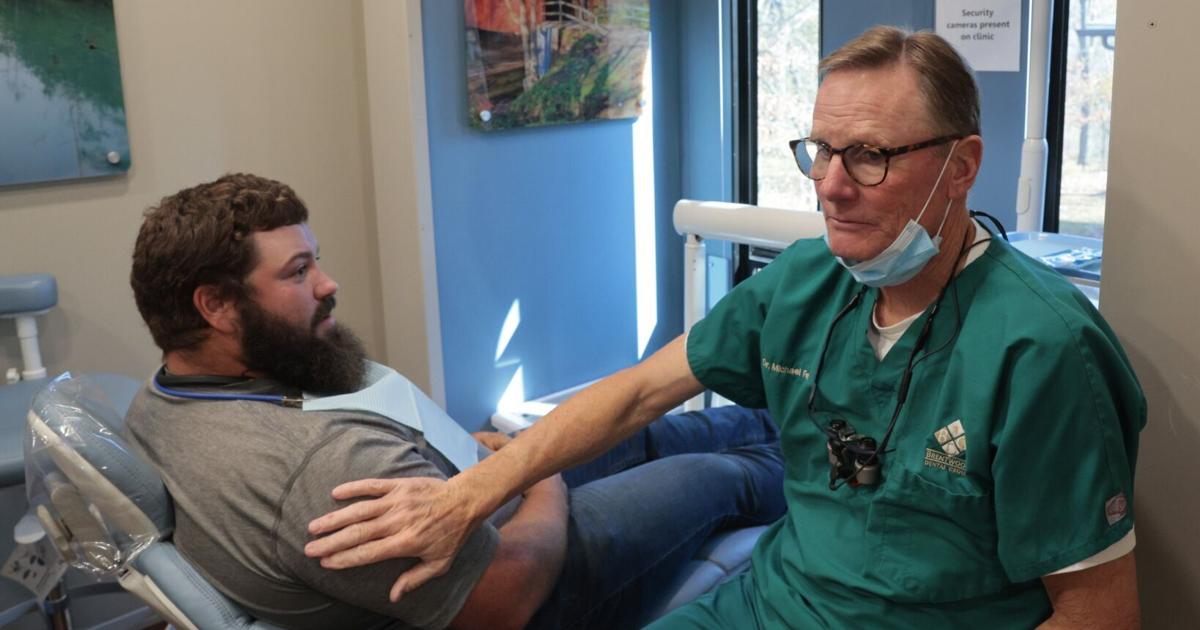
Dr. Michael Faddis talks with Aaron Lawson of Cadet, Mo. on Tuesday, Nov. 7, 2023, before a dental checkup on the Archdiocese of St. Louis’ Rural Parish Dental Clinic truck outside St. Joachim Church in Cadet.


For months, Aaron Lawson had braced for a shock every time he took a swig of water. But without insurance, the tree trimmer couldn’t afford to get his cracked filling fixed.

He heard about the Rural Parish Clinic from his mom. He checked in this month while the truck was parked outside St. Joachim Catholic Church in Cadet, not far from where Lawson lives in Lincoln County.

An hour or so later, he was as good as new, if a little numb.

“I probably would have lost the tooth otherwise,” Lawson said.

‘Transforming people’

The Rural Parish Clinic’s model is built around continuity of care, said director Sister Mary Rachel Nerbun, a physician and nun. There aren’t many one-and-done visitors.

“The goal is to improve health outcomes over time,” said Nerbun.


Archdiocese saves smiles with rural dental clinic

Larry Hill of Old Mines, Mo. shares a laugh with dental assistant Connie Notestine on Tuesday, Nov. 7, 2023, after getting a filling and other work done on the Archdiocese of St. Louis’ Rural Parish Dental Clinic truck outside St. Joachim Church in Cadet, Mo. Photo by Christian Gooden, [email protected]


Many dental patients are referred from the medical clinic, local service agencies or food pantries. Initial appointments last an hour and include screenings for diseases such as hypertension and diabetes.

Poor dental health has consequences that extend outside the mouth. Conditions including heart disease, stroke and bacterial pneumonia have been linked to substandard dental hygiene. Chronic pain reduces quality of life. And beyond the physical discomfort, missing or damaged teeth can restrict job opportunities and erode self-esteem.

Bobbie Harris of Bloomsdale makes pies at her daughter’s restaurant in Ste. Genevieve County. Harris often felt exhausted even before she had pulled out the rolling pin.

“To stay up all night with a toothache is unbearable,” she said.

In June, a customer pointed her to the mobile dental clinic. Over the course of three visits to Bonne Terre, she had 10 teeth extracted and was fitted for dentures, work that would have cost a few thousand dollars.

“I’m 100% more confident,” Harris said. “It’s your looks. It’s your appearance.”

The dental truck is the only free clinic in Missouri that offers dentures, said Nerbun. Its target group, she said, is the working poor: people who earn too much to receive government assistance but too little to pay for procedures out of pocket.


Archdiocese saves smiles with rural dental clinic

Dr. Michael Faddis performs a dental procedure on Rebecca Ricks of Park Hills on Tuesday, Nov. 7, 2023, on the Archdiocese of St. Louis’ Rural Parish Dental Clinic truck outside St. Joachim Church in Cadet, Mo. Photo by Christian Gooden, [email protected]


It takes about a million dollars a year — including five paid staff members — to run both clinics, which are funded through private donations and small grants. About 80 volunteers contribute to the dental side. Eventually, if it can get more help and raise more money, the Rural Parish Clinic would like to add dates to its calendar, and possibly another truck.

“We want to reach everybody in need,” Nerbun said. “We’re transforming people.”


Archdiocese saves smiles with rural dental clinic

Larry Hill of Old Mines, Mo., opens real wide for a filling on Tuesday, Nov. 7, 2023, on the Archdiocese of St. Louis’ Rural Parish Dental Clinic truck outside St. Joachim Church in Cadet, Mo.


Kathi Brandle of Bonne Terre has had dental problems for 45 years, since several of her teeth were knocked out during a horseback-riding accident when she was a teenager. Her tongue would catch on the jagged edges.

Time only made things worse, but Brandle, who is raising two grandchildren on a fixed income, never had the money to keep up with the treatment.

“My mouth just hurt all the time,” she said. “I didn’t smile. I didn’t like talking.”

After several months on the Rural Parish Clinic waitlist, Brandle had her first appointment in May. By August, she had new dentures, top and bottom. When her grandkids came home from school that afternoon, she greeted them with a big grin.

“It’s life-changing at 61 years old to be able to smile again,” said Brandle. “I feel so blessed.”


Archdiocese saves smiles with rural dental clinic

Aaron Lawson of Cadet, Mo. (seen through the window) holds still for an X-ray on Tuesday, Nov. 7, 2023, beneath a photo of Archbishop Mitchell Rozanski on the Archdiocese of St. Louis’ Rural Parish Dental Clinic truck outside St. Joachim Church in Cadet, Mo.


Grants Support New Businesses Launched During COVID-19 Pandemic

0
Grants Support New Businesses Launched During COVID-19 Pandemic

Over the past few years, many communities have provided small business grants to small businesses that were negatively affected by the pandemic. But businesses that launched during this period were often left out of these programs. Now, Illinois is working on a new program to support businesses that started during 2020 and 2021. Read about this program and more in the list below.

Illinois B2B New Business Grant Program

The Illinois Department of Commerce and Economic Opportunity is partnering with Lendistry to run a small business grant program aimed at businesses that started during the COVID-19 pandemic. The Back to Business New Business Grant Program will provide reimbursement funds between $5,000 and $30,000 to eligible small businesses. The program specifically aims to support businesses in industries that were most negatively affected by the pandemic and did not qualify for state grants or federal emergency support due to their startup status. To qualify, businesses must have a date of incorporation between January 2020 and December 2021. Lendistry and the state will take many factors into account when determining grant amounts, including the date of incorporation and whether the business has a brick-and-mortar or home-based location.

Niagara Falls Small Business Property Improvement Program

New York state is offering grants of up to $100,000 to help small businesses in Niagara Falls make various improvements. The program includes a total of $5 million in funding, which is allocated for businesses along Pine Avenue, Main Street, and Portage Road. The Niagara Falls Small Business Property Improvement Program will provide grants to cover up to half of the total costs of each project, up to $100,000 per property. Eligible expenses include facade restoration and other mixed-use building upgrades.

York County 2023 BLOOM Grant Program

York County, Pennsylvania is supporting local women-owned small businesses through its 2023 BLOOM Grant Program. The BLOOM Business Empowerment Center, a program of the York County Economic Alliance, is facilitating the program. Eligible businesses owned and operated by women can apply for grants of up to $1,500. The organization will consider each business’s need and the potential impact of their project when determining grant amounts. December 1 is the deadline to apply for the program.

San Marcos Minority Business Stabilization Fund

San Marcos, Texas is offering grants to minority entrepreneurs and small business owners who were negatively impacted by the COVID-19 pandemic. The city council allocated about $100,000 in American Rescue Plan Act funds to the Minority Business Stabilization Fund. To qualify, applicants must be in continual operation within San Marcos for at least 12 months before the application date. Grant amounts can range from $1,000 for self-employed entrepreneurs to $10,000 for businesses with up to 25 full-time employees.

Adirondack Rail Trail Small Business Grant

The Franklin County Economic Development Corporation is partnering with the towns of Tupper Lake and Harrietstown, New York to apply for grant funding to improve the Adirondack Railroad and Adirondack Rail Trail. While the towns would receive funding from the grant, the availability of funds could lead to infrastructure and service improvements that also benefit local businesses. And the application must show sufficient need and interest from local businesses. So businesses can fill out an online interest and eligibility form to submit project proposals. The deadline for local businesses to submit proposals is December 11.

SCORE Foundation Educational Programming Grants

The SCORE Foundation, the philanthropic arm of business mentorship organization SCORE, recently announced the receipt of financial support for various educational and training programs to benefit small business owners. Specifically, the Glenn W. Bailey Foundation is providing financial support for the workshop “Simple Steps for Finding the Right Funding.” And The LPL Financial Foundation is supporting a three-part series of national webinars on business planning. Both organizations have supported SCORE’s programming in past years as well.

Image: Envato Elements


More in: Small Business Grants


Thirsty Suitors mini-review: Fixing what you broke | Kaser Focus

0
Thirsty Suitors mini-review: Fixing what you broke | Kaser Focus

Usually when I play a relatively short indie game, I find more often than not that its length is satisfactory (see: Jusant). Rarely do I think “That needed to be at least three or four hours longer.” But Outerloop’s Thirsty Suitors is a rare exception, because I wanted more room for everything this game was trying to do. As it is, the game feels exceptionally overstuffed with gameplay, story and culture (for lack of a better word). Thirsty Suitors is an absolute riot, in the sense that it’s a chaotic mix of color and sound and that it’s hilarious. It’s not perfect, but its flaws come from trying to do too much rather than overt minimalism.

You play as Jala Jayaratne, a South Asian American woman returning to her hometown with her tail between her legs years after disappearing on both her strict-but-loving family and her legion of exes. Now she must try to make amends for her years as a heartbreaker and prove herself to her disappointed parents in the main story, while doing such side quests as investigating a skate-park cult, fending off her grandmother’s well-meaning matchmaking attempts and cooking a mouthwatering variety of South Asian food.

Everything in Thirsty Suitors is an exaggerated take on real experiences — in particular, the boss battles with Jala’s exes take place in their inner worlds where their arguments are imagined as turn-based battles. But that’s not to say the actual experiences themselves are taken lightly. On the contrary, Thirsty Suitors delves into the kinds of story topics that games rarely touch upon and in a way that makes it easy to understand and relate to, even if you don’t share Jala’s particular cultural background.

One thing I liked about Thirsty Suitors is how it doesn’t shy away (or indeed, allow Jala to shy away) from the fact that the main character is the villain of the story. Jala has been thoughtless and self-centered. She’s only making an effort now because she’s finally run out of luck, and absolutely no one is willing to let her forget that. But at the same time, the story also gives her a little grace and allows her to confront some of the forces that made her this way, including the suffocating expectations from her otherwise-loving family. Even her exes are willing to hear her out, if only after a knock-down, drag-out mental fight.

Event

GamesBeat at the Game Awards

We invite you to join us in LA for GamesBeat at the Game Awards event this December 7. Reserve your spot now as space is limited!

Learn More

In personal news, I hope everyone who celebrated had a pleasant, drama-free Thanksgiving and got what they wanted on Black Friday if they partook. I’m still in the early phases of my end-of-year cleanup, where I try out games I didn’t get to play earlier in the year. This week I’ve been hitting indie games on Game Pass, including Cocoon, Venba and Sea of Stars. Goodness knows how long the final, end-of-year list will be, but it’s going to be fun to write!

What to play this week

What’s new:

  • Jurassic Park: Classic Games Collection
  • In Stars and Time
  • Worldless
  • Evil Diary
  • Pathfinder: Wrath of the Righteous – Lord of Nothing

New on subscription services:

  • Dragon’s Dogma: Dark Arisen (PlayStation Plus Extra + Premium)
  • Mobile Suit Gundam: Extreme vs. Maxi Boost On (PlayStation Plus Extra + Premium)
  • Dead Island: Riptide Definitive Edition (PlayStation Plus Extra + Premium)
  • Superliminal (PlayStation Plus Extra + Premium)
  • Eiyuden Chronicle: Rising (PlayStation Plus Extra + Premium)
  • Nobunaga’s Ambition: Taishi (PlayStation Plus Extra + Premium)
  • Alternate Jake Hunter: Daedalus The Awakening of Golden Jazz (PlayStation Plus Extra + Premium)
  • River City Melee Mach!! (PlayStation Plus Extra + Premium)
  • Grandia (PlayStation Plus Premium)
  • Jet Moto (PlayStation Plus Premium)
  • Up (PlayStation Plus Premium)
  • Klonoa Phantasy Reverie Series (PlayStation Plus Premium)
  • PaRappa the Rapper 2(PlayStation Plus Premium)
  • Breathedge (GeForce Now)
  • Bridge Constructor: The Walking Dead (GeForce Now)
  • Bus Simulator 21 (GeForce Now)
  • Chivalry 2 (GeForce Now)
  • Dungeons 4 (GeForce Now)
  • Hexarchy (GeForce Now)
  • Hearts of Iron IV (GeForce Now)
  • I Am Future (GeForce Now)
  • Imagine Earth (GeForce Now)
  • The Invincible (GeForce Now)
  • Land of the Vikings (GeForce Now)
  • Saints Row IV: Re-Elected (GeForce Now)
  • SHENZHEN I/O (GeForce Now)
  • Supraland: Six Inches Under (GeForce Now)
  • The Surge 2 (GeForce Now)
  • Thymesia (GeForce Now)
  • Tropico 6 (GeForce Now)
  • West of Dead (GeForce Now)
  • The Dungeon of Naheulbeuk: The Amulet of Chaos (Prime Gaming)
  • Black Widow: Recharged (Prime Gaming)
  • Delicious – Miracle of Life+ (Apple Arcade)

GamesBeat’s creed when covering the game industry is “where passion meets business.” What does this mean? We want to tell you how the news matters to you — not just as a decision-maker at a game studio, but also as a fan of games. Whether you read our articles, listen to our podcasts, or watch our videos, GamesBeat will help you learn about the industry and enjoy engaging with it. Discover our Briefings.

An economist explains what the data says about how the U.S. economy is doing : NPR

0
The threatened strike by United Auto Workers nears deadline : NPR

NPR’s Ayesha Rascoe talks with economist Betsey Stevenson about Bidenomics and the latest economic data.


AYESHA RASCOE, HOST:

President Biden talked up his economic agenda – what his administration has termed Bidenomics – at a community college in Maryland last week.

(SOUNDBITE OF ARCHIVED RECORDING)

PRESIDENT JOE BIDEN: A higher share of working-age Americans are on the workforce now than any time in the past 20 years. And job satisfaction is higher than it’s been 36 years – for 36 years. And we’re growing the economy.

RASCOE: It was another attempt by the president to tout the positive economic changes the country has seen under his administration. To see what an economist makes of Biden’s argument and what the White House has accomplished, we called up Betsey Stevenson. She’s a professor of economics and public policy at the University of Michigan and was the chief economist in the Labor Department under President Obama. She joins us now. Welcome to the program.

BETSEY STEVENSON: Hi. It’s great to talk to you.

RASCOE: How would you characterize the strength of the economy right now?

STEVENSON: What President Biden has just highlighted is that a higher share of working-age people are working than at any other time in the past, and that’s really nothing short of a miracle. If you had told me in 2020 that we would see not only a full recovery of labor force participation, but one that even exceeded where we had been, I would have thought that that was a real long shot. If you go back to thinking about what should the Fed have done, and did the Fed need to be worried about inflation? – a lot of what they were trying to think about is, will people come back into the labor force? And do we need to worry about prematurely cooling down the economy and preventing that labor market recovery? – because this labor market recovery is what gets us back to our overall economic potential.

RASCOE: But there has been pain, and that was in inflation. New data last week showed inflation ticked up a bit in August. The Federal Reserve hasn’t taken another hike in interest rates off the table yet. Mortgage rates are still high if anybody’s in the home-buying market. Are we still on precarious footing?

STEVENSON: I think the Fed’s been pretty good overall at getting inflation down in a way that we haven’t seen that kind of, you know, wage price spiral take off. But it’s not going to be a smooth path. There’s going to be some bumps like what we saw last month. I just want to be clear. Like, inflation is terrible, and nobody likes it. You’ve got, you know, your paycheck, and then, all of a sudden, it’s not buying you as much stuff as you thought it was going to buy you. I have to say, though, a little bit of inflation – it’s painful, but it’s spreading that pain over lots and lots of people. This is really hard for President Biden because that’s got all the people grumbling about him. But what it’s really avoided is the pain of unemployment, which really hits a smaller group of people but extremely hard.

RASCOE: But when it comes to the idea of a recession or the looming shadow of a recession, are we past that, or is that still something that could, you know, be around the corner?

STEVENSON: There’s always a threat of a recession, but what I know is it doesn’t feel like we’re in any kind of extra-risky period of time for a recession right now. Growth remains pretty strong. Unemployment remains quite low. And even if we saw a further slowdown of the economy, it could slow, and we still wouldn’t be in recession territory where growth is actually turning negative. Some of this is really about the way people responded to the pandemic. They built up a lot of savings. And, you know, the pandemic has started to recede. Consumer spending has been incredibly strong, and that strong consumer spending is what’s fueled our ongoing economic growth. It’s also actually, though, what’s fueled inflation. And so it’s got – it’s like a double-edged sword.

RASCOE: I want to ask you about this disconnect that we’ve been seeing for a while now. If people feel bad about the economy, does that mean that the economy is bad?

STEVENSON: I think we’ve just been in a period where there’s been so much change. And difference and change is so hard, and then you’ve got these higher prices, and you’ve got different ways people work. And then we’ve got this younger generation coming up behind us who want things very differently. And I think that that feeling of being unsettled is real. The economy’s changing, and there’s lots of reasons to feel nervous and worried. But there’s been tremendous gains. You know, we’ve seen a world in which the wages at the bottom have risen much faster than the wages at the top. And that wage compression, that narrowing of the gap between the haves and the have-nots – and certainly President Biden would like you to think that’s all due to Bidenomics. It’s also due just to this period of underlying change that we’re in. So there’s a lot of good things that are coming about because of it, but there’s some scary things. Nobody really likes feeling unsettled.

RASCOE: That’s Betsey Stevenson. She is a professor of economics and public policy at the University of Michigan. Thank you for being here.

STEVENSON: Thank you.

Copyright © 2023 NPR. All rights reserved. Visit our website terms of use and permissions pages at www.npr.org for further information.

NPR transcripts are created on a rush deadline by an NPR contractor. This text may not be in its final form and may be updated or revised in the future. Accuracy and availability may vary. The authoritative record of NPR’s programming is the audio record.

Strategies to Shield Your Business from Embezzlement

0
Strategies to Shield Your Business from Embezzlement

In this episode of the Duct Tape Marketing Podcast, I interviewed Todd Rammler, president and founder of Michigan CFO Associates. A firm offering outsourced Chief Financial Officer services to small-business owners. With his extensive experience in financial management, Todd is a leading expert in implementing strategies to protect small businesses from embezzlement while enhancing their profitability.

Key Takeaways:

Amidst the challenging landscape of small business finances, Todd Rammler sheds light on the critical issue of embezzlement. He emphasized the common ways small businesses fall victim to financial misconduct and highlighted the importance of preemptive measures to safeguard against such risks.

During our conversation, Todd outlined the fundamental strategies businesses can employ to fortify their financial foundations. He stressed the significance of employee dishonesty insurance as a protective layer against potential embezzlement, a critical step often overlooked by many small businesses.

Moreover, Todd underlined the necessity of maintaining strict internal controls, such as segregation of duties, even in small business settings. These measures, while challenging to implement in smaller organizations, are pivotal in minimizing vulnerabilities to financial misconduct. His insights on the proactive steps to prevent embezzlement and strengthen financial structures serve as a guide for businesses aiming to protect their bottom line.

If you’re seeking practical strategies to shield your small business from the risks of embezzlement while fortifying your profits, this episode is a must-listen. Todd Rammler’s expertise promises to redefine your approach to safeguarding your finances as your business grows.

Chief economist: War will cut GDP by 1.4% in 2023

0
Chief economist: War will cut GDP by 1.4% in 2023

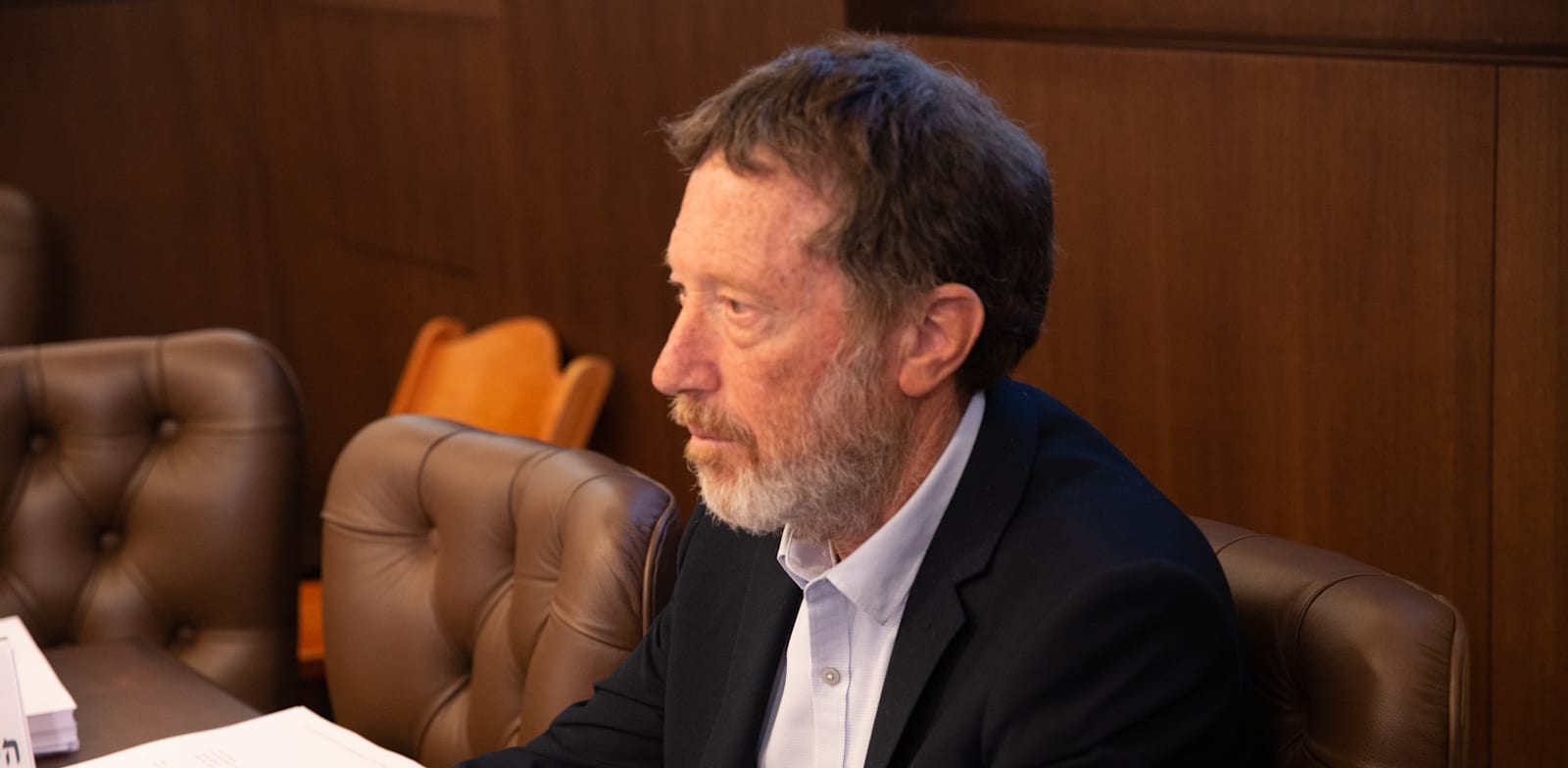
Israel will record zero economic growth in real terms in 2023, according to an updated forecast released today by the chief economist in the Ministry of Finance, Shmuel Abramson. According to the economic review, the effect of the Iron Swords war will be to reduce economic growth to just 2%, which amounts to stagnation, taking into account the growth of the population.

The chief economist’s previous economic growth forecast, in July, was 2.7%. The current report states that, were it not for the war, this forecast would have been revised upwards, and that the war will cause an estimated 1.4% downturn in GDP.


As far as next year is concerned, the analysis states, “Given the high degree of uncertainty in connection with the situation in the fighting, several scenarios have been prepared.” In the base scenario, on which the forecast is based, Israel’s economy will grow by 1.6% in 2024. This scenario assumes that the war will continue until the first quarter of 2024, but that low-intensity conflict will persist until the end of the year. On the basis of the “rapid recovery scenario”, growth next year will be 2.2%, while on the basis of the “slow recovery scenario”, it will be 0.2%.

In the forecast for 2023, the chief economist stresses that “the damage to the sense of security and the depression of consumer sentiment are diminishing private consumption,” which is also being affected by lower household income. Growth in private consumption in 2023 is projected to be just 0.1%. Exports are expected to show a decline of 0.6%, while imports are projected to decline by 4.4% because of the fall in demand. “Victory in the war is important for the recovery of the economy as well,” Abramson states.

No state revenues forecast

The Ministry of Finance published the chief economist’s growth forecast separately from the Budgets Division’s state revenues forecast. This was because the Budgets Division made its final forecast dependent on a decision by Minister of Finance Bezalel Smotrich on changes to the 2023 budget, including cuts in amounts allocated to coalition parties yet unspent.

The Ministry of Finance hopes that tomorrow (Friday) a proposal will be brought before the government on changes to the 2023 budget, but the decision is liable to be postponed until next week. In any event, there is no agreement on the horizon on the part of Smotrich and his partners in the coalition on the main change required, in the 2024 budget, where the cut is due to be much deeper.

Published by Globes, Israel business news – en.globes.co.il – on November 23, 2023.

© Copyright of Globes Publisher Itonut (1983) Ltd., 2023.


Redemption price of 1st SGB tranche announced; investors make 128% return excluding interest

0
Redemption price of 1st SGB tranche announced; investors make 128% return excluding interest
The Reserve Bank of India (RBI) has announced the final redemption price of the first tranche of the sovereign gold bond (SGB) scheme at Rs 6,132 per gram and fixed the redemption date as November 30, Thursday. The investors who invested in the scheme have made an income of a whopping 128% (Rs 3,448) over the issue price of Rs 2,684 per gram. This does not include an interest income of 2.5% given by the government.

The first tranche of the SGB (SGB 2015-I) was launched on November 5 and was available for subscription till November 20, 2015. It was issued on November 30, 2015.

The SGBs are repayable on the expiration of eight years from the date of the issue of the Gold Bonds.

The redemption price of SGB is based on the simple average of the closing price of gold of 999 purity of the week (Monday, November 20-Friday, November 24), preceding the date of redemption, as published by the India Bullion and Jewellers Association Ltd. (IBJA).

Meanwhile, the issue price of SGBs is based on the simple average closing price for gold of 999 purity in the last three working days of the week preceding the subscription period. The RBI decides the price based on the price published by IBJA.

In the current financial year, the RBI on behalf of the Government of India issued SGBs in two tranches — the first tranche opened for subscription in June at an issue price of Rs 5,926 per gram while the second tranche was available for subscription in September at an issue price of Rs 5,923 per gram.

The SGBs are restricted for sale to resident individuals, HUFs, Trusts, Universities and Charitable Institutions. They are denominated in multiples of gram(s) of gold with a basic unit of one gram. While the tenor of the SGB is 8 years, investors have an option of premature redemption after the 5th year.The minimum permissible investment will be one gram of gold while the maximum limit of subscription is 4 Kg for individuals, 4 Kg for HUF and 20 Kg for trusts and similar entities per fiscal year (April-March).

(You can now subscribe to our ETMarkets WhatsApp channel)

(Disclaimer: Recommendations, suggestions, views and opinions given by the experts are their own. These do not represent the views of Economic Times)