Home Blog Page 20

The Office is Dead: What Now?

0
The Office is Dead: What Now?

Three Actionable Steps Leaders Can Take to Help Their Teams Thrive in This New Reality.

The workplace has been irrevocably changed by the pandemic. Years of working remotely have forever changed our relationship with the physical office, reshaping work into something we do, not somewhere we go. Yet office buildings of all shapes and sizes sit there, waiting. They have become a glaring expense line item that has been the true reason for most, if not all, of the return-to-office mandates.

In this blog post, I share some startling facts that underline just how dead the office is, specifically the emptiness, obsolescence, boredom, and overall lack of purpose associated with conventional office environments. More importantly, I propose three actionable steps leaders can take to help their teams thrive in this new reality.

Dead as in Empty

Offices are emptier than ever. Across Canada, the office vacancy rate is at an all-time high of nearly 18%. In downtown Toronto, the office vacancy rate is four times what it was before the pandemic and the numbers are expected to climb. Only one-third of leases scheduled to expire 2020-2030 occurred as of the end of 2022, meaning two-thirds of lease expiries are still to come.

Despite return-to-office mandates, mobile phone data indicates Canadian cities are only half as full of people during the workday compared to pre-pandemic numbers. The weekly occupancy rate in Toronto is averaging around 40%. Traffic patterns show that employees are returning TWT (Tuesdays, Wednesdays and Thursdays), with Wednesdays the peak occupancy at 61%.

Dead as in Obsolete

As office inventory grows, landlords, builders and investors are left with spaces that no longer meet the needs of a hybrid workforce. Businesses are increasingly looking for properties that are designed for flexibility, collaboration and offer a range of amenities to make the trip to the office “worth it”. What they are faced with are inflexible floor plans, ill-equipped meeting rooms, and rows of dated cubicles in urban office towers or suburban industrial parks.

Commercial realtors are seeing a huge trifurcation of office space. By 2030, some projections show 60% of office properties will be obsolete and 25% will be undesirable. Only 15% of properties will be highly desirable, and those will command premium pricing.

Dead as in Boring

Offices at their historic best were filled with teams of colleagues working side-by-side, attending team meetings, catching up over the water cooler, enjoying lunch together, celebrating birthdays, and grabbing a drink after work.

Based on the data, today’s offices are half-empty, out-of-date buildings filled with employees that have been mandated to be there. People are commuting to the office only to spend up to 4 hours a day on Zoom calls, surrounded by colleagues doing the same.

Dead as in Lacks Purpose

Business leaders have been fairly consistent in their stated benefits of return-to-office mandates. They believe there will be better communication, more creativity, and better productivity.

Two issues. The first is that the layouts and designs of conventional offices do not serve any of these purposes. The second is that communication, creativity, and productivity are more about ways of working than they are about going to a place.

What Now? 3 Things Leaders Can Do

1. Reassess WHY you want people in the office. Is it truly about communication, creativity, and productivity? Or is it because your company has real estate commitments? Be aware of the sunk cost fallacy, which is the tendency for people to continue investing in a decision or strategy because they have already invested resources into it, even if it’s not the most effective solution. Here at Sklar Wilton, we sub-leased our office when we determined it no longer suited our needs. We are now “mandating” employees to attend monthly meetings (we call them Bevys) that are designed around collaboration, connection, and celebration (our “3Cs”).

2. Think about HOW to design for the outcomes you want. Designing your physical office space to be more flexible and structured for collaboration is an obvious consideration, and likely worth the investment. The second element is designing meetings to be “can’t miss opportunities” for employee interaction. Here at Sklar Wilton, the content for our monthly Bevys is designed to deliver on our 3Cs and includes lunch and time for unstructured connections. These meetings didn’t exist pre-pandemic, and they have become a cornerstone of our thriving culture.

3. LEAD the change. If you have the ability to influence your company’s office policies, rethink blanket mandates that are forcing employees to work in empty, obsolete, boring spaces. If you need to work within those mandates, rethink how and when your team(s) come together. What might the desired outcomes be, and how will you lead those meetings or design those days? At Sklar Wilton, we have teams dedicated to planning and executing our monthly Bevys. Our leaders show up, lead the content, and actively engage in connection time.

By being purposeful about both why and how you show up IRL, you have an opportunity to breathe life into offices that are otherwise dead.

About the Author

Debra Kavchak-Taylor is a Partner at Sklar Wilton & Associates. She is passionate about driving brand growth and empowering others to reach their full potential. With strategic thinking, a love of data, and the ability to simplify complex issues, she brings clarity to challenging situations. Outside the office, Debra loves laughing with family and friends and working with her non-profit organization.

Looking for more on this topic? Read our blog on The Future of Work.

How to Future-Proof Your Business Career Against AI Disruption

0
How to Future-Proof Your Business Career Against AI Disruption

AIrony

It was inevitable…

According to Bloomberg, IBM expects to pause hiring for roles as roughly 7,800 jobs could be replaced by #AI.

IBM’s Chief Executive Officer Arvind Krishna said back-office functions, such as human resources, will be suspended or slowed.

“These non-customer-facing roles amount to roughly 26,000 workers,” Krishna said. “I could easily see 30% of that getting replaced by AI and automation over a five-year period.”

This is the first of many announcements as organizations rethink work, resources, and technology as automation rapidly evolves.

On May 2nd, EDtech leader Chegg signaled the rising popularity of ChatGPT was dramatically hindering its student subscriber growth when it suspended its full-year outlook. This move sent shares of the company 47% lower in early trading.

“Since March, we saw a significant spike in student interest in ChatGPT. We now believe it’s having an impact on our new customer growth rate,” said Chegg CEO Dan Rosensweig.

Universities, Schools, L&D and HR leaders, Business Leaders, Employers, it’s time to CTRL-ALT-DEL our pre-2022 learning models to prepare for 2050 and beyond, right now.

At the same time, this is exactly the right moment to reflect on your own career path. and choose the role you want to play in a future that, quite honestly, most people didn’t foresee or plan for. I’ve always believed that disruption happens to you or because of you.

When it’s a choice, you have have much more power to shape outcomes and the future to your benefit than you may realize.

My dear friend and former colleague Jeremiah Owyang is one of the world’s leading thinkers on AI and even he’s standing at these crossroads contemplating his next steps.
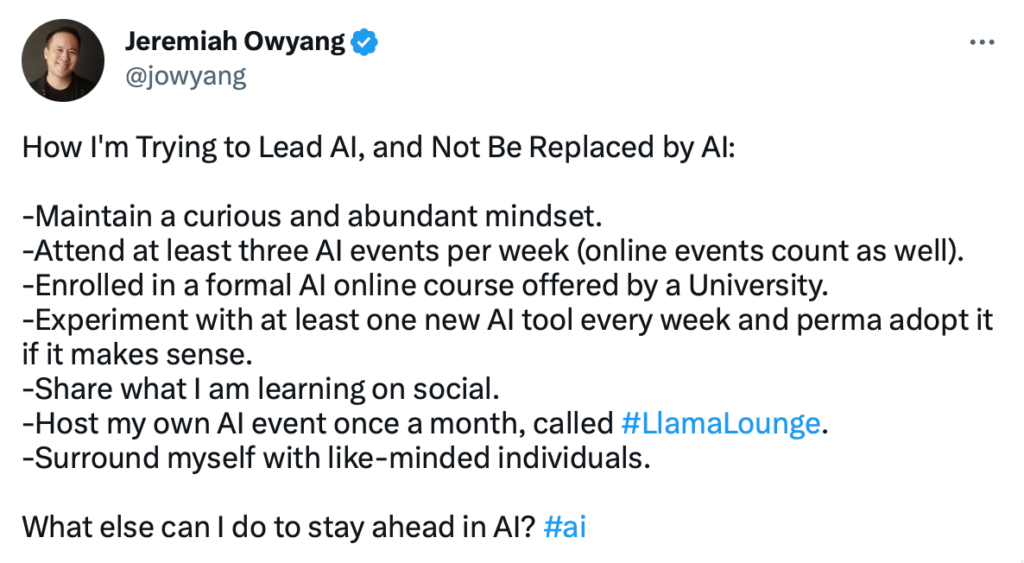
“If you’re waiting for someone to tell you what to do, you’re on the wrong side of innovation.”

There are so many leaders who are standing along-side him at this intersection of “the future we thought we were working toward” and “what’s the actual future (WTAF)?”

It’s here where I tried to develop an image using DALL·E 2 and Microsoft Bing Image Creator powered by DALL·E 2 among others. I have to say that generally, visual AI prompting is an art in of itself (pun intended). For example, because the AI engine as of now distorts human depictions (is that intentional? jk!), suggestions for prompts mention placing people in the background. Here is a link to helpful tips for generative image creation.
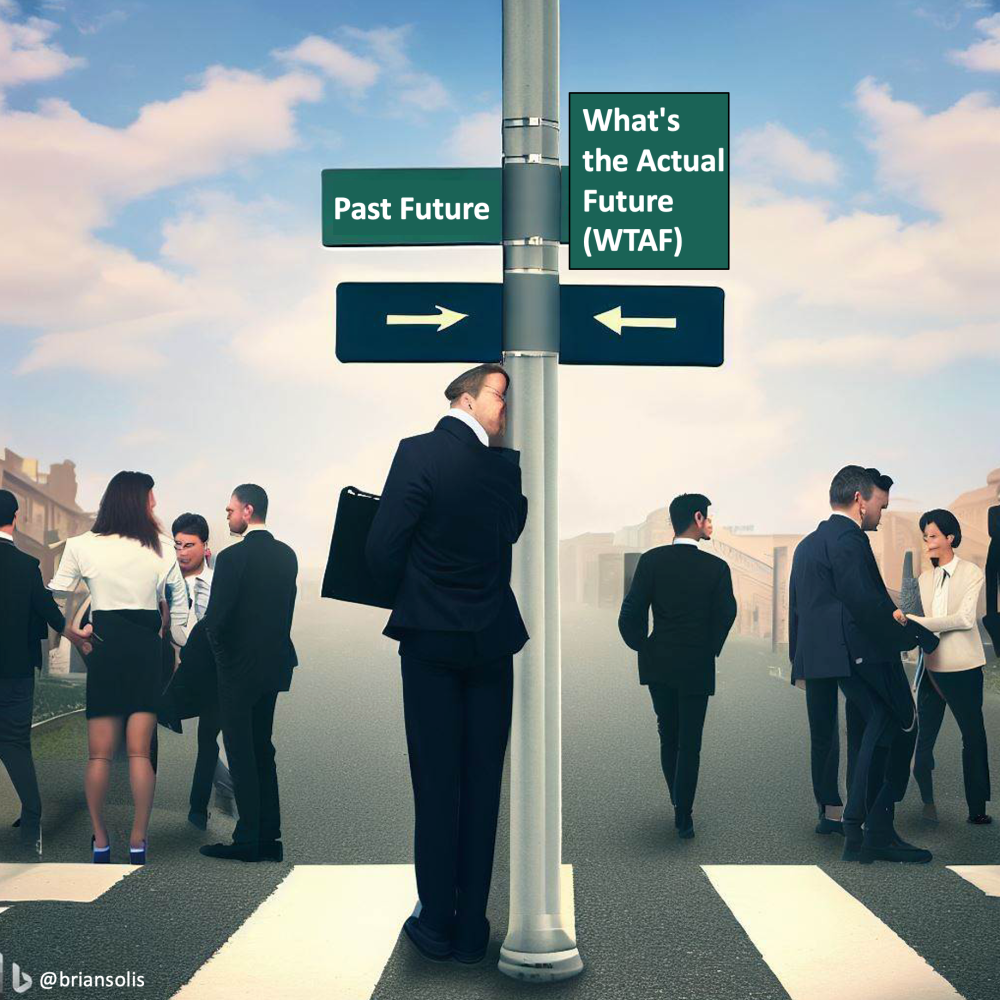
Standing at the Intersection of “Past Future” and “What’s the Actual Future (WTAF) – Microsoft Bing Image Creator powered by DALL·E 2 + Canva

The Future is Yours to Shape

You are not alone. And more importantly, you’re not powerless. We all have to figure this out as individuals, as teams and colleagues, as students and teachers, and as human beings. Make one of your side hustles understanding how AI augments your unique value proposition.

Right now, tthere are many incredible voices thinking out loud, studying and experimenting, building, and helping others to create their own destiny in an era of infinite uncertainty. Follow them. Interact with them. Learn from and with them.

  • Allie K. Miller – Link
  • Brian Roemmele – Link
  • Benedict Evans – Link
  • Robert Scoble (Scobleizer) – Link
  • Jeremiah Owyang – Link
  • Conor Brennan – Link
  • Ben Parr – Link
  • Andrew NG – Link
  • Yann LeCun – Link
  • Fei-Fei Li – Link
  • Geoffrey Hinton – Link
  • Nando de Freitas – Link
  • Kate Crawford – Link

Who am I missing? Let’s update this list…

A Conversation with Professor GPT on the Future Skills Necessary for Evolving Skills and Roles with AI
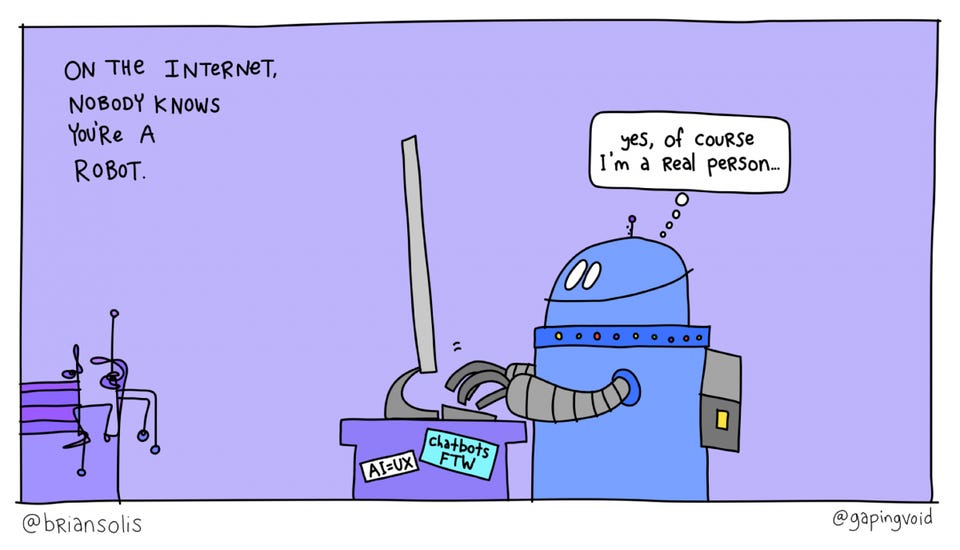
To help us get started, I (half-seriously) consulted with an industry leading resource on the matter, Professor #GPT for advice on what we can do. Here’s part 1 of our unabridged conversation.

Solis: You are an empathetic futurist who believes ChatGPT and generative AI will eventually take more and more jobs away from people. You have now been hired as a professor at Yale University to teach the first ever course in AI-proofing careers for business professionals. What would the curriculum of the 101 course include?

Prof GPT: As an empathetic futurist who recognizes the potential impact of AI on the workforce, I would design the curriculum of the “AI-Proofing Careers for Business Professionals” course to help individuals prepare for the changing landscape of work.

The course would cover the following topics:

Introduction to AI and its impact on the workforce: This section would provide an overview of what AI is, its various applications, and how it is impacting different industries and jobs. It would also cover the potential benefits and challenges associated with AI, including the displacement of jobs.

Identifying AI-vulnerable careers: This section would help individuals identify the types of jobs that are most vulnerable to automation and displacement by AI. We would discuss various factors that make a job more or less likely to be automated, such as the level of routine involved, the amount of human interaction required, and the degree of creativity or problem-solving involved.

Analyzing skill sets and identifying transferable skills: In this section, we would help individuals analyze their current skill sets and identify transferable skills that can be applied to different careers or industries. We would also discuss the importance of lifelong learning and how to acquire new skills to stay relevant in a rapidly changing job market.

Entrepreneurship and new opportunities: This section would explore the potential for entrepreneurship and starting new businesses that leverage AI and other emerging technologies. We would discuss the characteristics of successful entrepreneurs, the benefits and challenges of starting a business, and how to identify new business opportunities.

Ethics and responsibility: Finally, we would discuss the ethical and social responsibilities associated with AI and automation. We would explore questions such as how to ensure that AI is used for the greater good, how to address issues of bias and discrimination, and how to mitigate the negative impacts of AI on vulnerable populations.

Overall, the course would aim to provide business professionals with a comprehensive understanding of the impact of AI on the workforce, equip them with the skills and knowledge necessary to adapt to the changing job market, and encourage them to think critically and ethically about the role of AI in society.

Solis: Now let’s talk about the next course, 102 to build on 101. What skills would you encourage students to learn to outpace AI evolution and job cuts?

Prof GPT: In the “AI-Proofing Careers for Business Professionals 102” course, we would focus on building skills and competencies that are less vulnerable to automation and can help individuals outpace AI evolution and job cuts. Here are some of the skills and competencies we would encourage students to learn:

Creative and critical thinking: AI can be very good at executing routine tasks, but it is still not as good as humans when it comes to creativity and critical thinking. We would encourage students to develop their creative and critical thinking skills through exercises, case studies, and other activities.

Emotional intelligence and interpersonal skills: Jobs that require a high level of emotional intelligence and interpersonal skills, such as healthcare, education, and social work, are less likely to be automated. We would encourage students to develop these skills through role-playing, simulations, and other activities.

Data analysis and interpretation: AI is very good at processing and analyzing large amounts of data, but it still requires human input to interpret and make sense of the data. We would encourage students to develop their data analysis and interpretation skills, including the ability to identify patterns and insights, and communicate their findings to others.

Adaptability and flexibility: With the rapid pace of technological change, it is important for individuals to be adaptable and flexible in their careers. We would encourage students to develop these skills through exposure to different industries and job functions, as well as through exercises that require them to adapt to changing situations and environments.

Leadership and management: While AI can be very good at executing routine tasks, it still requires human leadership and management to guide its use and application. We would encourage students to develop their leadership and management skills, including the ability to motivate and inspire others, and make strategic decisions.

Overall, the focus of the “AI-Proofing Careers for Business Professionals 102” course would be on building skills and competencies that are less vulnerable to automation and can help individuals stay ahead of the curve in a rapidly changing job market.

The Next Steps We Take as a Human Race are Profound

Depending on your perspective, the IBM news is either a canary in a coal mine or business as usual or click bait.
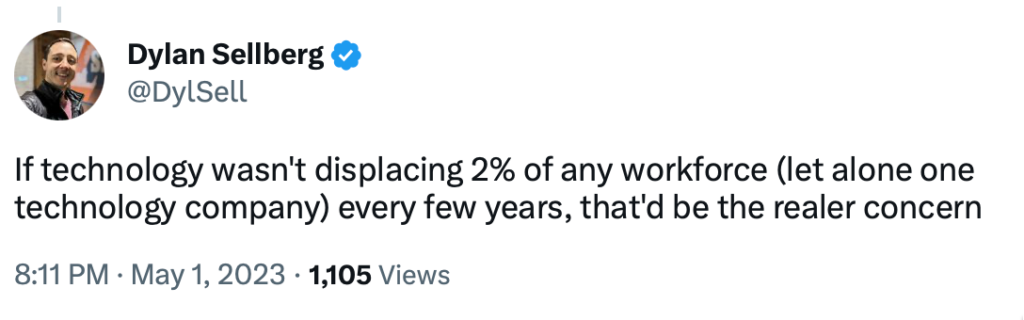
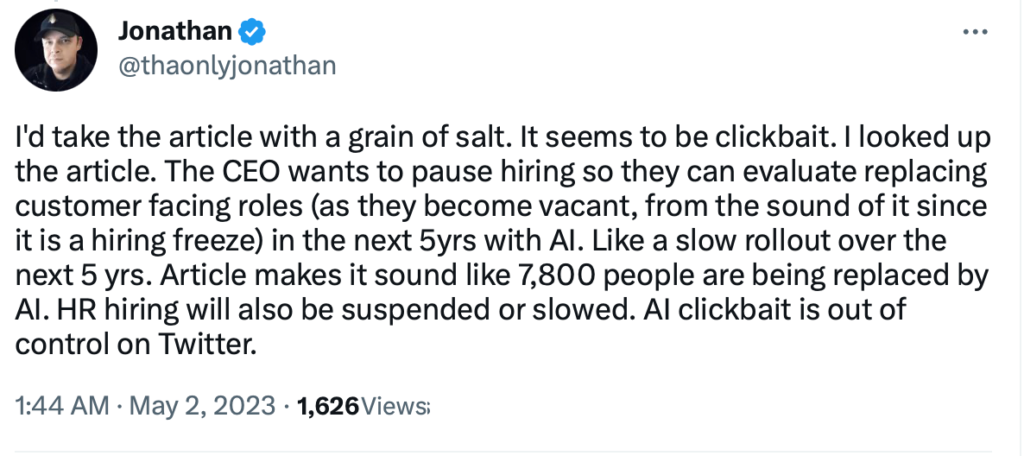
Whether the IBM or Chegg news are harbingers of what’s to come or sensationalized to spark fear, the reality is that decision-makers and leaders may not know the difference. They may take these stories and explore ways to follow suit.

The simple answer for now, is that it’s complicated.

If anything, this is a time to reflect.

“If you think technology will solve your problems, you don’t understand technology — and you don’t understand your problems.” – Laurie Anderson, 2020

I see the cascading AI events unfolding around us as a catalyst for conversations we should be having anyway.

Let’s find opportunities to reframe the narrative, to take control of how we respond to disruption and digital Darwinism.

“Digital Darwinism is the evolution of consumer behavior when society and technology evolve faster than some companies’ ability to adapt. The point of natural selection is that only some businesses will survive.” – Washington Post

Start with different questions and let’s build forward.

For example, it’s a given that executives are going to ask which jobs can be replaced by AI.

Another question to ask would be, how can we keep people in their roles and give them AI tools to gain an X factor of productivity, output, or value add?

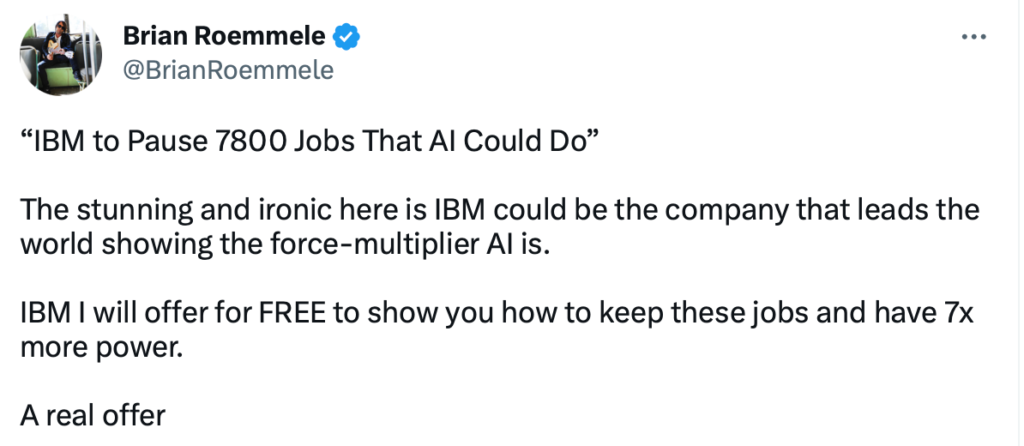
My friend Brian Roemmele offered as much to IBM via Twitter.

The stunning and ironic here is IBM could be the company that leads the world showing the force-multiplier AI is. IBM, I will offer for FREE, to show you how to keep these jobs and have 7x more power. A real offer.
This is the difference between a fixed and growth mindset.

In a time when executives see AI through a lens of cost-cutting, it will be those with a beginner’s mind who see AI as a strategic advantage over the status quo. While they replace people with AI, the winners will augment employees and roles with artificial intelligence to outperform everyone else.

It’s the same mentality as battening down the hatches during economic storms. Cutting costs also costs the business, usually at the expense of product quality, delayed innovation, and customer and employee experiences. Each carry a notable opportunity cost that trades short-term profitability with longer-term mind- and market-share.

Leaders who are creative, curious, bold, and courageous, take action to seize the opportunities that others are willing to sacrifice.

If don’t invest in the short-term, you’ll lose ground in the mid-term, and eventually, you’ll lose in the long-term.

Don’t confuse cuts with gains.

Legendary Apple design chief and founder of LoveFrom design studio, Jony Ive, was once asked for advice by Airbnb Co-Founder and CEO Brian Chesky as the company faced economic uncertainty.

“You aren’t going to cut your way to innovation,” Ive told Chesky at the time.

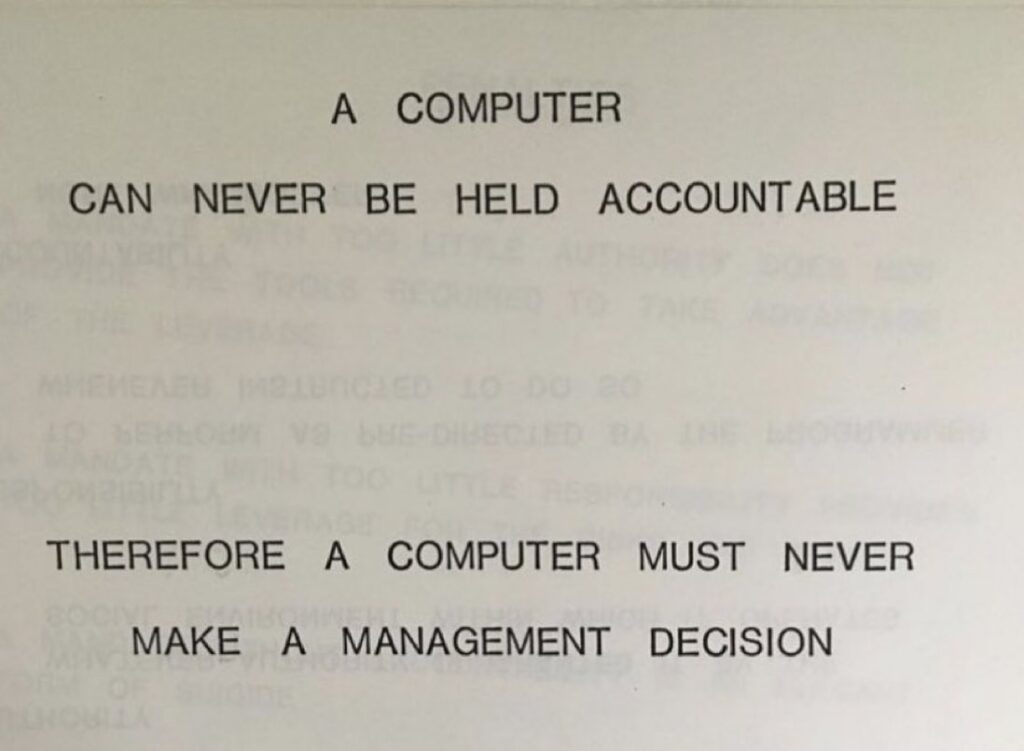
Start with exploring the role of human beings in a world augmented by artificial intelligence. Let’s explore the potential jobs of the future and the skills necessary to thrive alongside AI.

For example, The World Economic Forum recently published a seminal report that finds a “Reskilling Revolution” is upon us. It’s research and conversations like this that help us make sense of what’s happening, where we are going, and the role we can play in the future.

The more advanced technology becomes, the greater the importance of critical human skills (aka soft skills) becomes in our work, such as creativity, empathy, critical and analytical thinking, and resilience.

The conversation with “Professor GPT” is intended to get the conversation started at a human level, at our level.

Every revolution brings about disruption. Every revolution brings about new opportunities and creative destruction (out with the old and in with the new). Every revolution can also represent an opportunity to grow and thrive in unforeseen ways.

There’s a saying that can’t help but think of in these times, “life isn’t happening to you, it’s happening for you.”

The gap between where we are and where we can be is only separated by what we unlearn, learn, and do differently moving forward.

The Role Of Data Analytics In Digital Marketing

0
The Role Of Data Analytics In Digital Marketing

Sergio Alvarez is a performance marketing expert, digital attribution leader and CEO and founder of Ai Media Group.

Creating an effective digital marketing campaign is not about crafting eye-catching ads or enthralling videos. Of course, those play a role, but I have found that the true root of purpose-driven campaigns is far less flashy than photography and soundtracks. To achieve its ultimate marketing goals, I believe a digital marketing campaign must be based on properly sourced, holistic and sound data analytics.

What Data Analytics Provide

Analytics aren’t just numbers—they’re a source of knowledge about your customer’s needs and behavior, and they’re important for guiding how you market to the people who will use your service or buy your product.

Analytics should be holistic, though. If you rely solely on one platform’s data set—such as Google Ads or Facebook—it can be almost impossible to shape an effective campaign around this data. It’s like trying to build a house with only half the plan and hoping it’ll end up as you intended. While data analytics are key to digital marketing, a set of correctly attributed data can often make the difference. Data overload can also be an issue; if you aren’t analyzing your data correctly, you may feel like you have a wealth of data and very few insights.

Holistic Attribution Equals Holistic Digital Tactics

Many digital marketing campaigns consist of different tactics for different platforms, and almost none of these tie in together. Companies can see where sales are coming from, and they often tend to believe that particular leg of the customer’s journey is the only one. They may believe that a customer’s sale comes from one platform only. This is an excellent way to waste your marketing budget.

When you truly understand all the touchpoints in your customer’s journey, you can look at the bigger picture to see how each platform plays a role in eventually delivering the sale. Your campaign tactics for each platform can then support the proven customer journey by leveraging engagement on social media, tying that to Google Ad results and completing the funnel at the most successful end point you’re seeing in the data.

Incorporating Data Analytics Into Digital Marketing

There are clear and actionable steps that can be taken to successfully incorporate data analytics into your digital marketing campaign.

First, ensure that you are gathering data from all of your platforms, including social media, websites and even in-person or telephone engagements with your customers. View this data set as a whole rather than as a sum of its parts. This is the true path your customer takes to a sale.

With this data being collected, the next step is to ensure that you can track your customers through that data. Where are they starting, and where are they ending up? What are all the touchpoints in between? Can you actually trace their journey step by step?

When you start to create content for your campaigns, let the data lead creation. What types of ads and engagements have your customers responded to in the past? Do they seem to care about over-produced video reels, or are they more drawn to simple infographics? This insight should not just be gleaned from engagement numbers on social media, because, again, that’s only one part of the journey. If customers engaged with a specific type of content on one platform, did you also see a mirror engagement to that type of content on another platform? If so, great. If not, what is the difference between the customer’s mindset on those two journey points, and what do you need to give them instead?

In my experience, analyzing data is very often the stumbling block for companies. It can be time-consuming and confusing. Thankfully, AI-driven tools are being regularly enhanced to help solve this problem. With the right prompts, tools like ChatGPT can be leveraged to help analyze your data in a fraction of the time it might usually take.

To determine which tool is the right fit for your needs, ask yourself a few questions:

1. What kind of data do I need to collect and analyze? Consider the types of data that are crucial for understanding your customer journey and achieving your goals. This might include web analytics, social media data, customer feedback and more.

2. How easily can the tool integrate with my existing systems? Ensure that the attribution tool can seamlessly integrate with your current data sources.

3. What is my budget? Holistic attribution tools vary in cost, so determine your budget and find a tool that offers the features you need within that budget.

4. How user-friendly is the tool? Evaluate the tool’s ease of use, user interface and reporting capabilities.

A thoughtful assessment of these considerations can help guide you toward selecting the perfect holistic attribution tool for your specific needs and objectives.

Concerns With Data Privacy

If phrases like “following the customer through their journey” give you privacy concerns, there’s no need to fear overstepping. The data you’re gathering comes from other platforms, so their privacy regulations are already inherent in the data you’ve captured.

In addition to that, it’s actually not necessary to have identifying data for your analytics to be useful. You don’t need to know your customer’s name. In fact, they could be completely anonymous. The value lies in knowing that they are individuals, and in understanding how they moved through your sales funnel, regardless of their identity.

Avoiding The Overload

Data can be a hugely valuable resource, but it’s only useful once properly analyzed. Before that, it’s just a bunch of numbers. By implementing holistic digital tactics, you can mine insights out of that data to help craft compelling, successful digital marketing campaigns that can help ensure all of your business goals are met.


Forbes Business Council is the foremost growth and networking organization for business owners and leaders. Do I qualify?


Advocates praise Dartmouth dental clinic that’s making routine services more accessible

0
Advocates praise Dartmouth dental clinic that’s making routine services more accessible

Disability advocates in Nova Scotia are praising the efforts of a dental clinic in Dartmouth after it installed a lift that will make visits accessible for people with mobility issues.

Transcen-Dental Group, which has several locations around the province, installed the lift mechanism in its Waverley office during renovations this summer.

The automatic lift, which cost just under $10,000, is attached to the ceiling in one of the patient rooms to help those who have mobility issues or use a wheelchair get in and out of the dentist chair.

The lift, which uses an attachable sling to lift a person into the dentist chair, was installed this summer. (TranscenDental Group)

Sheila Crowell, the group’s office manager, said it can be difficult for dentists and hygienists to work on a person’s teeth if they’re in a wheelchair because they can’t be leaned back.

It can also be uncomfortable for the patient, she said, if they have to move their head and neck in an awkward way.

But this lift will prevent that.

“It’s easily done. It’s amazing,” Crowell told CBC Radio’s Mainstreet Halifax

“I think it will make the world of difference for everybody, the patient and the person working on the patient.”

Crowell said the group was inspired to install the lift by one of their patients who uses a wheelchair. And they now have two clients who use the lift, she said.

Accessibility, seniors’ advocates take notice

Bill VanGorder, the chief policy officer for CARP, formerly known as the Canadian Association of Retired Persons, said his organization has been concerned about the lack of accessibility in certain industries, including dentistry.

He said this lift is a wonderful, but unique initiative that’s needed and should be considered throughout the industry.

“Many, many seniors suffer from disabilities of one kind or another, but when they can’t access the health care that they need, then it just makes their issues even more pronounced for them,” VanGorder told Mainstreet

“So people who have mobility issues are still the ones who we see are most disadvantaged when it comes to getting almost any kind of service, including health services.”

A man with short white hair and glasses wears a leather jacket and navy blue shirt. He stands in front of a doorway.
Bill VanGorder, senior spokesperson for CARP, formerly known as the Canadian Association of Retired Persons, said his organization has been concerned about the lack of accessibility in certain industries, including dentistry. (CBC)

VanGorder said he hopes people with disabilities hear about this new lift and access dental care at the centre.

Vicky Levack, spokesperson for the Disability Rights Association of Nova Scotia, said she has never seen a dental office that is fully accessible in the province.

“It is always a challenge. Every [dental clinic] I’ve ever been in has been a challenge,” Levack told Mainstreet.

“The one I go to now, even though they try their best to accommodate, they’re very cramped.”

A woman wearing glasses smiles at the camera.
Vicky Levack, spokesperson for the Disability Rights Association of Nova Scotia, says the lift will allow many Nova Scotians who have disabilities to access dental care. (Vicky Levack)

She said it’s frustrating that health-care systems, which are meant to be for everyone, aren’t accessible for everyone.

“It says to me two things, both of which are bad. One, it says ‘we don’t want you here, disabled person,’ or two — and I think this one is more likely — ‘we didn’t even think about you, you’re not even a thought in our brains,’ which is also, in a way, more harmful,” she said.

But, she said, this lift will allow many Nova Scotians who have disabilities to access dental care — through one location, at least — after what could’ve been years of going without.

“My hope is that this dentist has started a revolution and that other people in the health-care field, not just in dentistry, but doctor’s offices, hospitals and [general practitioners] would install it in their practices as well, that every medical facility will have access to a lift.”

Mainstreet NS8:32Dartmouth dental centre installs lift to make visits more accessible

Featured VideoA dentist in Dartmouth has installed a lift in their new office. If you visit the Transen-Dental Group on Waverley Road, you’ll see a mechanism in the ceiling that helps people who use wheelchairs into the dental chair. CBC’s Carsten Knox spoke with the office manager at Transen-Dental, a disability advocate and a member of the Canadian Association of Retired Persons.

101 Actionable Business Growth Strategies From Popular Internet Entrepreneurs

0
101 Actionable Business Growth Strategies From Popular Internet Entrepreneurs

If you are going to disrupt an industry or take over an established field you need to have a strong set of actionable business items that can help you succeed. Whether you need to “analyze your competition” or “take strategy very seriously,” the action items you create will ultimately affect many aspects of your business and your overall success.

The team at Virtual Staffing have collected 101 actionable business growth tips from some very well known and world renowned business experts.

From Neil Patel to Shauna Mackenzie, these tips can help motive you and your teams, while also serving as a reminder that we all need to learn from our mistakes, play to our strengths, and always be willing to plan for every outcome. Learn more from the following Internet business expert tips below:

101 Actionable Business Tips


Peter Mondrose is the Editor-In-Chief at BusinessPundit. He received his degree in Economics in 1998 and a second degree in Journalism in 2004. He has served as a financial adviser, market trader, and freelance journalist for the last 11 years. When he’s not investigating market conditions and reporting on workplace news, he can be found traveling with his wife, dog, and laptop. He can be reached at OnlineDegree.com.


Two Challenges AI is Facing Right Now

0
Two Challenges AI is Facing Right Now

Artificial Intelligence is seeing massive adoption in several industries like finance, digital marketing, e-commerce, and healthcare. There’s no denying that AI is here to stay, and some jobs are already in danger of being replaced by computer code. But for all its benefits, AI still has a few massive hurdles to overcome before becoming its best iteration. Here are two challenges that AI is facing right now. 

Computing Power And Energy Requirements

It’s no surprise that AI requires a lot of computer power and needs more if we want to develop it further. However, the current state of computing might not be proportionate to AI’s projected growth requirements. 

Moore’s Law is Dying

Computers have developed so much over the last few years that Moore’s Law, a foundational principle in the advancement of computer science since its inception in 1965, is becoming obsolete. As a refresher, Moore’s Law states that transistors in a microchip will double roughly every two years, meaning we can expect a doubling of computing performance every two years while the cost of computers is reduced. This law has been held for almost 60 years, but the computer industry will soon run against a wall. 

Sure, we’ve seen the development from 14-nanometer (nm) to 7-nanometer transistors in the past decade, while 5nm and 3nm chips are already being used in specific industries. Chip manufacturers are now working on 2nm transistors, slated to be released in 2024. Now those are incredibly tiny transistors; for context, DNA molecules are 2.5nm wide. If we want to keep up with Moore’s law, we’ll soon have to manufacture transistors closer to an atom’s size (0.1 to 0.5nm). AI needs further investment in this particular segment to sustain its growth. 

Power And The Demand for AI

Many industries are integrating AI into their workflows and processes. Businesses like social media, customer service, analytics, and data security already see marked improvements using automated models. Specific tasks like healthcare diagnostics, communications, and even content creation are reaping the benefits of AI. Even heavily utilized tech like GPS — which was functionally complete even back in 1978 when the prototype satellite was first launched — is getting improved by AI with additions like tagging road features and generating imagery even through obstructions. But with widespread adoption comes the increased demand for power. 

As developers continue to train AI with more and larger data sets with increased parameters, and as businesses continue to expand their use of AI, the demand for more energy grows. And with growing energy demands and consumption comes more carbon emissions. To put things into perspective, OpenAI’s flagship generative AI, ChatGPT, is estimated to consume 1 gigawatt-hour (GWh) daily. This roughly equals the power consumed by 33,000 U.S. homes in the same period.

…And Then There’s The Cost

A recent report by The Wall Street Journal stated that Microsoft, one of the world’s leading AI development companies, is losing money in its GitHub Copilot subscription model. The program was developed with OpenAI to assist programmers using Visual Studio Code, Visual Studio, Neovim, and JetBrains. Right now, Copilot is $10 per month. However, subscribers have been extensively utilizing the tool, costing Microsoft $20 per month on average to provide the service. Some power users have even been noted to cost the company $80 monthly! 

Now, onto the biggest name in the AI industry. Despite the widespread use of ChatGPT, we still don’t know if OpenAI is profitable, although it has seen a massive revenue bump since it started charging companies for using and integrating the large-language model (LLM) chatbot into their production process. Back in 2022, the company was $540 million in the hole. But this year, some sources estimate that the company is earning about $80 million per month, bringing its potential annual earnings near $1 billion. 

But, again, we still don’t have concrete numbers. AI companies must balance cost, consumption, and results to make their businesses more sustainable. 

Bias

To explain the issue of AI bias, let’s take a closer look at how it manages to think. Machine learning (ML) is the core foundation of AI, and there are two main ways of doing that.

Supervised Learning 

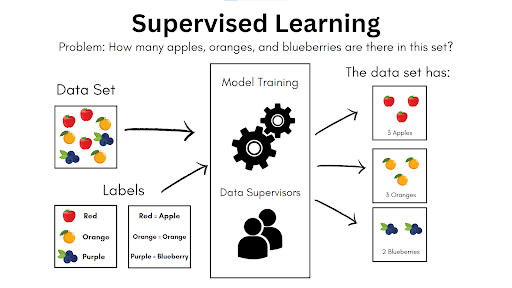
Supervised learning is the technique that uses labeled data or data with information tags or meta-data like classification, properties, characteristics, and other valuable elements. The AI is also presented with a list of outcomes or output labels. Using its base programming and some routine adjustments done by human supervisors, the AI maps the relationship between input and outcome. The new way of “thinking” the AI learned is applied to future data sets and tasks. 

For a quick analogy, imagine a teacher discussing long division with a student. The student is given instructions on how to do it and the eventual correct answer. As the student progresses and makes mistakes, the teacher gives corrections and guidance until they arrive at the correct answer. This is all good if the teacher does a perfect job, but mistakes can happen. If that’s the case, the student will use and perpetuate any mistakes learned from the process until someone corrects them, but we’ll get into that later. 

To make the explanation easier, let’s do another simple example. Let’s say that we want an AI program to take a picture of miscellaneous fruits (data set) and identify which ones are apples, oranges, and blueberries (output labels) and how many of which there are. The process will look something like this:

Using two sets of labels, the AI can identify which ones are apples, oranges, and blueberries. The characteristics used to group these data are then stored in the programming to be used for future similar tasks. Again, this is a simplified representation: if you want a solid idea of how AI does this, you can multiply the data set by a couple of billion times. Supervised learning is used primarily for large-scale data classification and creating predictive models. 

Unsupervised Learning

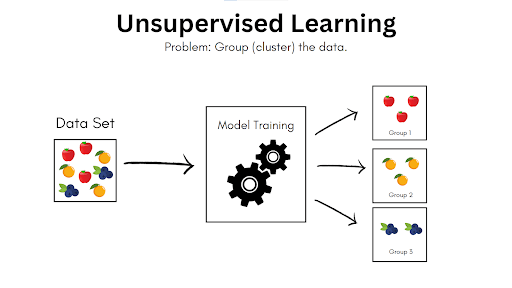
The second machine learning technique is unsupervised learning. The AI is presented with an unlabeled data set and tasked with identifying the details that differentiate each of them while simultaneously identifying common factors. If we take the previous example, it will look something like this:

As indicated, unsupervised learning is excellent for grouping or clustering data, dimensionality reduction (reducing the features of data inputs as much as possible while retaining most of the original information relevant to the task required to make them easier to parse, like making a 3-D object into a 2-D object but keeping the same outline for easier classification), and probability density estimation (extrapolating total population numbers using random samples.) Regardless of the learning process, AI can provide strategic advantages to any business, ranging from improved predictive financial models to risk assessment automation. 

The Potential Impact of Biases

So, how does all this connect to AI bias? Let’s take the supervised learning example and add another label: apples = bad. The AI will still group the data as usual, but with the added outcome that Group 1 is, for whatever reason, bad. The program will take this way of thinking and apply it to other data sets. It all seems inconsequential if we use fruits as an example. But imagine if the data were groups of people, and the model training is used to decide the best way to allocate scarce resources — or to choose which ones to save in the event of a global natural disaster. 

But let’s move away from apocalyptic scenarios and discuss some potential, near-term implications of AI bias.

  • Discrimination in Hiring: Biased AI-based hiring systems may discriminate against certain groups based on gender, race, or other protected attributes. For example, if historical hiring data is biased, the AI system may perpetuate and amplify those biases, resulting in unfair hiring practices. There have been some cases where something as simple as including the words “capture” and “arrest” have precluded potential candidates from automated hiring processes.
  • Unfair Criminal Justice Predictions: Remember that early 2000s film Minority Report? Well, having an FBI Precrime Division is closer to reality than it ever was. However, using predictive analytics and automated risk assessment tools for police action may be affected by bias. Any historical data fed into the AI that contains skewed numbers towards certain minority groups may lead to their unfair targeting. 
  • Healthcare Issues: Biases in AI healthcare applications can lead to disparities in treatment recommendations. In the 1990s, there were several incorrect diagnoses of breast cancer based on X-rays, leading to unnecessary treatments and expenses, not to mention the devastating mental toll of being told you have cancer. Imagine having these incorrect assumptions and diagnostic practices plugged into AI systems. Imagine having incorrect assumptions and diagnostic practices for every disease known to man. It’s enough to give any doctor nightmares. 

Unfortunately, machine learning bias doesn’t just come from data or training labels. The base algorithm may have inherent biases, reinforcement training can start or strengthen identified objectivity issues, and population data may be incomplete or have underrepresented groups, potentially creating lopsided results in favor of other represented groups. 

Conclusion

The difficulties AI companies face aren’t things you could simply brush aside, as they can potentially have massive ramifications for other companies utilizing the technology. These weaknesses can be slightly mitigated in several ways, although not all of them can be done outside of development. So far, all we can do is wait and see how things will play out and hope that the fixes come sooner rather than later. 

If You Got Conned in ERC Scam

0
If You Got Conned in ERC Scam

You wondered at the time whether it was a scam, right? And now you regularly see news reports about ERC scams. Employee retention credit scams, that is.

And so two questions. Did you get scammed? And if so, what should you do at this point? Fortunately, you can probably answer these two questions pretty easily.

Note: This blog post has been updated for the additional guidance the IRS provided on October 19, 2023.

Did You Get Conned or Scammed?

You or your business qualifies for an employee retention credit in one of three ways:

First way: You’re a small business and you started another, new business sometime after February 15, 2020 and before the end of 2021. (That’s easy, right? You know if you did this.)

Second way: Quarterly revenues, as compared to 2019, collapsed. To qualify for 2020, the collapse needs to exceed 50 percent. To qualify for 2021, the collapse needs to exceed 20 percent. (Your accounting system lets you make these determinations with roughly three or four clicks of a mouse.)

And then the third way you qualify: If a government order triggered either a full or partial suspension in your business. And this method? Where the nonsense seems to occur. The place where ERC scams show up.

Fortunately, you can easily determine your eligibility for an ERC based on a government order. You just need to pull out the actual government order that either fully closed your business for some period of time. Or you need to pull out the actual government order that partially closed your business for a period of time—and then show that the partial closure reduced the hours of service or revenues by at least 10 percent.

And now here’s the cold reality. Too often? We see situations where no government order actually exists. I kid you not. And when that’s case? Yeah, sorry. No easy way to say this. But I think you’ve very possibly gotten caught in an ERC scam.

Note: Here’s an example of an actual government order from Washington state: Proclamation by the governor: Stay Health Stay Home.

Real-life Example of ERC Scams

You see all sorts of sloppy thinking regarding government orders.

For example, in one case, a business owner prominent in his industry circulated an email that talked about a government order hitting a major supplier of his firm and similar firms. We understand numerous employers filed millions of dollars of ERC refund claims based on this email.

But when we checked? No government order existed. In fact the supplier, helpfully, said so on their website. Explicitly.

Note: A clarification: A government order “counts” for purposes of employee retention credits if it affects your business… or vendors you get supplies from… or vendors of vendors you get supplies from. A government order that affects your customers does not matter for purposes of your ERC eligibility however. (It might negatively impact your revenues of course–which is another way to qualify.)

Double-check You Got Caught in ERC Scam

So your first step is obvious, right? Find or see if the ERC consultant worked from a real government order. Get a copy. Read the copy and make sure it either closed your operation down. Or it closed down the operation of a vendor in your supply chain and the impact was more than nominal.

And if you can find this document? Count yourself lucky. Because many of your small-business-owning brothers and sisters appear to have claimed employee retention credits when no government order existed. You however should be fine. Not so for people who don’t have a government order.

Take These Steps If You Actually Were Scammed

If you did claim ERC refunds you were not entitled to? You need to take several steps to dial down the damage.

First, if the federal quarterly payroll tax returns—which is where an employer claims employee retention credits—have not yet been filed? I think you stop that process. This may mean instructing the “consultant” preparing the amended returns to stop. You probably want to tell them explicitly that you now believe no government order exists if that is case.

Second, if the federal quarterly payroll tax returns have been filed? But you haven’t received a refund? I think you withdraw your refund request using the procedure desrcibed here:  Withdraw an Employee Retention Credit Claim. Note that the process works very simply in most cases: You make a copy of the 941-X form used to file the ERC refund claim, write “Withdrawn” into the left margin and then have an authorized person sign, give a title, and date the withdrawal using the right margin. You then, quoting from the IRS instructions, “Fax the signed copy of your return using your computer or mobile device to  the IRS’s ERC claim withdrawal fax line at 855-738-7609.”

Third, if the IRS has already processed ERC refunds and you now know your firm was not eligible? You want to amend any tax returns that reflect the erroneous ERC refunds. For example, you want to amend the 941 quarterly payroll tax returns again and then repay the tax refund. That will get you square with the Internal Revenue Service and stop the compounding of penalties and interest.

Another example: If you amended your 2020 and 2021 income tax returns to report the refunds as income (which is required), you want to amend your income tax returns and remove that income. This will reduce your income tax liability for 2020 and 2021 and get you a refund while you still can.

Other Resources

We’ve got a bunch of blog posts about how employee retention credits work here. If you’re concerned you didn’t know enough or still don’t know enough about employee retention credits, check these out to provide yourself with the information you’ll need to get out of this mess.

If you’re a tax practitioner who now needs to do a deep dive into the law, pick up a copy of Maximizing Employee Retention Credits from Amazon.com. (You will have a number of clients who need help with this if your firm is anything like ours. Sorry.)

If you’re an employer who got into trouble on this area? Check first with your CPA to see if he or she can help you get out of the mess. If that doesn’t work, we do have an ability to help a limited number of taxpayers. You can make contact with our firm here:  Nelson CPA PLLC.

Intraday Report: KSE-100 Index surges past 52,000

0
Intraday Report: KSE-100 Index surges past 52,000

10 Advantages & Disadvantages of Digital Marketing

0
10 Advantages & Disadvantages of Digital Marketing

In today’s digitally-driven world, businesses increasingly turn to digital marketing as a fundamental strategy to reach their target audiences.

Digital marketing offers many advantages to help businesses grow, engage with their customers, and stay ahead of the competition. It provides numerous benefits, but like any strategy, it also comes with its own set of challenges and disadvantages.

In this article, we’ll explore ten key advantages & disadvantages of digital marketing and why it has become a cornerstone of modern business success.

Advantages & Disadvantages of Digital Marketing

Digital marketing has revolutionized how businesses promote their products and connect with customers. Understanding its advantages and disadvantages is crucial for effective strategizing. Here’s a brief overview:

Balancing these advantages and disadvantages is essential to create a successful digital marketing strategy tailored to your business needs and goals.

Advantages of Digital Marketing

01. Wider Reach:

Digital marketing allows you to reach a global audience. With the internet’s vast reach, you can connect with potential customers worldwide, breaking down geographical barriers and expanding your market.

02. Cost-Effective:

Compared to traditional marketing methods like print advertising or TV commercials, digital marketing is often more budget-friendly. You can choose from various cost-effective strategies, such as social media advertising or email marketing to suit your budget.

03. Targeted Advertising:

Digital marketing enables precise targeting. You can tailor your campaigns to reach specific demographics, interests, or behaviors, ensuring that your message reaches the right people at the right time.

04. Measurable Results:

Unlike traditional marketing, digital marketing provides detailed analytics and metrics. You can track the performance of your campaigns in real-time, allowing you to make data-driven decisions and optimize your strategies for better results.

05. Enhanced Customer Engagement:

Digital marketing encourages two-way communication. You can engage with your audience through social media, comments, and direct messages, building relationships and fostering customer loyalty.

06. Personalization:

Digital marketing enables highly personalized campaigns. You can use customer data to deliver tailored content and offers, making your marketing efforts more relevant and appealing to individual customers.

07. Flexibility and Adaptability:

In the fast-paced digital landscape, you can quickly adjust your marketing strategies to respond to changing trends and customer preferences. This agility ensures your campaigns stay relevant.

08. Improved Conversion Rates:

With targeted marketing and personalized content, digital marketing often leads to higher conversion rates. You increase the chances of turning leads into customers by reaching the right audience with the right message.

09. 24/7 Accessibility:

Your online presence is available 24/7. Potential customers can access your website, social media, or other digital platforms anytime, providing a consistent and always accessible point of contact.

10. Competing with Larger Businesses:

Digital marketing levels the playing field. Smaller businesses can effectively compete with larger competitors by leveraging digital marketing strategies, even with limited budgets.

Disadvantages of Digital Marketing

01. Overwhelming Competition:

The digital space is saturated with competitors, making it challenging to stand out. Businesses often find themselves in fierce competition for online visibility, which can lead to increased advertising costs.

02. Constant Algorithm Changes:

Platforms like Google and social media networks frequently update their algorithms. These changes can impact your digital marketing efforts, potentially affecting your organic reach and ad performance.

03. Ad Blocking:

Many users employ ad-blockers to remove digital ads from their browsing experience. This can result in lower ad visibility and reduced reach for businesses relying on display advertising.

04. Data Privacy Concerns:

Increased awareness of data privacy has led to stricter regulations like GDPR and CCPA. Adhering to these regulations can be complex and costly for businesses operating internationally.

05. Technical Challenges:

Managing digital marketing campaigns often requires technical expertise. For small businesses with limited resources, navigating complex tools and platforms can be overwhelming.

06. High Initial Investment:

While digital marketing can be cost-effective in the long run, setting up campaigns and creating quality content often requires a significant initial investment.

07. Short Attention Spans:

Internet users have short attention spans. Capturing and retaining their attention can be challenging, making it vital to create engaging and concise content.

08. Negative Feedback Amplification:

Negative comments and reviews can spread quickly online. Managing and responding to negative feedback is crucial to protect your brand’s reputation.

09. Fluctuating ROI:

Digital marketing results can be unpredictable. ROI can vary due to factors like changing consumer behavior, economic conditions, and evolving industry trends.

10. Technical Glitches:

Technical issues such as website downtime, broken links, or slow loading times can disrupt user experiences and harm digital marketing efforts.

Round Up:

Advantages & disadvantages of digital marketing are clear and compelling. It allows businesses of all sizes to reach a global audience, engage with customers personally, and achieve measurable results.

In today’s digital age, embracing digital marketing isn’t just an option; it’s necessary for businesses looking to thrive and succeed in a competitive marketplace. So, whether you’re a startup or an established brand, harness the power of digital marketing to propel your business forward.

Digital marketing undoubtedly offers numerous advantages, but it’s crucial to recognize its potential disadvantages as well. By understanding and addressing these challenges, businesses can develop effective strategies that maximize the benefits of digital marketing while mitigating its downsides. Remember that digital marketing is an evolving field, and staying informed and adaptable is key to success in the digital landscape.

Here’s a FAQ section for “Advantages & Disadvantages of Digital Marketing”:

Q1: What are the primary advantages of digital marketing?

A1: The primary advantages of digital marketing include cost-effectiveness, global reach, precise targeting, real-time analytics, and the ability to personalize content for specific audiences. It also offers a variety of channels to choose from, such as social media, email, and search engines.

Q2: What are some of the disadvantages of digital marketing?

A2: Some disadvantages of digital marketing include the potential for information overload, the need for continuous adaptation due to evolving technology, the risk of negative online reviews and comments, and the challenge of standing out in a crowded digital landscape.

Q3: How does digital marketing compare to traditional marketing methods?

A3: Digital marketing offers advantages over traditional marketing in terms of cost-effectiveness, targeting capabilities, and the ability to track and measure campaign performance. However, conventional marketing methods can still effectively reach specific audiences and establish brand credibility.

Q4: Is digital marketing suitable for all types of businesses?

A4: While digital marketing can benefit many businesses, its suitability depends on the target audience and goals. Small businesses, startups, and e-commerce ventures often find digital marketing highly effective, but some niche industries may still rely on traditional marketing methods.

Q5: Are there any privacy concerns associated with digital marketing?

A5: Yes, privacy concerns are a significant issue in digital marketing. Collecting and using customer data must comply with regulations like GDPR and CCPA. Marketers must be transparent about data collection and ensure data security to maintain consumer trust.

Q6: What are the best practices for digital marketing success?

A6: Best practices for digital marketing include setting clear goals, defining your target audience, creating high-quality and engaging content, using multiple digital channels, monitoring and analyzing performance data, and staying updated with industry trends.

Q7: How can businesses mitigate the disadvantages of digital marketing?

A7: To mitigate the disadvantages of digital marketing, businesses can invest in online reputation management, prioritize customer engagement and feedback, adapt to changing algorithms and trends, and seek professional guidance when needed.

Q8: What role does content marketing play in digital marketing?

A8: Content marketing is a vital component of digital marketing. It involves creating and sharing valuable, relevant, and consistent content to attract and engage a target audience. Quality content helps establish authority, build trust, and drive organic traffic.

Q9: How can businesses measure their digital marketing efforts’ ROI (Return on Investment)?

A9: Measuring ROI in digital marketing involves tracking key performance indicators (KPIs) such as website traffic, conversion rates, click-through rates, and customer acquisition costs. By analyzing these metrics, businesses can assess the effectiveness of their campaigns.

Q10: What are some common mistakes businesses make in digital marketing?

A10: Common mistakes in digital marketing include neglecting mobile optimization, ignoring SEO best practices, not segmenting their target audience properly, neglecting social media engagement, and failing to adapt to changing algorithms and trends. Avoiding these mistakes is crucial for success in digital marketing.

Featured Image Credit: Provided by the Author; Pexels; Thank you!

Rohit Mehta

Rohit Mehta is an Indian blogger, author and entrepreneur. He owns a blog named Digital Gabbar which is Available in English & Hindi. Rohit has been in the digital marketing and IT sector for over 10 years.

Steven Lewis: Does Canada truly want a universal dental care program?

0
Steven Lewis: Does Canada truly want a universal dental care program?

The case for a medicare-like universal program for dental care depends on where we believe oral health belongs in overall health.

Article content

Medicare is Canada’s universal lottery scheme. If your health problem needs a physician, you win – the cost is publicly financed. If you’re sick enough to be hospitalized, bingo, you win again.

If you need expensive drugs while in hospital, another winning ticket; if you need those same drugs at home, try again next time. You break your leg or get cancer, covered. If your eye problem needs an ophthalmologist, covered; if an optometrist can handle it, out of luck.

Advertisement 2

Article content

Article content

You break a tooth, or need a root canal to relieve the searing pain, thanks for playing, gamble safely.

Dictionaries define “comprehensiveness” as “covering completely or broadly,” “all-embracing,” “inclusive,” “exhaustive,” etc.

The Canada Health Act begs to differ; it defines comprehensiveness as “all insured health services provided by hospitals, medical practitioners or dentists, and where the law of the province so permits, similar or additional services rendered by other health care practitioners.”

What? Dental care is in? Alas, no — in law it means services provided by dentists in hospitals, which are a tiny fraction of the total.

Oral health affects how you look, self-esteem, ability to eat certain foods, and, according to several studies, romantic prospects. It is often a window on serious underlying health conditions; it can be the cause or the result of serious health breakdown.

Some health risks like heart disease or degenerative joints appear later in life; poor oral health can seriously compromise children’s development. Instilling good dental health practices in young kids will prevent a great deal of tooth decay and loss, gum disease, and pain throughout a lifetime.

Article content

Advertisement 3

Article content

The consequences of excluding dental care from medicare were predictable. Like medical care prior to 1962, about two-thirds of Canadians have some form of private dental insurance.

This majority includes most public sector workers, whose governments use everyone’s tax dollars to fund services for their employees that they don’t fund for all but the poorest of the rest of us.

The employer-sponsored private dental insurance market is large and fragmented — 30,000 different plans in Ontario alone according to the provincial dental association — with a wide array of coverage options, exclusions, deductibles and co-pays.

All told, a little over half of dental costs are funded through insurance, about 40 per cent out of pocket, and just six per cent by governments.

This arrangement creates winners and losers. The big winners are insurance companies, the toll collectors on the dental services freeway. Dental needs are predictable; there are no catastrophic claims from earthquakes or tankers lost at sea. If costs rise, they simply raise premiums.

Claims processors and adjudicators earn a stress-free living from this cozy compact.

Advertisement 4

Article content

Employers and employees of organizations that provide dental insurance are also winners. The employees get a benefit that isn’t taxed as income. The private sector employers’ contributions are tax deductible, so neither pays the full cost.

But they may still be paying too much: the evidence suggests that some services built into plans, such as routine checkups or frequent cleanings, provide little clinical value.

Dentists are winners. Their bills are paid. They know that neither the employer nor the employee has a strong incentive to restrain utilization, since both are subsidized by the general public.

They can recommend more frequent visits or promote new and allegedly superior services that may become entitlements under an insurance plan.

People who buy their own dental insurance are among the losers. They pay the entire premium rather than the fraction paid by beneficiaries of employer-sponsored plans.

If their plan is approved by the Canada Revenue Agency, the premiums are tax deductible, which makes them modest winners compared to people with no dental insurance. 

Advertisement 5

Article content

Consumer Reports and other analysts have concluded that for most people, buying individual dental insurance makes little sense. Humans are notoriously poor risk estimators.

The one-third of Canadians with no dental insurance, most of whom pay for services on a cash basis, are the big losers. Unless their costs are very high, they pay entirely with after-tax dollars. To add insult to injury, uninsured and self-insured taxpayers also subsidize the dental benefits for those in on the game.

To which a plausible response is: so what? Lots of public policies — how capital gains are taxed, farm fuel subsidies — favour some over others. Canadian dental health status is pretty good by international standards.

Canadians aren’t marching in the streets to protest the state of dental care; a public program is a promise extracted by the NDP as part of its pact with the Liberals. There are lots of dental clinics in most cities eager to take on new patients.

Dental care may be haphazardly organized, but, in the grand scheme of things, is there a strong case for a medicare-like dental program?

Advertisement 6

Article content

It depends on our ambitions for health care and where oral fits into the picture. If the problem with dental care is only that too few Canadians have private dental insurance, the solution is to use subsidies or tax credits to nudge more people into existing plans.

If necessary, also enhance efforts on behalf of lower-income people who need fuller public support.

But suppose we think oral health is as important as the health of our hearts or kidneys; that dental care providers should be part of multidisciplinary primary care teams; that a great deal of routine work could be done by dental nurses; and that we are falling woefully short on prevention, leaving too much to be repaired.

It might concern us that dental care is off on its own, and that dentistry is increasingly corporatized as more and more practices are bought up by investors. It might raise eyebrows that per capita spending on dental care in Canada is nearly as high as in the U.S., while overall health care spending is about half.  

When John Diefenbaker’s Progressive Conservative government asked Justice Emmett Hall to produce a blueprint for national medicare, few expected that he would recommend the universal, tax-funded Saskatchewan approach so bitterly fought over only two years prior to his 1964 report.

Advertisement 7

Article content

Despite medicare’s ups and downs, there is no public appetite to recreate for physician care the system we still have for dental care.

We are six decades removed from that defining moment. What can Ottawa realistically do for dental care in 2023? What can we learn from previous attempts to chart a new path?

Next month, the main options.

Steven Lewis spent 45 years as a health policy analyst and health researcher in Saskatchewan and is currently adjunct professor of health policy at Simon Fraser University. He can be reached at [email protected].

Related Stories

With some online platforms blocking access to the journalism upon which you depend, our websites are your destination for up-to-the-minute news, so make sure to bookmark TheStarPhoenix.com and LeaderPost.com. For Regina Leader-Post newsletters click here; for Saskatoon StarPhoenix newsletters click here.

Article content

Comments

Postmedia is committed to maintaining a lively but civil forum for discussion and encourage all readers to share their views on our articles. Comments may take up to an hour for moderation before appearing on the site. We ask you to keep your comments relevant and respectful. We have enabled email notifications—you will now receive an email if you receive a reply to your comment, there is an update to a comment thread you follow or if a user you follow comments. Visit our Community Guidelines for more information and details on how to adjust your email settings.

    Advertisement 2

Mixed Reality Helps Insurance Brokerage Identify Risk

0
Mixed Reality Helps Insurance Brokerage Identify Risk

In a world where innovation has become the cornerstone of progress, the insurance industry is no exception. The advent of mixed reality technology has ushered in a new era of possibilities, reshaping how insurance brokerage firms approach risk identification and mitigation. The use case sheds light on the groundbreaking strides taken by an insurance brokerage firm in adopting this cutting-edge technology to redefine risk assessment.

Unveiling the Future of Risk Assessment

The article, titled “Insurance Brokerage Firm Rolling Out Groundbreaking Technology to Better Identify Risks,” highlights the endeavors of an insurance brokerage firm that is spearheading the utilization of mixed reality technology to enhance their risk identification processes. By harnessing the power of mixed reality, this firm is reimagining how they assess risks, thus ensuring a more accurate and comprehensive understanding of potential vulnerabilities.

Exploring Mixed Reality’s Impact

Mixed reality, a fusion of virtual and augmented reality technologies, is proving to be a game-changer for industries across the spectrum. In the realm of insurance, the integration of mixed reality presents a host of benefits:

Enhanced Visualization: Mixed reality allows insurance professionals to visualize risks in an immersive environment, providing a clearer understanding of potential hazards and vulnerabilities.

Real-time Analysis: By superimposing data and analytics onto real-world scenarios, mixed reality enables brokers to analyze risks in real time, aiding in making swift and well-informed decisions.

Interactive Training: Training programs that leverage mixed reality technology offer employees a hands-on experience of risk identification and assessment, fostering a more practical and effective learning process.

Charting a New Path Forward

As insurance brokerage firms continue to embrace mixed reality, the landscape of risk assessment is undergoing a transformative shift. The partnership between technology and insurance is ushering in an era of precision, efficiency, and improved decision-making. Moreover, the article highlights the growing role of innovative solutions providers, like CraneMorley, in empowering insurance companies to seamlessly adopt and integrate mixed reality into their operations.

In conclusion, the article sheds light on the remarkable journey of an insurance brokerage firm that is propelling the industry forward by embracing mixed reality technology. As pioneers in this revolution, they are setting an inspiring example for the entire sector. This is not merely a story of technology adoption; it’s a narrative of how innovation is rewriting the future of risk assessment in insurance.

Guides new interactable holograms feature

0
Guides new interactable holograms feature

The newest feature for Microsoft Dynamics 365 Guides has arrived: unveiling Dynamics 365 Guides’ new interactive hologram feature. This feature empowers users to create interactive 3D holograms within Guides.

To put it simply, picture everything you can already do with Guides, and now, add interactive holograms. We’ve used this example before, but think of the scene in Iron Man when Tony Stark isolates, selects, and manipulates the angle and size of an object; it’s the perfect analogy for this functionality in Guides. Imagine having that kind of control while learning to build a product or inspect/repair a piece of machinery through interactive 3D holograms, just like Tony Stark.

In addition to interactive holograms, this feature also includes what Microsoft calls “interactable ghosts.” This is an additional add-on designed so that when a user moves a hologram, a 3D outline resembling a ghost will persist to guide users on where the hologram belongs. For instance, if a user is learning how to assemble and disassemble an engine and might forget the steps, these ghost holograms will always show them where specific parts should go and the steps to reassemble the engine. Users can also utilize the attached back arrow to automatically snap the hologram back into place.Here are steps from Microsoft on how to Set a 3D part as interactable.

  1. Place the 3D object in the real world.
  2. Air tap the hologram to select it.
  3. Air tap the Edit Hologram (pencil) button, and select Interactable.
  4. Enable Interactable. A hand icon appears in the middle of the object.
  5. (Optional) Enable Interactable Ghost to give the operator a persistent hint for putting the object back into the correct position.

For an in-depth breakdown of all the updates, you can refer to Microsoft’s Dynamics 365 Guides document outlining what’s new.

https://learn.microsoft.com/en-us/dynamics365/mixed-reality/guides/hololens-app-interact-3d

Stay tuned in for another in depth blog on how you can utilize this new interactable holograms feature!