A bomb threat has been received through an email to multiple locations, including the BJP office in the Coimbatore city of Tamil Nadu. The email, received on Sunday, claimed that petrol bombs would be hurled at multiple locations in the city, India Today reported. The email sent to the Crime and Criminal Tracking Network and Systems (CCTNS) portal reportedly stated that petrol bombs would be hurled at multiple locations, including BJP offices.
Police sources told India Today that an “unknown person sent a bomb threat mail to the police officials through the CCTNS portal on Saturday night”. The person claimed that petrol bombs would be hurled at many places in Coimbatore to condemn Prime Minister Narendra Modi’s government at the Centre.
The Coimbatore City Police have now launched an investigation into the threat email. However, the Coimbatore City Commissioner called it a hoax email. “It is a hoax mail and police are investigating the mischief-maker,” the top cop told India Today.
In October last year, a suicide bomber, Jamesha Mubeen, was killed when his vehicle laden with improvised explosive device (IED) exploded prematurely in front of the ancient Arulmigu Kottai Sangameshwarar Thirukovil temple at Eswaran Kovil Street, Ukkadam in Coimbatore.
The case was initially registered at the Ukkadam Police Station in Coimbatore city and subsequently handed over to the NIA a few days later. The NIA has so far arrested 15 suspects in connection with the case.
ICC Cricket World Cup 2023 semi-finals schedule: After Pakistan’s hopes of qualifying for the ICC World Cup 2023 semi-finals ended due to a poor net run rate, the International Cricket Committee (ICC) on November 11 (Saturday) announced that New Zealand will play India in the first semi-final of the 50-over World Cup at the Wankhede Stadium on Wednesday (November 15). In the second semi-final of the ODI World Cup, South Africa are set to face five-time champions Australia at the Eden Gardens stadium in Kolkata on Thursday (November 16). Both semi-finals will start at 2 pm. The final match of the tournament will be played at the Narendra Modi cricket stadium in Ahmedabad on November 19 (Sunday).
Also Read: India Vs Netherlands LIVE Score, Cricket World Cup 2023 Updates: India won the toss, and chose to bat; Netherlands to bowl first at Chinnaswamy Stadium, Bengaluru
ICC Cricket World Cup 2023 semi-finals schedule:
Semi-final 1: India vs New Zealand, Wankhede Stadium, Mumbai, 2 pm, November 15, Wednesday Semi-final 2: South Africa vs Australia, Eden Gardens, Kolkata, 2 pm, November 16, Thursday
Also Read:ICC Men’s ODI World Cup 2023 Points Table, Team Standing: England, Australia win; India to meet New Zealand and South Africa to face Australia in semis— Most Runs, Most Wickets, Stats, Net Run Rate
ICC Cricket World Cup 2023 semi-finals Squads:
ICC Cricket World Cup 2023 semi-finals: India squad
ICC Cricket World Cup 2023 semi-finals: Australia Squad
Pat Cummins (c), Steve Smith, Alex Carey, Josh Inglis, Sean Abbott, Cameron Green, Josh Hazlewood, Travis Head, Marnus Labuschagne, Mitch Marsh, Glenn Maxwell, Marcus Stoinis, David Warner, Adam Zampa, Mitchell Starc.
ICC Cricket World Cup 2023 semi-finals: South Africa Squad
Temba Bavuma (c), Gerald Coetzee, Quinton de Kock, Reeza Hendricks, Marco Jansen, Heinrich Klaasen, Keshav Maharaj, Aiden Markram, David Miller, Lungi Ngidi, Andile Phehlukwayo, Kagiso Rabada, Tabraiz Shamsi, Rassie van der Dussen, Lizaad Williams.
Also Read: ICC World Cup 2023: List of centuries; Most tons in World Cup so far
ICC Cricket World Cup 2023 semi-finals: New Zealand Squad
Kane Williamson (c), Trent Boult, Mark Chapman, Devon Conway, Lockie Ferguson, Matt Henry, Tom Latham, Daryl Mitchell, Jimmy Neesham, Glenn Phillips, Rachin Ravindra, Mitch Santner, Ish Sodhi, Tim Southee, Will Young.
Windows Holographic, version 23H2 is the latest update to the operating system that powers HoloLens devices. This update includes a number of new features and improvements that make HoloLens devices more powerful, versatile, and secure.
One of the most significant new features in Windows Holographic, version 23H2 is support for NFC readers. This means that users can now tap their HoloLens device to an NFC reader to authenticate or sign in. This can be useful for a variety of scenarios, such as logging into enterprise applications or accessing secure locations.
Another important new feature is faster eye position updates. This improves the overall performance and responsiveness of the HoloLens device. Users will notice that HoloLens is able to track their movements more accurately and quickly, resulting in a more immersive and engaging experience.
In addition to these new features, Windows Holographic, version 23H2 also includes a number of other improvements, such as:
A viewfinder for the camera: This allows users to see what the HoloLens camera is seeing, which can be helpful for debugging or troubleshooting purposes.
The ability to rename HoloLens devices: This makes it easier to identify and manage multiple HoloLens devices in an organization.
New MDM policies: These policies allow IT administrators to configure and manage HoloLens devices in more detail.
The ability to block USB peripherals: This can be used to improve security by preventing users from connecting unauthorized devices to their HoloLens device.
Control Windows Hello provisioning behavior: This allows IT administrators to specify how Windows Hello is provisioned on HoloLens devices.
Overall, Windows Holographic, version 23H2 is a significant update that makes HoloLens devices more powerful, versatile, and secure. This update is essential for any organization that is using HoloLens devices for business or educational purposes.
Here are some specific examples of how the new features in Windows Holographic, version 23H2 can be used:
NFC support: NFC support can be used to implement a variety of new scenarios, such as:
Logging into enterprise applications: Employees can tap their HoloLens device to an NFC reader to log into enterprise applications without having to enter their credentials each time.
Accessing secure locations: Employees can tap their HoloLens device to an NFC reader to access secure locations, such as server rooms or data centers.
Point-of-sale systems: NFC support can be used to implement mobile point-of-sale systems that allow customers to pay for goods and services with their HoloLens devices.
Faster eye position updates: Faster eye position updates can improve the experience of using HoloLens for a variety of tasks, such as:
Viewing 3D models: Users can experience 3D models more immersively and realistically when HoloLens is able to track their eye movements more accurately.
Playing games: Faster eye position updates can improve the performance of HoloLens games, making them more responsive and enjoyable to play.
Using productivity applications: Faster eye position updates can improve the usability of productivity applications, such as Word and Excel, by making it easier for users to interact with menus and other UI elements.
The new features and improvements in Windows Holographic, version 23H2 make HoloLens devices more powerful and versatile than ever before. These devices are now even more suitable for a wide range of business and educational applications.
Crude oil futures rose Friday but logged a third straight weekly decline, trading at the lowest since mid-July before bouncing to end the week, as sentiment has shifted in the oil market.
“Concerns about demand have replaced the fear of production outages related to the Middle East conflict,” analysts at Commerzbank said.
Demand worries were raised early this week as Chinese refiners asked for less supply for December.
In the U.S., consumer sentiment fell for a fourth straight month, and Federal Reserve Chair Jerome Powell suggested that officials could further raise interest rates.
Front-month Nymex crude (CL1:COM) for December delivery rose 1.9% Friday but settled -4.1% for the week to $77.17/bbl, while January Brent crude (CO1:COM) also was -4.1% for the week after adding 1.7% Friday to $81.43/bbl; also December gasoline (XB1:COM) -0.5% for the week to $2.19/gal, and December diesel (HO1:COM) -6.2% this week to $2.74/gal.
U.S. natural gas futures fell every day this week, the result of generally mild weather forecasts for most regions of the country; for the week, front-month December natural gas (NG1:COM) ended -13.7% to $3.033/MMBtu.
The week’s big drop in diesel – a key fuel in powering the economy- echoes softness in Europe, where declines in industrial and economic activity have driven a sharp retreat in fuel consumption.
Raj told MarketWatch that “smugglers, dark fleet operators, thieves and black market dealers are working overtime washing and gushing oil produced or stolen from Russia, Iran, Kurdistan, and Nigeria.”
For his part, Saudi energy minister Prince Abdulaziz bin Salman said this week that people are just “pretending” oil demand is weak, claiming “it’s all a ploy” by speculators.
The energy stock sector, represented by the Energy Select Sector SPDR Fund (NYSEARCA:XLE), rose 1.1% Friday but was the week’s worst performer, -3.8%.
The sector is this month’s only decliner, down 2.1% vs. a 4.8% month-to-date gain in the S&P 500.
This week’s top 5 gainers in energy and natural resources: Ramaco Resources (METC) +44%, Genie Energy (GNE) +19.5%, Ramaco Resources Class B (METCB) +14.8%, Permianville Royalty Trust (PVL) +13.3%, Excelerate Energy (EE) +11.7%.
This week’s top 10 decliners in energy and natural resources: Plug Power (PLUG) -46.7%, Montauk Renewables (MNTK) -39.9%, NuScale Power (SMR) -39.2%, Nine Energy Service (NINE) -36.1%, Ameresco (AMRC) -25.2%, Stem (STEM) -22.9%, BP Prudhoe Bay Royalty Trust (BPT) -18.8%, Comstock Resources (CRK) -18.4%, Coeur Mining (CDE) -18.2%, Riley Exploration Permian (REPX) -17.8%.
The NCA warned of deliberate attempts “to launder sanctioned gold to mask its origin so that it can be hidden in supply chains and sold in the UK and around the world”.
The UK government has also just become the first Western nation to announce a series of sanctions targeting specific companies involved in Russia’s gold trade.
These include UAE-based gold trader Paloma Precious. Paloma is alleged to have traded $300m (£246m) in Russian gold since Vladimir Putin invaded Ukraine.
UAE is now under intense scrutiny for its role in the global market for shadowy Russian gold.
Russian gold is melted down to scrub it of its origin before being sold on – Andrey Rudakov/Bloomberg
The metal is being shipped from Russia to refineries in countries such as the UAE that do not have sanctions against Russia. There, the gold is melted down to scrub it of its association with Russia before being sold on.
“Once melted down and recast or refined, the origin cannot be determined by examination, as any hallmarks are lost,” the NCA warned.
The trail of gold is generating a vital source of revenue for President Putin’s war machine. And it is becoming glaringly clear that the bulk of this is moving through the UAE.
London is the centre of the world’s gold trade and London Bullion Market Association (LBMA), which regulates the trade, banned Russian gold shortly after the invasion of Ukraine.
The LBMA, which accredits gold refineries and sets the standard for global trade, banned bars made in Russia from March 7 2022 onwards from being traded. Western allies followed suit and banned all Russian gold exported from July 2022 onwards.
Yet rather than crush the trade, it has been rerouted. UN data shows that UAE imports of Russian gold increased 15 times over between 2021 and 2022.
Other data suggests the true figure may be even higher. Russian customs records obtained earlier this year by Reuters showed that the UAE had imported 75.7 tonnes of gold from Russia worth a total of $4.3bn in the year since the war in Ukraine began. This was 58 times the volume by weight that was imported across 2021.
The UAE was by far the largest destination for Russian gold, followed by China (primarily via Hong Kong) and Turkey, which each imported around 20 tonnes.
This data suggests sanctions on Paloma Precious are hitting only the tip of a very large iceberg.
Based on the customs records, the $300m in Russian gold traded by Paloma is equivalent to only about 7pc of the total that entered the UAE in the first 12 months of the war.
The majority of the world’s gold refineries are accredited by the LBMA, which means they have to prove the source of every gram of gold handled and are subjected to annual external audits. LBMA-accredited refineries account for around 90pc of annual mined gold production around the world.
But in the recycled gold sector there is less oversight. LBMA-accredited refineries cover about 50-60pc of recycled gold production.
It is the recycled gold that makes up the bulk of the UAE’s market. In the UAE, there are three or four major gold refineries. None are accredited by the LBMA.
Until July this summer, the Emirates Gold refinery was an affiliate member of the LBMA. But after the LBMA completed a due diligence review this summer, it suspended the refinery’s membership “until further notice”. The suspension is understood to be driven by suspected links to Russia.
Separately, the UAE also blocked Emirates Gold from delivering into Dubai’s gold market after it failed to meet standards for responsible sourcing and anti-money laundering.
The beneficial owner of Emirates Gold is Paloma Precious. In September, London-listed Rockfire Resources announced a deal to acquire 100pc of Emirates Gold, provided it was reinstated to the UAE’s good delivery list. Rockfire has since said it is taking urgent legal advice to determine the impact of UK sanctions on the transaction.
Paloma Precious did not respond to a request for comment.
Because the UAE has no sanctions on Russia, Putin is free to export Russian gold to these refineries. Russia’s reliance on friendly countries such as the UAE to wash its gold mimics the way Putin has managed to circumvent the G7 oil price cap by building a “dark fleet” of tankers operating outside the Western insurance market.
Putin has managed to circumvent the G7 oil price cap by building a ‘dark fleet’ of tankers – AP
The bulk of the Russian gold that passes through the UAE is likely going on to China and India, but some will also be coming to the UK. It cannot be imported into the UK as bars because it lacks LBMA certification, but it can be imported as jewellery or even in electronics. British holidaymakers who buy jewellery in the UAE may also inadvertently be purchasing Russian gold and bringing it home.
The end result is a lifeline for the Kremlin. Russia produces more than 300 tons of gold per year and the sector was worth £12.6bn to the economy in 2021. It is a “critical revenue stream” for Russia’s war effort and one of the largest after oil and gas, the Foreign Office warned.
“Gold is essential to Russia,” says Christopher Swift, a national security lawyer at Foley & Lardner and formerly an official in the US Treasury Department’s Office of Foreign Assets Control.
“Russia has evolved into a barter-style economy where they are using products from their extractive industries such as oil, gas and metals mining, to pay for the purchase of weapons overseas as well as for consumer goods.”
While the West was quick to realise the significance of oil and gas to Putin’s war machine, it was slower to realise the significance of gold.
However, as the Foreign Office sanctions last week demonstrate, Westminster is now waking up – and turning the screws on Putin.
Nearly 2.5 lakh employees have been laid off so far this year in the global technology and startup sector, as the tech layoffs continue unabated for the past two years. Nearly 1,106 tech companies have sacked 248,974 employees (till November 11), according to data compiled by the website Layoffs.fyi.
Last year, 1,024 tech companies laid off a total of 154,336 employees.
Citing the global macroeconomic conditions, Big Tech firms and startups across the spectrum have fired employees.
On average, about 555 employees lost their jobs every day in the last two years – or 23 workers every hour.
In January alone, 89,554 employees were laid off.
In terms of sector, retail tech and consumer tech were the ones which laid off the most employees in this year.
As 2023 is not over yet, more layoffs are set to happen in the remaining period.
Several tech and gaming companies laid off employee this month.
French video game company Ubisoft, which published popular franchises like Assassin’s Creed and Far Cry, has laid off about 124 employees as part of a corporate restructuring and reorganisation effort.
Game development software company Unity has announced that it will “likely” go for layoffs as part of cost-saving measures.
Snap, the parent company of Snapchat, has laid off nearly 20 employees who held product management titles as part of a restructuring aimed at streamlining the social messaging company.
US-based F5, a global leader in multi-cloud application security and delivery, reportedly laid off 120 employees this month.
Global communications company Viasat is laying off 800 employees, about 10 per cent of its workforce, and the impact will spread across the business in terms of geographies and divisions.
US-based cybersecurity company Splunk has announced to lay off about 7 per cent of its global workforce, just months ahead of its acquisition by global networking giant Cisco.
Uttarakhand is reportedly set to become the first state in the country to implement the Uniform Civil Code next week. A report will be submitted to Chief Minister Pushkar Singh Dhami in the next couple of days by a committee formed under the leadership of Justice (retired) Ranjana Desai, India Today reported citing sources.
The UCC is a proposal to formulate and implement personal laws which will apply uniformly to all citizens regardless of their religion, gender or sexual orientation. The code comes under Article 44 of the Constitution.
The Uttarakhand government will convene a special session of its Legislative Assembly in the week immediately after Diwali, when the Uniform Civil Code bill will be passed, granting it legal status.
Desai, a member of the Uniform Civil Code (UCC) draft committee, had earlier this year mentioned that the drafting of the UCC for Uttarakhand has been completed and will be submitted to the state government soon.
“It gives me immense pleasure to inform you that the drafting of the proposed Uniform Civil Code of Uttarakhand is now complete,” she said. The report of the expert committee along with the draft will be printed and submitted to the Government of Uttarakhand, she said.
Separately, she had stated that implementing the Uniform Civil Code will strengthen the social fabric, promote gender equality and help fight economic, social and religious inequalities.
Vice President Jagdeep Dhankhar too had called for the implementation of UCC. Addressing the 25th convocation of the Indian Institute of Technology, Guwahati, Dhankhar also said Article 44 of the Constitution clearly states that the state shall endeavour to secure the Uniform Civil Code for its citizens across the country.
“This was the thought process of the founding fathers. The time has come for its implementation and there can be no rationale for impediment or further delay”, he said.
The India Today report, further citing sources, mentioned that Gujarat may also implement the Uniform Civil Code before the 2024 Lok Sabha elections.
If done, Gujarat will then become the second state to implement the Uniform Civil Code.
(With inputs from Himanshu Mishra)
Also Read: Raghuram Rajan says India needs to grow at 8% to create enough jobs to meet demand: Report
Although working remotely from home has been on the rise in recent years, the COVID-19 pandemic quarantine gave many no choice but to jump into the growing remote workforce.
While there are many benefits to working from home, there are also challenges that many didn’t realize before starting to work remotely or becoming part of a remote team.
Benefits of Remote Working
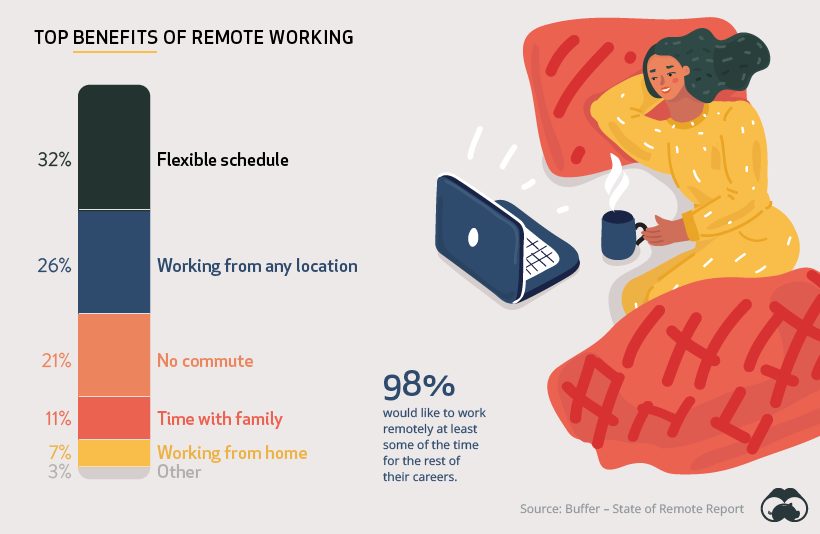
Working remotely offers a flexible schedule and allows you to work from home or wherever you are.
Not having to factor in commute times allows more time to do other things, like spending time with family and having regular meals together at a regular time whether or not there is a traffic gridlock or trains are running late.
Almost everyone agrees that they would like to work remotely at least part of the time permanently.
Top Struggles of Remote Workers
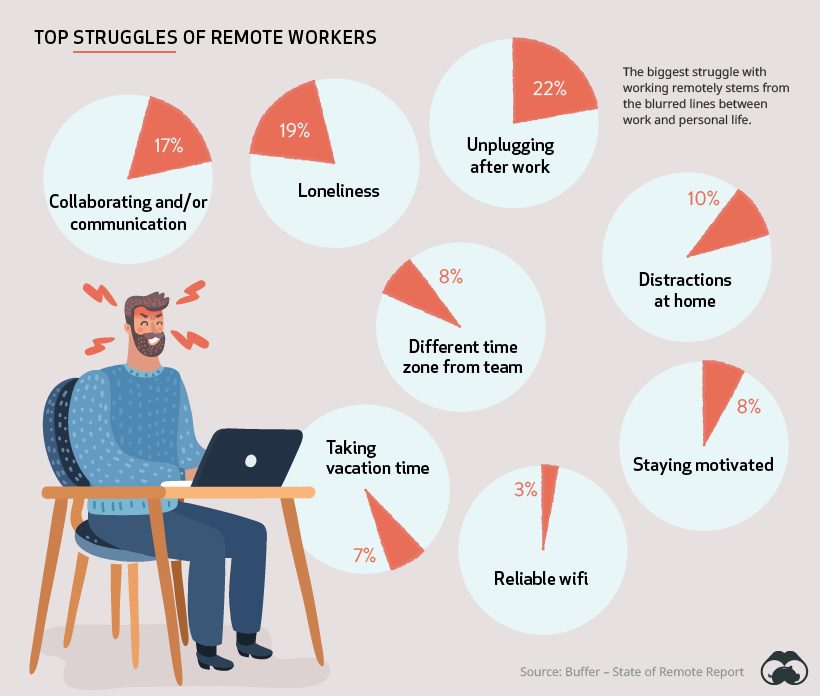
One of the biggest challenges for remote workers are the blurred lines between work and home life. While working from home it can be difficult to get out of the work mindset or back into the work mindset after personal time.
Many remote workers report feeling lonely and disconnected because of the lack of social interaction that normally occurs in the workplace.
Some people are frustrated that communication and collaboration efforts can be more difficult when working remotely. It’s harder to pin others down when you don’t see them face to face and it’s more difficult to get answers you need quickly when others are working on different schedules.
When working remotely you may be working with a team in a different time zone, which can slow communications down even further. You may also face the challenge of distractions at home and a lack of motivation to put in the time to do your best work.
Flexible Workplace Obstacles
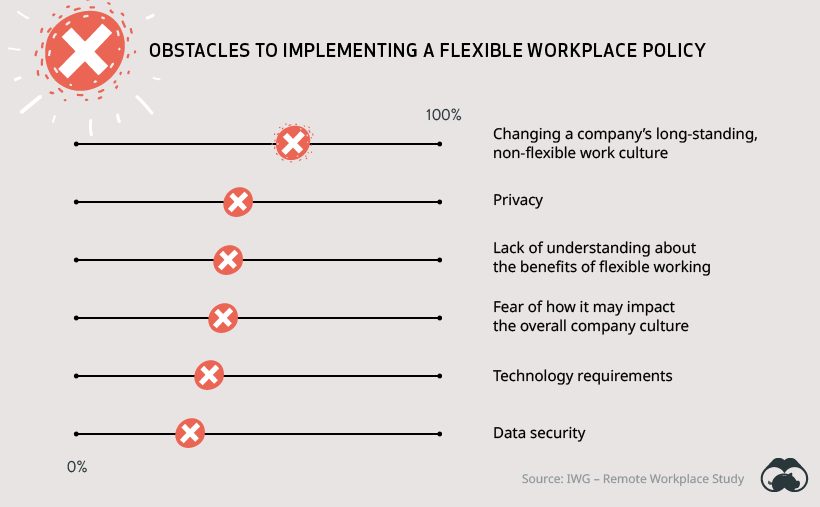
Change is not easy. Managers face many obstacles when implementing a flexible workplace policy, including:
Changing the non-flexible work culture that has always been in place
Privacy
Confusion about the benefits of flexible working
Technology requirements
Data security
Concerns of Managers of Remote Teams
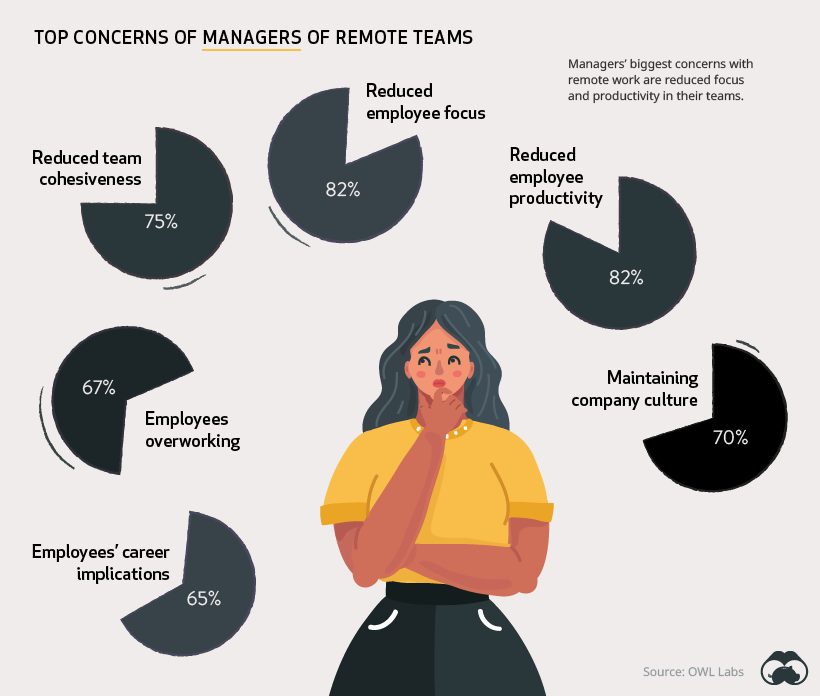
The top concerns of managers of remote teams are reduced productivity and reduced focus. These are very legitimate concerns. Not everyone is cut out for remote work and many will lack focus and not have the self-discipline to complete their jobs while working remotely.
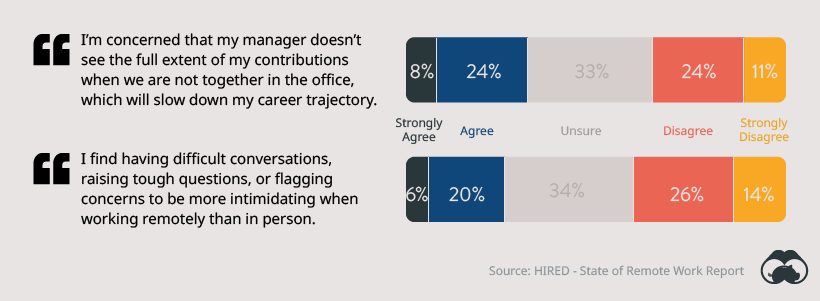
Managers also worry about the ability of the remote workers to work as a team cohesively, employees being overworked, maintaining the company culture while teams work remotely, and the implication on employees’ careers.
Attracting Remote Worker Talent
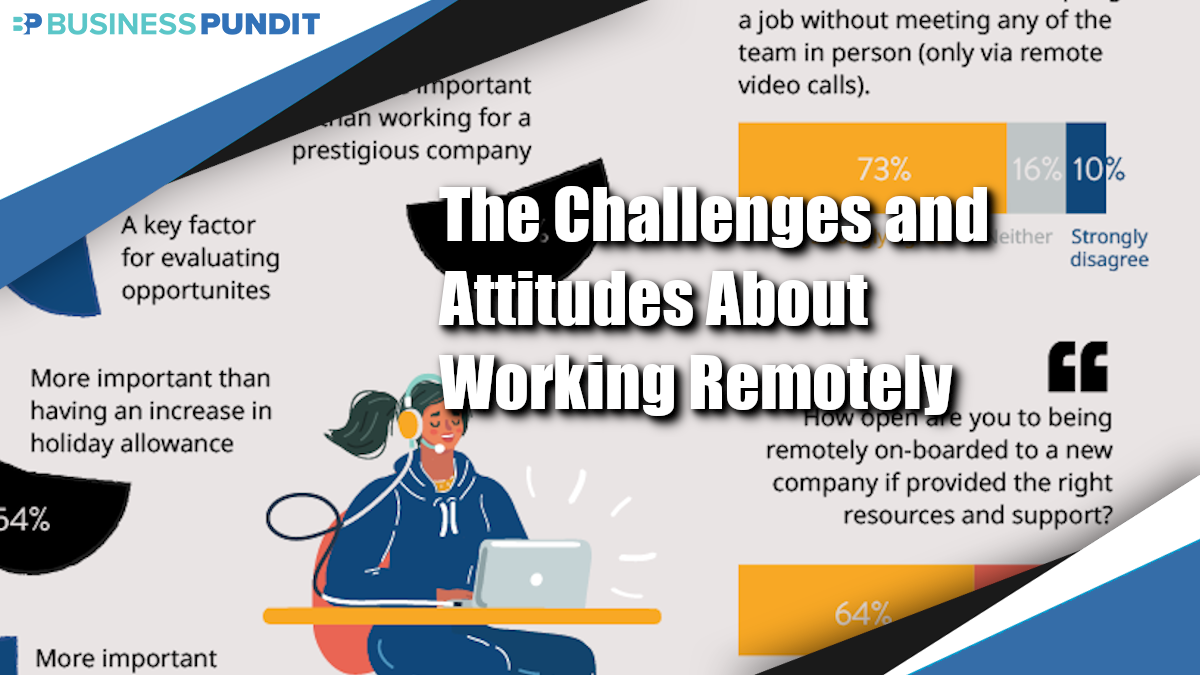
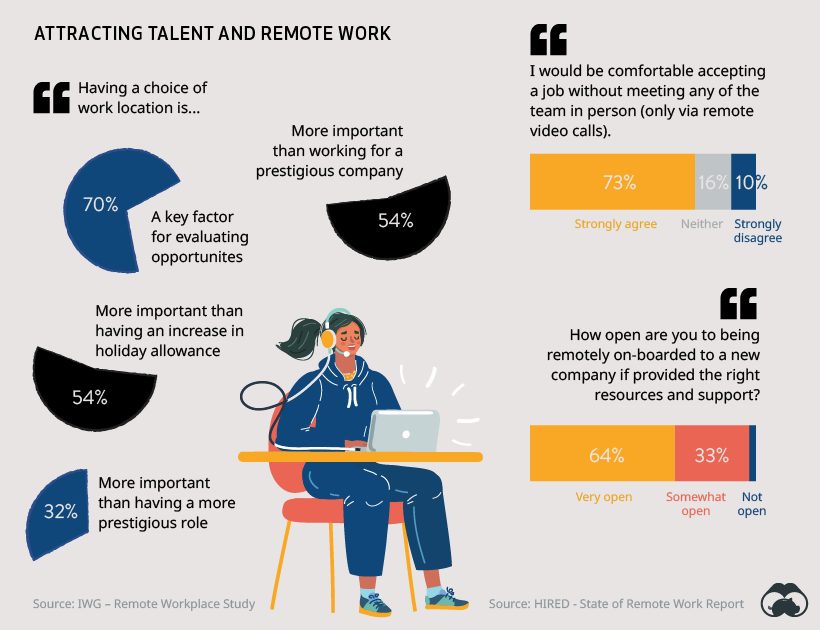
On the up side for managers is the ability to attract new talent to their companies by offering the ability to work remotely. About 70% of job seekers consider the ability to work remotely a key factor in considering job opportunities.
Most workers (73%) also would be comfortable accepting a job opportunity without meeting any team members face-to-face. 64% of workers are open to starting remote work with a new company if the right resources and support are available to them.
LOBO Systems, a global leader with its user-configurable work platform system, recently collaborated with Astroscale to create a bespoke solution. The brief was to create a system for use in a clean room environment for working at height on large satellites. – with the prime aim of allowing for a safer and more efficient working environment for the technicians involved.
LOBO provided an online product demonstration where they introduced the system, the safety aspects, its versatility and how quickly it can be assembled.
Once the requirements were outlined, LOBO designed and created a custom drawing using standard LOBO components, allowing Astroscale to visualise the system’s effectiveness.
The system included Aluminium finished Loboards (LOBO deck boards) to ensure cleanroom compatibility and wheels to ensure it could be easily manoeuvred around the facility.
One pool of kit was developed with many different platform options to ensure Astroscale could reuse the same components repeatedly around the site at each maintenance issue.
Rob Bokros, CEO of LOBO Systems, states, “It is great to see this collaboration with Astroscale at the Harwell Campus, UK. The Harwell Campus includes many LOBO customers, including Diamond Light, STFC RAL, Interserve and Mitie Magnox.”
“As soon as the enquiry came through, we knew LOBO would be the answer. This is a true testament to LOBO’s capabilities, and we’re thrilled to be able to support so many high-tech companies and key space-related companies across the different industries,” he adds.
LOBO’s vision is to reduce downtime and labour costs globally while increasing safety and productivity. Its main aim is to empower its customers by enabling them to take more control over their working environment and finances. If you have a working at height issue that you need support with, please call LOBO at +44(0)1332 365 666 / North America: 1-800-640-5492 or email: [email protected]
-ENDS-
About LOBO:
LOBO is a leader in the Work Platform industry, providing cutting-edge solutions designed to meet its customers’ needs. With a focus on innovation, LOBO constantly develops new and improved Work Platform systems that offer enhanced safety, efficiency, and versatility.
One of the critical features of the LOBO Work Platform is its modular design, which allows for quick and easy setup and takedown. This makes the LOBO Work Platform ideal for a wide range of applications, from construction and maintenance to painting and cleaning. In addition, the LOBO Work Platform is highly customisable, allowing customers to configure their work platform systems to meet their specific needs.
Put your customers at the heart of every decision. Read more to discover intent-based marketing’s impact.
For too long, digital marketers have defined customer intent in context of someone’s search behavior. And with Google processing 8.5 billion searches a day, who can blame marketers for thinking this way? This focus has served smart search marketers and content creators well. But marketers need to understand intent in context of the entire customer journey, including and beyond search. Failing to do so results in a disjointed customer experience. It’s time for marketers to understand intent-based marketing more broadly to put the customer at the center of their decision making.
Customer Intent: A Traditional Definition
In the world of digital marketing, customer intent, also known as search intent, is typically defined as the purpose of a customer when searching for queries. Those intent classifications include:
Informational: a customer seeks to learn more or find general information.
Navigational: a customer looking for information from a specific place/location.
Commercia: a customer is interested in potentially buying something and wants more information.
Transactional: a customer is ready to purchase something.
The Pitfalls of the Traditional Search Interest Definition
The above definition is common in SEO and content-marketing communities. However, it narrows our scope of view as marketers. As a result, brands make marketing decisions without the customer’s intent in mind, leaving a disjointed customer experience. What are some examples?
Trying to rank commercial product or services pages on search engine results pages when a customer wants informational content
Conquesting a competitor’s brand terms without addressing the difference between your brand and theirs
Emailing an unsegmented customer list
Making user experience decisions without A/B testing
Determining unique selling points without surveying real customers
Let’s take a step back and reconsider how we define customer intent.
How Customer Intent Should Be Defined
Customer intent should be defined as the purpose or motivation that drives any interaction with a brand. This definition allows us to put the customer’s intentions at the center of all touchpoints.
By doing so, we can classify intent in numerous ways, allowing us to get more creative with our strategy. In addition to informational, navigational, commercial, and transactional, customer intent might include:
Local: the customer is interested in finding products and/or services nearby or in a particular location.
Social: the customer wants to connect with groups of people whether that be online or in-person.
Comparative: the customer is seeking to understand the difference between two subjects, products, or products.
Entertainment: the customer is hoping to interact with interesting and engaging content whether that be copywriting, games, audio, or video.
Activity: the customer needs interactive content with a goal in mind, like quizzes or calculators for example.
Educational: the customer is looking for information to gain some type of knowledge around a particular topic. This type of intent could present itself in many ways, whether it is the subject which they are looking to understand more, they’re trying to learn more about a particular type of product or service.
Advice or help: the customer is looking for an answer to their question and/or problem. This intent may be personal such as advice on dealing with anxiety or more tactical like needing help to repair their dishwasher.
Personalization: the customer wants content tailored to their wants and needs, rather than generic information or recommendations that apply to larger groups of people.
How might we discover a customer’s intent and how can we use it to inform our digital strategies?
The answer is simple, ask them! But . . . how?
Learning More about Your Customer’s Intent
These days, there are more tools than ever to uncover customer intent. Anyone who says they don’t know how to ask a customer what they want isn’t trying hard enough.
Here are 10 ways you can gather more intel into your customer’s intent:
Send surveys via email or SMS
Enable abandoned cart surveys
Run exit-intent surveys
Create a preference center for customers with valuable fields
Reward customers for completing their profiles within their preference center
Use audience paneling to survey people that fit your target customer
Use heatmapping to understand page-level interactions like scroll depth, navigational paths, or frustration clicks
Scrape customer reviews and testimonials for unmet needs
Analyze behavioral data like Google Analytics to help define customer journey mapping
Inspect search result pages to see what type of content and results are being shown to the searcher dependent of their query (Hey, I didn’t say search interest analysis was wrong! It’s just not the only approach to intent marketing)
Once you understand your customer’s intent, map their need states to the customer journey stages. With a better understanding of intent at each stage of the funnel, you can identify gaps in your marketing strategy to serve the most relevant content and experience to your target audience.
Benefits of Intent-Driven Marketing
Intent-driven marketing is valuable because it delivers results! Benefits include:
Increased conversion rates: By targeting customers who are already interested in their products or services, businesses can expect to see higher conversion rates. This is because the marketing messages are reaching individuals who are already in the buying cycle.
Improved customer engagement: Intent-driven marketing allows businesses to deliver more relevant content and messaging to their customers, which can lead to improved engagement and loyalty.
Reduced marketing costs: By targeting their marketing efforts more effectively, businesses can reduce the amount of money they spend on marketing campaigns.
Reduced waste: Traditional marketing strategies often involve broad targeting, which can lead to wasted resources on individuals who are not interested in the product or service. Intent-based marketing, on the other hand, focuses on individuals with a demonstrated interest, reducing the waste of marketing resources.
Scalability: As businesses gather more data and refine their intent-based marketing strategies, they can scale their marketing efforts to reach a larger audience without a proportional increase in marketing costs.
Competitive advantage: By leveraging intent data, businesses can gain a competitive edge in the market. They can identify opportunities faster and respond to market changes more swiftly.
Bottom line: intent-driven marketing is more powerful marketing.
Getting Started
It can be intimidating reading advice and not knowing what the next steps are. Well, here are a few ideas to get you started on your way!
Here are some tips on how to get started with intent-driven marketing:
Define your ideal customer profile. Who are you trying to reach with your marketing messages? What are their needs and pain points? Once you have a good understanding of your profile, you can start to identify the types of content and messaging that will be most relevant to them.
Gather intent data. Please see the section above.
Create relevant content and messaging. Your ad creative, content, and messaging should be tailored to the specific needs and interests of your target audience. Be sure to address their pain points and offer solutions to their problems.
Use marketing automation to deliver personalized messages. Marketing automation platforms allow you to deliver targeted messages to your customers based on their behavior and interests. Doing so can help you to nurture leads and convert them into customers more effectively.
Similarly, segment your paid media campaigns to serve the right content at the right time of their journey.
At IDX, we have experts who can help you! Click here to learn more about our services
Stock index futures were choppy Friday following the selloff in the previous session.
S&P futures (SPX) were off slightly. Dow futures (INDU) +0.1% were up and Nasdaq 100 futures (NDX:IND) -0.2% were down.
The averages are also mixed for the week going into today’s trading. The S&P (SP500) is off 0.25%, with the Nasdaq (COMP.IND) up 0.3% and the Dow (DJI) down 0.5%.
“Generally this week it’s been a series of winners for a 60/40 portfolio but that came to a shuddering halt,” Deutsche Bank’s Jim Reid said. “Indeed on Tuesday we paraphrased the famous “just as you thought it was safe to buy bonds” line from the Jaws movie. That was a false alarm … However, the sharks have fought back with a vengeance via a bond sell-off that was made worse by a very poor 30yr auction and what was interpreted to be a hawkish Powell speech.”‘
The 30-year auction tailed by a record 5.3 basis points, pricing at 4.769%.
This morning, the 30-year yield (US30Y) rose 1 basis point to 4.79%. The 10-year yield (US10Y), which rallied the most after the auction, was up 2 basis points to 4.65%. The 2-year (US2Y) was flat at 5.03%.
Allianz Adviser Mohamed El-Erian noted the “crazy volatility in US Treasuries” is “problematic for the functioning of a broad range of markets, resource allocation throughout the economy, and the standing of the US in global finance.”
Dallas Fed President Lorie Logan and Atlanta Fed President Raphael Bostic round wrap up the blitzkrieg of Fed speakers this week. Both have spoken recently, with Logan watching to see if financial conditions are tight enough and Bostic saying policy looks sufficiently restrictive.
After the bell, the preliminary measure of November Michigan consumer sentiment arrives. The forecast is for little change at 63.7.