Home Blog Page 93

Top Growth Digital Marketing Strategies For Business in 2022

0
Top Growth Digital Marketing Strategies For Business in 2022

As we move into a new year, it’s important for businesses to start thinking about their digital marketing strategy for the year ahead. What worked well in the past may not be as effective in the coming year, and new trends are always emerging that could provide a major boost to your growth.

To help you stay ahead of the curve, we’ve put together a list of the top digital marketing strategies that we believe will be key to success in 2022 and beyond.

  1. Personalized Marketing

One of the most important trends in digital marketing is the move toward personalized marketing. This involves using data collected about your customers to create highly targeted campaigns that are much more likely to resonate with them.

There are a number of ways to personalize your marketing, such as using customer segmentation to target different groups with different messages, or using dynamic content to show different versions of your website or emails depending on who is viewing them.

  1. Omnichannel Marketing

Another big trend that businesses need to be aware of is the move towards omnichannel marketing. This involves using a variety of channels to reach your customers, such as email, social media, paid advertising, and more.

The key to success with omnichannel marketing is to create a consistent experience across all channels so that your customers know what to expect from you no matter where they interact with you.

  1. Video Marketing

Video is one of the most powerful marketing tools available, and it’s only going to become more important in the coming years. People are more likely to engage with and remember a video than any other type of content, making it a great way to promote your brand, products, or services.

There are a number of different ways to use video in your marketing, such as creating promotional videos, educational videos, video games or even just sharing customer testimonials.

ALSO READ: VIDEO MARKETING TRENDS FOR 2022: ESSENTIAL NUMBERS YOU NEED TO KNOW

  1. Chatbots

Chatbots are a type of artificial intelligence that can be used to simulate human conversation. They’re becoming increasingly popular as a way to provide customer support or lead generation, as they can automate many of the tasks that would traditionally be done by a human.

  1. Influencer Marketing

Influencer marketing is a form of online marketing that involves working with people who have a large following on social media or other online platforms. These influencers can help to promote your brand or product to their followers, which can lead to a significant increase in sales or website traffic.

  1. Content Marketing

Content marketing is a strategy that involves creating and sharing helpful or entertaining content with the aim of attracting and retaining customers. This content can take many different forms, such as blog posts, infographics, ebooks, and more.

Content marketing is an effective way to build trust and relationships with your customers, as well as to promote your brand or product in a natural and organic way.

ALSO READ: CONTENT MARKETING TACTICS THAT ALWAYS GET RESULTS

  1. Social Media Marketing

Social media marketing is the process of using social media platforms to promote your products or services. This can involve creating and sharing content, running ads, or even just interacting with your followers.

Social media marketing is an incredibly effective way to reach a large audience of potential customers, and it’s also a great way to build relationships with them.

  1. Search Engine Optimization

Search engine optimization (SEO) is the process of optimizing your website and content to rank higher in search engine results. This can lead to more website visitors, as well as increased brand awareness and traffic.

  1. Pay-Per-Click Advertising

Pay-per-click (PPC) advertising is a form of online advertising where you pay for each click on your ad. This can be an effective way to drive traffic to your website, as you only pay when someone actually clicks on your ad.

  1. Email Marketing

Email marketing is a form of online marketing that involves sending emails to potential or current customers. These emails can promote your product or service, offer discounts or coupons, or even just provide helpful information.

Email marketing is an effective way to stay in touch with your customers and keep them updated on what’s going on with your business. It can also be a great way to promote new products or services.

These are just a few of the top digital marketing strategies that you should consider for your business in 2022. By using these strategies, you can reach more customers, build relationships with them, and increase sales.

ALSO READ: WHY DIGITAL MARKETING IS CRUCIAL FOR EVERY BUSINESS

Top Growth Digital Marketing Strategies For Business in 2022
Retail Banking IT Spending Market to record USD 15.69 Bn growth — Driven by the growing need for greater customer satisfaction

0
Retail Banking IT Spending Market to record USD 15.69 Bn growth — Driven by the growing need for greater customer satisfaction
Classified in: Science and technology
Subject: MRR

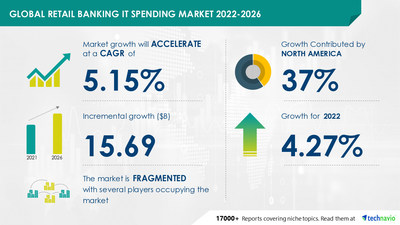
NEW YORK, Aug. 8, 2022 /PRNewswire/ — The “Retail Banking IT Spending Market by Type and Geography – Forecast and Analysis 2022-2026” report by Technavio expects the market size to grow by USD 15.69 billion between 2021 and 2026, expanding at a CAGR of 5.15% during the forecast period. The report identifies North America as the key region. The rapid growth of the banking sector is creating significant opportunities for vendors operating in the region. The report provides a comprehensive analysis of recent developments, new product launches, major revenue-generating segments, and market behavior across geographies. Download Sample PDF Report Here

The global retail banking IT spending market is fragmented, with the presence of a significant number of vendors. Key vendors hold significant shares in the market. Established vendors have strong financial abilities and technical expertise in offering innovative and quality products. They also invest a significant share of their capital in R&D and adopt organic growth strategies, such as product launches, to bring considerable differentiation in their solutions and gain high customer penetration. Small-scale vendors compete with established vendors by using low-price strategies and strengthening their local customer base. As more banks are embracing digital transformation in retail banking, this is expected to create further growth opportunities for the vendors during the forecast period.

Technavio identifies Accenture Plc, Atos SE, Capgemini SE, CGI Inc., Cisco Systems Inc., Cognizant Technology Solutions Corp., Dell Technologies Inc., Fidelity National Information Services Inc., Fujitsu Ltd., Genpact Ltd., HCL Technologies Ltd., Hitachi Ltd., HP Inc., Infosys Ltd., Intel Corp., International Business Machines Corp., Microsoft Corp., NetApp Inc., Oracle Corp., SAP SE, Wipro Ltd., and WNS Holdings Ltd. as some of the major market participants.

Although the growing need for greater customer satisfaction, increased efficiency in banking operations, and rise in autonomous banking will offer immense growth opportunities, issues related to data privacy and security, interoperability issues, and the lack of sufficient skilled labor will challenge the growth of the market participants. To make the most of the opportunities, market vendors should focus more on the growth prospects in the fast-growing segments, while maintaining their positions in the slow-growing segments. View Sample Report Here

The retail banking IT spending Market is segmented as below:

  • Type
    • IT Services
    • IT Hardware
    • IT Software

The IT services segment held the largest share of the market in 2021. The segment includes application development and maintenance, system integration, IT consulting, software deployment and support, and hardware deployment and support. The adoption of advanced technologies such as big data analytics, AI, and cloud-based computing to reduce costs and increase operational efficiencies is driving the growth of the segment.

  • Geography
    • North America
    • Europe
    • APAC
    • Middle East and Africa
    • South America

37% of the market growth will originate from North America during the forecast period. The increase in mobile banking transactions and the deployment of AI and machine learning (ML) technologies by BFSI firms are driving the growth of the regional market. Technavio presents a detailed picture of the market by the way of study, synthesis, and summation of data from multiple sources. Our retail banking IT spending market report covers the following areas:

Retail Banking IT Spending Market 2022-2026: Vendor Analysis

We provide a detailed analysis of around 25 vendors operating in the retail banking IT spending market. Backed with competitive intelligence and benchmarking, our research report on the retail banking IT spending market is designed to provide entry support, customer profile, and M&As as well as go-to-market strategy support.

Retail Banking IT Spending Market 2022-2026: Key Highlights

  • CAGR of the market during the forecast period 2022-2026
  • Detailed information on factors that will assist retail banking IT spending market growth during the next five years
  • Estimation of the retail banking IT spending market size and its contribution to the parent market
  • Predictions on upcoming trends and changes in consumer behavior
  • The growth of the retail banking IT spending market
  • Analysis of the market’s competitive landscape and detailed information on vendors
  • Comprehensive details of factors that will challenge the growth of retail banking IT spending market vendors

Related Reports:

Retail Banking IT Spending Market Scope

Report Coverage

Details

Page number

120

Base year

2021

Forecast period

2022-2026

Growth momentum & CAGR

Accelerate at a CAGR of 5.15%

Market growth 2022-2026

USD 15.69 billion

Market structure

Fragmented

YoY growth (%)

4.27

Regional analysis

North America, Europe, APAC, Middle East and Africa, and South America

Performing market contribution

North America at 37%

Key consumer countries

US, Canada, China, Germany, and UK

Competitive landscape

Leading companies, competitive strategies, consumer engagement scope

Companies profiled

Accenture Plc, Atos SE, Capgemini SE, CGI Inc., Cisco Systems Inc., Cognizant Technology Solutions Corp., Dell Technologies Inc., Fidelity National Information Services Inc., Fujitsu Ltd., Genpact Ltd., HCL Technologies Ltd., Hitachi Ltd., HP Inc., Infosys Ltd., Intel Corp., International Business Machines Corp., Microsoft Corp., NetApp Inc., Oracle Corp., SAP SE, Wipro Ltd., and WNS Holdings Ltd.

Market Dynamics

Parent market analysis, Market growth inducers and obstacles, Fast-growing and slow-growing segment analysis, COVID 19 impact and future consumer dynamics, market condition analysis for the forecast period.

Customization purview

If our report has not included the data that you are looking for, you can reach out to our analysts and get segments customized.

Table of Contents:

1 Executive Summary

  • 1.1 Market overview
    • Exhibit 01: Executive Summary ? Chart on Market Overview
    • Exhibit 02: Executive Summary ? Data Table on Market Overview
    • Exhibit 03: Executive Summary ? Chart on Global Market Characteristics
    • Exhibit 04: Executive Summary ? Chart on Market by Geography
    • Exhibit 05: Executive Summary ? Chart on Market Segmentation by Type
    • Exhibit 06: Executive Summary ? Chart on Incremental Growth
    • Exhibit 07: Executive Summary ? Data Table on Incremental Growth
    • Exhibit 08: Executive Summary ? Chart on Vendor Market Positioning

2 Market Landscape

  • 2.1 Market ecosystem
    • Exhibit 09: Parent market
    • Exhibit 10: Market Characteristics

3 Market Sizing

  • 3.1 Market definition
    • Exhibit 11: Offerings of vendors included in the market definition
  • 3.2 Market segment analysis
    • Exhibit 12: Market segments
  • 3.4 Market outlook: Forecast for 2021-2026
    • Exhibit 13: Chart on Global – Market size and forecast 2021-2026 ($ million)
    • Exhibit 14: Data Table on Global – Market size and forecast 2021-2026 ($ million)
    • Exhibit 15: Chart on Global Market: Year-over-year growth 2021-2026 (%)
    • Exhibit 16: Data Table on Global Market: Year-over-year growth 2021-2026 (%)

4 Five Forces Analysis

  • 4.1 Five forces summary
    • Exhibit 17: Five forces analysis – Comparison between 2021 and 2026
  • 4.2 Bargaining power of buyers
    • Exhibit 18: Bargaining power of buyers ? Impact of key factors in 2021 and 2026
  • 4.3 Bargaining power of suppliers
    • Exhibit 19: Bargaining power of suppliers ? Impact of key factors in 2021 and 2026
  • 4.4 Threat of new entrants
    • Exhibit 20: Threat of new entrants ? Impact of key factors in 2021 and 2026
  • 4.5 Threat of substitutes
    • Exhibit 21: Threat of substitutes ? Impact of key factors in 2021 and 2026
  • 4.6 Threat of rivalry
    • Exhibit 22: Threat of rivalry ? Impact of key factors in 2021 and 2026
  • 4.7 Market condition
    • Exhibit 23: Chart on Market condition – Five forces 2021 and 2026

5 Market Segmentation by Type

  • 5.1 Market segments
    • Exhibit 24: Chart on Type – Market share 2021-2026 (%)
    • Exhibit 25: Data Table on Type – Market share 2021-2026 (%)
  • 5.2 Comparison by Type
    • Exhibit 26: Chart on Comparison by Type
    • Exhibit 27: Data Table on Comparison by Type
  • 5.3 IT services – Market size and forecast 2021-2026
    • Exhibit 28: Chart on IT services – Market size and forecast 2021-2026 ($ million)
    • Exhibit 29: Data Table on IT services – Market size and forecast 2021-2026 ($ million)
    • Exhibit 30: Chart on IT services – Year-over-year growth 2021-2026 (%)
    • Exhibit 31: Data Table on IT services – Year-over-year growth 2021-2026 (%)
  • 5.4 IT hardware – Market size and forecast 2021-2026
    • Exhibit 32: Chart on IT hardware – Market size and forecast 2021-2026 ($ million)
    • Exhibit 33: Data Table on IT hardware – Market size and forecast 2021-2026 ($ million)
    • Exhibit 34: Chart on IT hardware – Year-over-year growth 2021-2026 (%)
    • Exhibit 35: Data Table on IT hardware – Year-over-year growth 2021-2026 (%)
  • 5.5 IT software – Market size and forecast 2021-2026
    • Exhibit 36: Chart on IT software – Market size and forecast 2021-2026 ($ million)
    • Exhibit 37: Data Table on IT software – Market size and forecast 2021-2026 ($ million)
    • Exhibit 38: Chart on IT software – Year-over-year growth 2021-2026 (%)
    • Exhibit 39: Data Table on IT software – Year-over-year growth 2021-2026 (%)
  • 5.6 Market opportunity by Type
    • Exhibit 40: Market opportunity by Type ($ million)

6 Customer Landscape

  • 6.1 Customer landscape overview
    • Exhibit 41: Analysis of price sensitivity, lifecycle, customer purchase basket, adoption rates, and purchase criteria

7 Geographic Landscape

  • 7.1 Geographic segmentation
    • Exhibit 42: Chart on Market share by geography 2021-2026 (%)
    • Exhibit 43: Data Table on Market share by geography 2021-2026 (%)
  • 7.2 Geographic comparison
    • Exhibit 44: Chart on Geographic comparison
    • Exhibit 45: Data Table on Geographic comparison
  • 7.3 North America – Market size and forecast 2021-2026
    • Exhibit 46: Chart on North America – Market size and forecast 2021-2026 ($ million)
    • Exhibit 47: Data Table on North America – Market size and forecast 2021-2026 ($ million)
    • Exhibit 48: Chart on North America – Year-over-year growth 2021-2026 (%)
    • Exhibit 49: Data Table on North America – Year-over-year growth 2021-2026 (%)
  • 7.4 Europe – Market size and forecast 2021-2026
    • Exhibit 50: Chart on Europe – Market size and forecast 2021-2026 ($ million)
    • Exhibit 51: Data Table on Europe – Market size and forecast 2021-2026 ($ million)
    • Exhibit 52: Chart on Europe – Year-over-year growth 2021-2026 (%)
    • Exhibit 53: Data Table on Europe – Year-over-year growth 2021-2026 (%)
  • 7.5 APAC – Market size and forecast 2021-2026
    • Exhibit 54: Chart on APAC – Market size and forecast 2021-2026 ($ million)
    • Exhibit 55: Data Table on APAC – Market size and forecast 2021-2026 ($ million)
    • Exhibit 56: Chart on APAC – Year-over-year growth 2021-2026 (%)
    • Exhibit 57: Data Table on APAC – Year-over-year growth 2021-2026 (%)
  • 7.6 Middle East and Africa – Market size and forecast 2021-2026
    • Exhibit 58: Chart on Middle East and Africa – Market size and forecast 2021-2026 ($ million)
    • Exhibit 59: Data Table on Middle East and Africa – Market size and forecast 2021-2026 ($ million)
    • Exhibit 60: Chart on Middle East and Africa – Year-over-year growth 2021-2026 (%)
    • Exhibit 61: Data Table on Middle East and Africa – Year-over-year growth 2021-2026 (%)
  • 7.7 South America – Market size and forecast 2021-2026
    • Exhibit 62: Chart on South America – Market size and forecast 2021-2026 ($ million)
    • Exhibit 63: Data Table on South America – Market size and forecast 2021-2026 ($ million)
    • Exhibit 64: Chart on South America – Year-over-year growth 2021-2026 (%)
    • Exhibit 65: Data Table on South America – Year-over-year growth 2021-2026 (%)
  • 7.8 US – Market size and forecast 2021-2026
    • Exhibit 66: Chart on US – Market size and forecast 2021-2026 ($ million)
    • Exhibit 67: Data Table on US – Market size and forecast 2021-2026 ($ million)
    • Exhibit 68: Chart on US – Year-over-year growth 2021-2026 (%)
    • Exhibit 69: Data Table on US – Year-over-year growth 2021-2026 (%)
  • 7.9 Canada – Market size and forecast 2021-2026
    • Exhibit 70: Chart on Canada – Market size and forecast 2021-2026 ($ million)
    • Exhibit 71: Data Table on Canada – Market size and forecast 2021-2026 ($ million)
    • Exhibit 72: Chart on Canada – Year-over-year growth 2021-2026 (%)
    • Exhibit 73: Data Table on Canada – Year-over-year growth 2021-2026 (%)
  • 7.10 China – Market size and forecast 2021-2026
    • Exhibit 74: Chart on China – Market size and forecast 2021-2026 ($ million)
    • Exhibit 75: Data Table on China – Market size and forecast 2021-2026 ($ million)
    • Exhibit 76: Chart on China – Year-over-year growth 2021-2026 (%)
    • Exhibit 77: Data Table on China – Year-over-year growth 2021-2026 (%)
  • 7.11 Germany – Market size and forecast 2021-2026
    • Exhibit 78: Chart on Germany – Market size and forecast 2021-2026 ($ million)
    • Exhibit 79: Data Table on Germany – Market size and forecast 2021-2026 ($ million)
    • Exhibit 80: Chart on Germany – Year-over-year growth 2021-2026 (%)
    • Exhibit 81: Data Table on Germany – Year-over-year growth 2021-2026 (%)
  • 7.12 UK – Market size and forecast 2021-2026
    • Exhibit 82: Chart on UK – Market size and forecast 2021-2026 ($ million)
    • Exhibit 83: Data Table on UK – Market size and forecast 2021-2026 ($ million)
    • Exhibit 84: Chart on UK – Year-over-year growth 2021-2026 (%)
    • Exhibit 85: Data Table on UK – Year-over-year growth 2021-2026 (%)
  • 7.13 Market opportunity by geography
    • Exhibit 86: Market opportunity by geography ($ million)

8 Drivers, Challenges, and Trends

  • 8.3 Impact of drivers and challenges
    • Exhibit 87: Impact of drivers and challenges in 2021 and 2026

9 Vendor Landscape

  • 9.2 Vendor landscape
    • Exhibit 88: Overview on Criticality of inputs and Factors of differentiation
  • 9.3 Landscape disruption
    • Exhibit 89: Overview on factors of disruption
  • 9.4 Industry risks
    • Exhibit 90: Impact of key risks on business

10 Vendor Analysis

  • 10.1 Vendors covered
    • Exhibit 91: Vendors covered
  • 10.2 Market positioning of vendors
    • Exhibit 92: Matrix on vendor position and classification
  • 10.3 Accenture Plc
    • Exhibit 93: Accenture Plc – Overview
    • Exhibit 94: Accenture Plc – Business segments
    • Exhibit 95: Accenture Plc – Key news
    • Exhibit 96: Accenture Plc – Key offerings
    • Exhibit 97: Accenture Plc – Segment focus
  • 10.4 Atos SE
    • Exhibit 98: Atos SE – Overview
    • Exhibit 99: Atos SE – Business segments
    • Exhibit 100: Atos SE – Key news
    • Exhibit 101: Atos SE – Key offerings
    • Exhibit 102: Atos SE – Segment focus
  • 10.5 Capgemini SE
    • Exhibit 103: Capgemini SE – Overview
    • Exhibit 104: Capgemini SE – Business segments
    • Exhibit 105: Capgemini SE – Key news
    • Exhibit 106: Capgemini SE – Key offerings
    • Exhibit 107: Capgemini SE – Segment focus
  • 10.6 CGI Inc.
    • Exhibit 108: CGI Inc. – Overview
    • Exhibit 109: CGI Inc. – Business segments
    • Exhibit 110: CGI Inc. – Key news
    • Exhibit 111: CGI Inc. – Key offerings
    • Exhibit 112: CGI Inc. – Segment focus
  • 10.7 Cisco Systems Inc.
    • Exhibit 113: Cisco Systems Inc. – Overview
    • Exhibit 114: Cisco Systems Inc. – Business segments
    • Exhibit 115: Cisco Systems Inc. – Key news
    • Exhibit 116: Cisco Systems Inc. – Key offerings
    • Exhibit 117: Cisco Systems Inc. – Segment focus
  • 10.8 Cognizant Technology Solutions Corp.
    • Exhibit 118: Cognizant Technology Solutions Corp. – Overview
    • Exhibit 119: Cognizant Technology Solutions Corp. – Business segments
    • Exhibit 120: Cognizant Technology Solutions Corp. – Key news
    • Exhibit 121: Cognizant Technology Solutions Corp. – Key offerings
    • Exhibit 122: Cognizant Technology Solutions Corp. – Segment focus
  • 10.9 Dell Technologies Inc.
    • Exhibit 123: Dell Technologies Inc. – Overview
    • Exhibit 124: Dell Technologies Inc. – Business segments
    • Exhibit 125: Dell Technologies Inc. – Key offerings
    • Exhibit 126: Dell Technologies Inc. – Segment focus
  • 10.10 HP Inc.
    • Exhibit 127: HP Inc. – Overview
    • Exhibit 128: HP Inc. – Business segments
    • Exhibit 129: HP Inc. – Key news
    • Exhibit 130: HP Inc. – Key offerings
    • Exhibit 131: HP Inc. – Segment focus
  • 10.11 International Business Machines Corp.
    • Exhibit 132: International Business Machines Corp. – Overview
    • Exhibit 133: International Business Machines Corp. – Business segments
    • Exhibit 134: International Business Machines Corp. – Key offerings
    • Exhibit 135: International Business Machines Corp. – Segment focus
  • 10.12 Microsoft Corp.
    • Exhibit 136: Microsoft Corp. – Overview
    • Exhibit 137: Microsoft Corp. – Business segments
    • Exhibit 138: Microsoft Corp. – Key news
    • Exhibit 139: Microsoft Corp. – Key offerings
    • Exhibit 140: Microsoft Corp. – Segment focus

11 Appendix

  • 11.2 Inclusions and exclusions checklist
    • Exhibit 141: Inclusions checklist
    • Exhibit 142: Exclusions checklist
  • 11.3 Currency conversion rates for US$
    • Exhibit 143: Currency conversion rates for US$
  • 11.4 Research methodology
    • Exhibit 144: Research methodology
    • Exhibit 145: Validation techniques employed for market sizing
    • Exhibit 146: Information sources
  • 11.5 List of abbreviations
    • Exhibit 147: List of abbreviations

About Us

Technavio is a leading global technology research and advisory company. Their research and analysis focus on emerging market trends and provides actionable insights to help businesses identify market opportunities and develop effective strategies to optimize their market positions. With over 500 specialized analysts, Technavio’s report library consists of more than 17,000 reports and counting, covering 800 technologies, spanning across 50 countries. Their client base consists of enterprises of all sizes, including more than 100 Fortune 500 companies. This growing client base relies on Technavio’s comprehensive coverage, extensive research, and actionable market insights to identify opportunities in existing and potential markets and assess their competitive positions within changing market scenarios.

Contact

Technavio Research
Jesse Maida
Media & Marketing Executive
US: +1 844 364 1100
UK: +44 203 893 3200
Email: [email protected]
Website: www.technavio.com/

SOURCE Technavio

These press releases may also interest you

at 21:00

LovelyWholesale (“LW” or “the Company”), an international online shopping e-commerce clothing brand, recently announced the launch of LW Basic garment collection. These basic garments are made to be more durable and environmentally friendly – an…

at 18:05

Today, Inc. revealed that Oyova is No. 4685 on its annual Inc. 5000 list, the most prestigious ranking of the fastest-growing private companies in America. The list represents a one-of-a-kind look at the most successful companies within the economy’s…

at 14:30

NUTS Technologies Inc., a data management platform empowering individuals and small businesses to protect and control their own data, was accepted into Newchip’s renowned global accelerator program. Designed to provide all the skills and tools…

at 14:17

A revolutionary PFP NFT called Throwing Dude Space Camp (TDSC) is launching in the Fall. 10,000 NFTs will be available.  TDSC features next level art, astonishing rarity, and a ground-breaking road map. Click here to join the waitlist….

at 12:00

Leading PPC agency, PPC.co is pleased to announced that it is expanding its services to include Amazon advertising management services. The move comes as Amazon increasingly becomes a key player in the digital advertising landscape. eMarketer…

at 11:00

Custom web design company, Website.Design, is pleased to announce that Website.Design is expanding its Shopify web design services to include custom Shopify application development. This move will allow the company to provide even more comprehensive…

News published on 8 august 2022 at 10:20 and distributed by:

https://www.lelezard.com/en/news-20511082.html

LGBTQ community denounces FL rule which restricts Medicaid insurance coverage for gender dysphoria treatments

0
LGBTQ community denounces FL rule which restricts Medicaid insurance coverage for gender dysphoria treatments

NEWYou can now listen to Fox News articles!

LGBTQ and health groups have denounced a new rule by Florida health officials set to take effect later this month to restrict Medicaid insurance coverage for gender dysphoria treatments for transgender people.

The Florida Agency for Health Care Administration filed the new rule this month, and it is set to take effect Aug. 21, according to online records.

The state agency previously released a report stating that puberty blockers, cross-sex hormones and sex reassignment surgery have not been proven safe or effective in treating gender dysphoria. Tom Wallace, the state’s deputy director of Medicaid, signed off on the report in June.

BILL MAHER CHALLENGES LGBTQ ORTHODOXY: ‘IT’S OK TO ASK QUESTIONS’ — ESPECIALLY WHEN IT INVOLVES KIDS

LGBTQ people in Florida are denouncing a plan which would restrict Medicaid insurance coverage for gender dysphoria treatments.

Lambda Legal, Southern Legal Counsel, Florida Health Justice Project and National Health Law Program issued a statement Thursday saying the AHCA is ignoring thousands of public comments and expert testimony by finalizing a discriminatory and medically unsound rule.

FLORIDA SCHOOL DISTRICT RESPONDS TO TRANSGENDER LAW WITH NEW REPORTING SYSTEM FOR LGBTQ STUDENTS

“AHCA’s actions, at the behest of Governor (Ron) DeSantis and his political appointees, are morally and legally wrong, as well as medically and scientifically unsound,” a joint statement from the groups said. “This rule represents a dangerous escalation in Governor DeSantis’s political zeal to persecute LGBTQ+ people in Florida, and particularly transgender youth.”

Transgender medical treatment for children and teens is increasingly under attack in many states where it has been labeled a form of child abuse and where Medicaid coverage is barred. Critics point to the irreversible nature of many elements of gender transition treatment.

WAPO, NY TIMES COLUMNS WARN OF GOP ‘BACKLASH’ AGAINST LGBTQ RIGHTS, FEAR REVERSAL OF GAY MARRIAGE

Many doctors and mental health specialists argue that medical treatment for transgender children is safe and beneficial and can improve their well-being, although rigorous long-term research on benefits and risks is lacking. Federal guidelines say gender-affirming care is crucial to the health and well-being of transgender and nonbinary children.

Last year, the American Medical Association issued a letter urging governors to block any legislation prohibiting the treatment, calling such action “a dangerous intrusion into the practice of medicine.

https://www.foxnews.com/us/lgbtq-community-denounces-fl-rule-restricts-medicaid-insurance-coverage-gender-dysphoria-treatments

Finance meme accounts are ‘driving the investor,’ Equity Animal CEO says

0
Finance meme accounts are ‘driving the investor,’ Equity Animal CEO says

Equity Animal CEO Mark Moran joins Yahoo Finance Live to discuss finance Twitter and investing-related meme accounts, increasing transparency between retail traders and corporate management, and disrupting investor relations.

Video Transcript

BRIAN CHEUNG: Welcome back to Yahoo Finance Live. Meme madness still very much in session. You can see GameStop, AMC, Bed, Bath & Beyond all ripping higher on this Friday morning. Check out Bed, Bath & Beyond up 8%. Why? We never really know. And then AMC up about 2 and 1/2% after Adam Aron tweeted a meme this morning about those Ape shares that they’re putting on the public market after that much awaited announcement earlier in the week. But we’ll keep that there for right now, continue to keep you tabs on what’s going on in the meme market.

But if you are plugged into the Fintwit world, you will have no doubt seen the litquidity account, or lit, known for its premium meme content, banker gossip, and merch. And Mark Moran, one of the minds behind that account, now going off to start his own thing in the form of Equity Animal, which hopes to bring some flair to investor relations and corporate marketing. Mark’s here on set, along with Yahoo Finance’s Alexandra Semenova, for this conversation. Mark, great to have you on the set.

MARK MORAN: Thank you so much for having me, Brian and Alexandra.

BRIAN CHEUNG: And I want to ask you just kind of about exactly what you’re doing here with Equity Animal. You have experience in the meme world and kind of bringing finance to a more accessible crowd. What are you hoping to do with this new venture?

MARK MORAN: So what we’re hoping to do here is to really disrupt investor relations entirely. It’s a very staid industry that there’s been no innovation in for the past 25, 30 years. Companies have been targeting institutional investors, really, just through traditional press releases, maybe some conferences here and there, but nothing major. What we’ve been able to do is, so while I was at Litquidity, we fell into working with RCI Hospitality Holdings. The stock ticker is RICK.

We’ve essentially turned them into a company that has a cult-like following on the internet. They have a very charismatic CEO. They’ve been overlooked by equity research for a long time and, oftentimes, misunderstood by the market. So in the three months that we’ve been working with them, we’ve almost 2 and 1/2 timed their average daily trading volume. Social mentions have gone through the roof and have really been able to show the value of this company to retail, bring in a bunch of new people, and generate awareness. So we’re looking to do a traditional IRR approach, but also blend in retail, targeting, and awareness.

ALEXANDRA SEMENOVA: Speaking of retail investors, one thing that we’ve been talking about a lot this week is earnings calls and what companies can be doing differently to make them more accessible to retail shareholders. I know you took RICK’s earnings call to Twitter Spaces. How did that go? And what should companies be doing differently in this process?

MARK MORAN: Yeah, great question. So we did do the first ever earnings call on Twitter Spaces. And so normally for an RCI earnings call, they would get 60 to 80 people. Usually, equity research analysts, no one would be able to ask questions who wasn’t one or a top shareholder. We had over 5,000 people listen in live or to the recording to the third quarter earnings call that we did last Tuesday.

And we also did a bulls versus bears debate when there was a short attack issued. And we had 16,000 people tune in live for that. So it’s something that we’re able to generate a ton of awareness, bring in more people, provide transparency for management, something retailers never had before.

BRIAN CHEUNG: So this is really interesting because, again, as you mentioned, right, the whole investor relations world is very kind of static. And so you have to dial in to some call. There’s no visual element to it. But at the same time, I imagine for any publicly traded company, they almost want it to be a little bit boring. Maybe they don’t want it to be accessible.

So when you interact with, for example, RICK– and their industry might be different than, let’s say, for example, a bank, right? But at the same time, what is the right balance? Because I’m sure that they would love to get more people engaged, but at the same time, you don’t want to meme it into a joke.

MARK MORAN: Exactly, exactly. And so how we think about it is that the companies we work with, they have to have strong management, management that can think on their feet and be able to handle questions that aren’t coming from equity research analysts. So it’s something that for us, we’re very experienced in the Fintwit world.

So my partner, Brian Hanly, he’s the CEO and founder of Bullish Studio. Through them, we have a network of 150 different creators, target about 35 million investors monthly. So we really know the ins and outs of this world and are able to kind of know who to call on, who to get questions from, and be able to orchestrate the flow of that in a professional manner.

ALEXANDRA SEMENOVA: A lot of these financial meme accounts are more than just accounts that put out funny photos. They’re actually making money on newsletters, merchandise. Can you talk about that process and how they’re monetizing on what they do?

MARK MORAN: Exactly, exactly. So for liquidity, for example, majority of the money came in through advertisements via the newsletter. The newsletter’s exact sum has about 160,000 subscribers, mostly in finance, also merchandise. You see some Bill Hwang T-shirts around. Everyone loves wearing those.

BRIAN CHEUNG: I need one, by the way.

MARK MORAN: Yeah, right, we’ll get you one after this.

BRIAN CHEUNG: Exactly.

MARK MORAN: You, too.

ALEXANDRA SEMENOVA: And a “Pls Fix” mug.

BRIAN CHEUNG: A “Pls Fix,” yeah. We need one of those. This is not doing it. This is not doing it.

MARK MORAN: Exactly, but it’s something that there’s never been humor in finance before, right? And especially for this younger generation, people who came into the market during COVID, you want to have a little fun. You want to have a little humor because it’s this community that I think is what is driving the retail investor where the, quote unquote, “smartest” guys in the room who don’t understand what’s going on, there’s a community there.

You look at AMC, Bed, Bath & Beyond. Is that going to continue to go? Not in full capacity, but it’s always going to be there because it’s just fun. If you go on Reddit, you go on Twitter, you see how these people are just there for hours a day, communicating with each other.

BRIAN CHEUNG: It’s not even just meme stocks, right? Econ data gets memed all the time.

MARK MORAN: Exactly.

BRIAN CHEUNG: But it’s kind of weird because for an industry that years ago was just like, OK, well, it’s just numbers, right, how do you make a joke out of that? Like, when you’re creating content, liquidity or not, how do you make a meme that just absolutely slaps? Like, how do you know that, like, this is the one that’s going to hit?

MARK MORAN: So, one, you have to be on Twitter 24/7. You have to be feeling the pulse of what’s going on, right?

BRIAN CHEUNG: No sleep in this job.

MARK MORAN: And not at all. Not at all, right? It’s a lot of people don’t get that part of it, Brian, but the big part is that you have to– I mean, a meme is a form of art, essentially, that’s telling a complicated story. The more layers you have to it, the more thought behind it, the better it’s going to do. And so the more experience you have creating these– I mean, I started probably two years ago back when I was a banker. Would just find some fun things to throw out there and have grown into a professional memer as I work my way up, so.

ALEXANDRA SEMENOVA: And are you going to keep at it with the memes at Equity Animal as well?

MARK MORAN: I am. When I was waiting in the lobby, I was creating a few memes, too, so definitely keeping at it.

BRIAN CHEUNG: Your drafts must be just a treasure trove of stuff.

MARK MORAN: Actually, so I don’t do drafts.

BRIAN CHEUNG: Oh, you don’t do drafts?

MARK MORAN: I just let it rip.

ALEXANDRA SEMENOVA: You just send them right off.

MARK MORAN: Yep, that’s my strategy.

BRIAN CHEUNG: You don’t have a due diligence process where–

MARK MORAN: Mm-mm.

BRIAN CHEUNG: –you have someone kind of just, like, put it on ice and look it over first?

MARK MORAN: Well, sometimes I’ll send it to friends if it could be a little controversial or pushing the boundaries, and then I’ll let it rip.

BRIAN CHEUNG: OK, well, if you ever create, like, a meme school, I would love to enroll. I’m a drafts guy.

MARK MORAN: OK, yeah.

BRIAN CHEUNG: So maybe I just– I might just not have it.

ALEXANDRA SEMENOVA: I mean, I send so many into our Slack channel. I think that I would [INAUDIBLE].

BRIAN CHEUNG: Yeah, well, Alex throws me a like every now and then, but it feels obligatory sometimes.

ALEXANDRA SEMENOVA: Yeah, absolutely.

BRIAN CHEUNG: All right, Mark Moran–

MARK MORAN: Wonderful.

BRIAN CHEUNG: –CEO of Equity Animal, as well as Yahoo Finance’s Alexandra Canal– Alexandra Semenova. Thank you so much.

ALEXANDRA SEMENOVA: You gotta get that right, Brian.

BRIAN CHEUNG: There are three Alexandras here.

ALEXANDRA SEMENOVA: It’s tough. I get it.

BRIAN CHEUNG: Alexandra Semenova, thanks so much. Appreciate it.

https://finance.yahoo.com/video/retail-trading-finance-meme-accounts-155009182.html

Should Bitcoin Replace Currency of Central Banks?

0
https://awsimages.detik.net.id/community/media/visual/2022/07/11/ilustrasi-aset-kripto-bitcoin-dan-xrp_169.jpeg?w=700&q=90

Distinction between Bitcoin and Currency of Central Banks

What is the difference between central bank authorized currency and Bitcoin? The bearer of central bank authorized currency can merely tender it for exchange of goods and services. The holder of Bitcoins cannot tender it because it’s a virtual currency not authorized by a central bank. However, Bitcoin holders may be able to transfer Bitcoins to another account of a Bitcoin member in exchange of goods and services and even central bank authorized currencies.

Inflation will bring down the real value of bank currency. Short term fluctuation in demand and supply of bank currency in money markets effects change in borrowing cost. However, the face value remains the same. In case of Bitcoin, its face value and real value both changes. We have recently witnessed the split of Bitcoin. This is something like split of share in the stock market. Companies sometimes split a stock into two or five or ten depending upon the market value. This will increase the volume of transactions. Therefore, while the intrinsic value of a currency decreases over a period of time, the intrinsic value of Bitcoin increases as demand for the coins increases. Consequently, hoarding of Bitcoins automatically enables a person to make a profit. Besides, the initial holders of Bitcoins will have a huge advantage over other Bitcoin holders who entered the market later. In that sense, Bitcoin behaves like an asset whose value increases and decreases as is evidenced by its price volatility.

When the original producers including the miners sell Bitcoin to the public, money supply is reduced in the market. However, this money is not going to the central banks. Instead, it goes to a few individuals who can act like a central bank. In fact, companies are allowed to raise capital from the market. However, they are regulated transactions. This means as the total value of Bitcoins increases, the Bitcoin system will have the strength to interfere with central banks’ monetary policy.

Bitcoin is highly speculative

How do you buy a Bitcoin? Naturally, somebody has to sell it, sell it for a value, a value decided by Bitcoin market and probably by the sellers themselves. If there are more buyers than sellers, then the price goes up. It means Bitcoin acts like a virtual commodity. You can hoard and sell them later for a profit. What if the price of Bitcoin comes down? Of course, you will lose your money just like the way you lose money in stock market. There is also another way of acquiring Bitcoin through mining. Bitcoin mining is the process by which transactions are verified and added to the public ledger, known as the black chain, and also the means through which new Bitcoins are released.

How liquid is the Bitcoin? It depends upon the volume of transactions. In stock market, the liquidity of a stock depends upon factors such as value of the company, free float, demand and supply, etc. In case of Bitcoin, it seems free float and demand are the factors that determine its price. The high volatility of Bitcoin price is due to less free float and more demand. The value of the virtual company depends upon their members’ experiences with Bitcoin transactions. We might get some useful feedback from its members.

What could be one big problem with this system of transaction? No members can sell Bitcoin if they don’t have one. It means you have to first acquire it by tendering something valuable you possess or through Bitcoin mining. A large chunk of these valuable things ultimately goes to a person who is the original seller of Bitcoin. Of course, some amount as profit will certainly go to other members who are not the original producer of Bitcoins. Some members will also lose their valuables. As demand for Bitcoin increases, the original seller can produce more Bitcoins as is being done by central banks. As the price of Bitcoin increases in their market, the original producers can slowly release their bitcoins into the system and make a huge profit.

Bitcoin is a private virtual financial instrument that is not regulated

Bitcoin is a virtual financial instrument, though it does not qualify to be a full-fledged currency, nor does it have legal sanctity. If Bitcoin holders set up private tribunal to settle their issues arising out of Bitcoin transactions then they might not worry about legal sanctity. Thus, it is a private virtual financial instrument for an exclusive set of people. People who have Bitcoins will be able to buy huge quantities of goods and services in the public domain, which can destabilize the normal market. This will be a challenge to the regulators. The inaction of regulators can create another financial crisis as it had happened during the financial crisis of 2007-08. As usual, we cannot judge the tip of the iceberg. We will not be able to predict the damage it can produce. It’s only at the last stage that we see the whole thing, when we are incapable of doing anything except an emergency exit to survive the crisis. This, we have been experiencing since we started experimenting on things which we wanted to have control over. We succeeded in some and failed in many though not without sacrifice and loss. Should we wait till we see the whole thing?

Exclusive-Malaysia’s Tenaga plans $1 billion IPO for power business, sources say

0
Exclusive-Malaysia’s Tenaga plans  billion IPO for power business, sources say

By Yantoultra Ngui

SINGAPORE (Reuters) -Malaysian electricity utility Tenaga Nasional Bhd plans to begin the process next year for a potential $1 billion listing of its power generation business, sources close to the matter told Reuters.

In what would be the country’s largest initial public offering (IPO) in a decade, TNB Power Generation Sdn Bhd, known as TNB Genco, could be valued at about $4 billion, the sources said, declining to be named owing to the confidential nature of the matter.

Proceeds from the offering will be used to grow TNB Genco’s renewable energy portfolio, they added.

Tenaga, which counts Malaysian sovereign wealth fund Khazanah Nasional Bhd as its biggest shareholder, said the company had been exploring various initiatives to boost shareholder value, including a potential listing of TNB Genco.

However, Tenaga had not made a “definitive decision in relation to these potential initiatives” and was currently focused on improving operational performance, the company said in response to a Reuters request for comment.

TNB Genco’s IPO plan comes as Malaysia’s economy grew at its fastest annual pace in the second quarter, boosted by expansion in domestic demand and resilient exports. The economy has seen strong recovery since it reopened its borders in April.

The IPO, if it materialises, would be Malaysia’s biggest since the listing of pay TV firm Astro Malaysia Holdings Bhd in 2012. The amount raised from Malaysian IPOs has risen 37% to $570 million so far this year, according to Refinitiv data.

CLEAN ENERGY

Tenaga has aimed at turning TNB Genco into a greener power generator as part of its ambition to grab a bigger share of the clean energy market, its president and CEO, Baharin Din, said in a statement on Aug. 2.

The clean energy market is estimated to be worth between 65 billion ringgit ($14.64 billion) and 80 billion ringgit in Malaysia by 2050, and Tenaga aims to have TNB Genco take 40 billion ringgit of it, he added.

The company will be looking to retire certain coal plants, and seek potential collaboration with technology partners to further the development of hydrogen as a viable clean source of energy, Baharin said.

Tenaga incorporated TNB Genco as a separate unit in August 2019 to take on its generation assets and liabilities as part of its group-wide transformation plan. TNB Genco says on its website it has a 54.3% share of Malaysia’s power generation market.

TNB Genco started operation in October 2020 and owns 10 thermal power plants, three hydroelectric schemes, two large solar farms and one port in Malaysia, according to its website. Its generating assets have a total capacity of 15,882 megawatts.

Its businesses also include operation and maintenance, repair and overhaul for energy-related industry.

($1 = 4.4410 ringgit)

(Reporting by Yantoultra Ngui; editing by Sumeet Chatterjee, David Goodman and Jason Neely)

https://news.yahoo.com/exclusive-malaysias-tenaga-plans-1-091715059.html

Barclays Hunts for Private Banking Deals Amid Singapore Rebuild

0
Barclays Hunts for Private Banking Deals Amid Singapore Rebuild

(Bloomberg) — Barclays Plc. is on the prowl for deals that will expand its business catering to Asia’s wealthy six years after largely retreating from the space.

The British lender is looking to buy assets and hire bankers to the super-rich, with a focus on Asia and Africa, Jean-Christophe Gerard, the Geneva-based chief executive of Barclays Private Bank said in an interview. The French national is fresh off a February deal in which Credit Suisse Group AG agreed to refer its private banking clients to Barclays across nine African markets.

“I’ve seen a lot of opportunities to buy globally, and it’s not just in Asia,” he said last week during a visit to Singapore, where the bank re-established a team serving super-rich clients just over a year ago. The industry is still “consolidating,” he said. Like the Credit Suisse agreement, “we can probably do others.”

Barclays’ ambition comes amid global market turmoil that has cut revenues and assets for wealth managers. Slowing economic growth, surging inflation as well as lockdowns in China have hit companies from UBS Group AG to Julius Baer Group Ltd. this year. That isn’t deterring Barclays, which is taking aim at the wealth creation trend in Asia that it sees as intact this decade and into the next, Gerard said.

“We are seeing a lot of capital flows, with family offices being set up here in Singapore,” from locations including China, Europe and India, said Evonne Tan, who was hired from UBS last year to rebuild the private bank in Singapore. “We’ve seen clients looking for opportunities to go into China during the down market.”

Singapore Focus

Customers in Singapore are also keen to invest in private equity deals and those linked to climate change and sustainability, she said in the same interview, adding the bank will continue to hire selectively.  

Tan’s team is hoping to ride on Singapore’s popularity as a choice location for the rich to set up entities managing their family wealth. About 700 single family offices have a presence there as at end-2021, a near-doubling from the year before.

The revived ambition under Barclays’ new Chief Executive Officer C.S. Venkatakrishnan marks the bank’s return to managing wealth in some of the world’s fastest growing economies after the 2016 restructuring. At that time, it sold its private banking business in Singapore and Hong Kong to Oversea-Chinese Banking Corp., as the lender wanted to focus on keeping core operations and selling under-performing units. 

Barclays’ assets under management in Singapore and Hong Kong were about $18 billion, with more than 80 relationship managers, when the sale to OCBC was announced. 

Asked whether Barclays will also return to private banking in Hong Kong, Gerard said: “We are looking at opportunities everywhere in Asia, but our current focus is in Singapore.”

Assets under management at Barclays’ private bank have been growing at a double-digit rate in the past five years, according to Gerard, who declined to give specific numbers for AUM and global headcount. The private bank, where clients can only open accounts with a minimum of 5 million pounds ($6.1 million), also operates in places like Ireland, Switzerland, Monaco, Dubai, and India.

©2022 Bloomberg L.P.


https://www.bnnbloomberg.ca/barclays-hunts-for-private-banking-deals-amid-singapore-rebuild-1.1800216

Sage launches Sage Payroll to simplify accounting, payroll and HR processes for small businesses

0
Sage launches Sage Payroll to simplify accounting, payroll and HR processes for small businesses

Sage

New solution integrates with Sage Accounting to automate payroll processes for small businesses while providing HR functionality to help business flow

TORONTO, Aug. 09, 2022 (GLOBE NEWSWIRE) — Sage (FTSE: SGE), the leader in accounting, financial, HR and payroll technology for small and mid-sized businesses, today announced the Canadian release of Sage Payroll, which integrates accounting, payroll and HR functions into a single unified platform with Sage Accounting. The new, cloud-first solution from Sage is uniquely positioned to enable small businesses, HR and accounting teams, to manage payroll and employee data in one platform with employee self-serve features, to help their business flow.

Delivering on its promise of continuous improvement and innovation, Sage has responded to customer needs to deliver a cloud payroll experience that helps solve today’s most pressing business challenges. With Sage Payroll, small business owners can pay their employees anytime and anywhere, with the platform automatically calculating the value of each employee’s individual payment based on their hourly pay or salary.

Rather than forcing small businesses and their accounting and HR teams to juggle between multiple solutions and chase after employee data, Sage Payroll centralizes employee records and automates time-consuming HR processes with ease. This helps to minimize time-wasting, manual work and human error mistakes while empowering small businesses to focus on what matters most – their people and their customers.

“For many SMBs, digital tools boost productivity and reduce cost while supporting hard-working teams to get work done more efficiently,” said Steve Ryujin, VP, Small Business Segment, Sage Canada. “With Sage Payroll, Canadian small business owners and accountants can now run their payroll, accounting, and HR processes from a single dashboard, making it easier to pay staff and track and manage HR information all in one place, to drive efficiencies and empower the workforce of today.”

And because Sage Payroll is integrated with Sage Accounting, business owners and their accounting staff need not worry about manually syncing payroll and accounting, saving them both time and effort. The software is also CRA Compliant and aligned with changing tax legislation.

Sage Payroll is designed to meet the administrative needs of Canadian small businesses. As a business grows from a sole proprietorship to a thriving company with hundreds of employees and performance targets, Sage can provide the right add-ons to accommodate every stage of their business growth.

Media Contact:

Monique Daniel
Sage
[email protected]
(905) 781-0758

About Sage

Sage exists to knock down barriers so everyone can thrive, starting with the millions of small and mid-sized businesses served by us, our partners and accountants. Customers trust our finance, HR and payroll software to make work and money flow. By digitizing business processes and relationships with customers, suppliers, employees, banks and governments, our digital network connects SMBs, removing friction and delivering insights. Knocking down barriers also means we use our time, technology and experience to tackle digital inequality, economic inequality and the climate crisis. Learn more at https://www.sage.com/en-ca/

https://nz.finance.yahoo.com/news/sage-launches-sage-payroll-simplify-130000905.html

State regulator says controversial wildfire risk map not affecting insurance rates and availability

0
State regulator says controversial wildfire risk map not affecting insurance rates and availability

The fallout over Oregon’s new state wildfire risk map continued Friday, as the state insurance regulator issued a news release attempting to reassure angry property owners that insurers are not and have no intention of using the map to make decisions about whether to insure individual homes and at what price.

He also issued a bulletin to insurance agents warning them that falsely blaming their decisions on the state’s map is against the state’s insurance code, and violators are subject to a penalty of up to $10,000.

The unusual move comes in the wake of public and political outcry following the Oregon Department of Forestry’s release of the map in June. Follow-up letters went out in July to tens of thousands of property owners warning them that their property was considered at “high” or “extreme” risk of burning and would be subject to new building code requirements and obligations to clear flammable vegetation from around existing homes and structures.

The reaction was swift and negative. Some 2,000 people sent comments to the agency, and its staff faced a raft of criticism from angry property owners at a virtual meeting attended by some 1,200 people on July 26. Many of them claimed the map was inaccurate, would require costly investments to reduce fire risks, and would impact insurance rates and availability.

With Republicans using the firestorm over the map as a political cudgel and the agency facing legitimate questions about its accuracy, State Forester Cal Mukumoto decided last week to pull the plug — withdrawing the map and suspending the risk designations for individual properties — until the map is refined.

In the news release Friday, State Insurance Commissioner Insurance Andrew Stolfi said new data collected by the Division of Financial Regulation indicates that the fears over insurance companies using the map to make decisions are unfounded.

The division put out a formal “data call” to insurers doing business in Oregon to determine if they were using or planned to use the state wildfire risk map for underwriting or rating decisions. Underwriting is the risk analysis process an insurance company goes through when issuing or renewing a policy. Rating is the pricing process.

The agency said insurers are required to answer data calls truthfully, and all responded that they don’t use the state’s wildfire map and have no plans to do so. Nor has the division received any new proposed rate filings that include the state wildfire map as a rating factor, the agency said.

“This confirms what we knew: Insurance companies are not using the state wildfire risk map,” Stolfi said in the news release. “Insurance companies have been using their own risk maps and other robust risk management tools to assess wildfire risk for years in making rating and underwriting decisions.”

Unfortunately, he added, wildfire risks have increased in Oregon. People who are canceled or non-renewed should work with an agent or contact the division’s consumer advocates if they need help.

The threatening bulletin that went out to insurance agents said consumers need accurate information about decisions made with respect to their policies.

“The insurance industry has robust data tools used to make pricing and underwriting decisions that have been in the marketplace for years,” it said. “Falsely attributing rating or underwriting decisions to the state wildfire risk map is a violation of the Insurance Code. Any person who violates a provision of the Insurance Code may face up to $10,000 in civil penalties per violation.”

Meanwhile, the Department of Forestry has no solid date for when the revised map and risk designation will be available. Derek Gasperini, a spokesman for the agency, said Friday that Doug Grafe, the state’s wildfire programs director and former chief of fire protection at agency, will be meeting with the state forester next week to establish a timeline.

– Ted Sickinger; [email protected]; 503-221-8505; @tedsickinger


https://www.oregonlive.com/politics/2022/08/state-regulator-says-controversial-wildfire-risk-map-not-affecting-insurance-rates-and-availability.html

Legislature’s Joint Finance Committee objects to Gov. Evers’ plan for $31 million opioid settlement money

0
Legislature’s Joint Finance Committee objects to Gov. Evers’ plan for  million opioid settlement money

The Legislature’s Joint Committee on Finance has delayed the Evers administration’s spending plan for $31 million in settlement funds to combat the state’s opioid epidemic.

Earlier this month, the state Department of Health Services submitted a proposal to the committee recommending how the state should use the money awarded from a legal settlement with pharmaceutical manufacturers and distributors.

The National Prescription Opiate Litigation (NPOL) settlement was reached as part of agreements that Attorney General Josh Kaul entered into settling the state’s legal claims.

DHS received its first $6 million payment on July 29 to begin using immediately, while the remaining $25 million is expected by the end of the calendar year.

Committee members had until Wednesday to anonymously object to the DHS’ plan.

Committee co-chairs state Rep. Mark Born, R-Beaver Dam, and state Sen. Howard Marklein, R-Spring Green, released a statement after the committee objected to the plan.

“Fighting the opioid epidemic has been a priority for Wisconsin Republicans for over a decade. We remain committed to ensuring our communities have the resources they need to help those with opioid use disorders and their families,” they wrote.

“We have been working with stakeholders to ensure that we are investing in impactful programs without duplicating our efforts. We will swiftly improve the plan to promptly distribute these funds to help combat the opioid crisis that continues to ravage our state.”

More: Wisconsin would receive $420 million in settlement lawmakers approved with opioid distributors

More: Wisconsin expected to receive more than $65 million in proposed resolution of Purdue Pharma case

The statement did not include specific objections or discuss alternative uses for the money.

The Joint Finance Committee will now meet to discuss the DHS proposal and the nonpartisan Legislative Fiscal Bureau will likely study the plan.

Gov. Tony Evers and Kaul slammed the committee’s decision.

“Wisconsin communities need funding to fight the opioid epidemic now,” Kaul said. “Wisconsin DOJ has fought hard and continues to fight to bring substantial resources to Wisconsin to combat the opioid epidemic, and there’s no good reason for Republican legislators to stand in the way of getting funds distributed that will save lives.”

Evers said legislators have turned their backs on Wisconsin families who are facing substance use and mental and behavioral health challenges now.

“The opportunity to invest millions into getting people treatment, support, and services does not come along every day,” Evers said. “For these legislators to turn their backs on the people of Wisconsin, especially given increases in substance misuse and the mental and behavioral health challenges our state is facing today in the wake of the pandemic, it simply defies logic.”

DHS is proposing several things for the $31 million including:

  • Investing in harm reduction by increasing the availability of NARCAN® and fentanyl test strips around the state.

  • Making investments in new and updated treatment facilities.

  • Funding for tribal nations to address the dramatic increase in opioid overdose deaths.

  • Enhancing data collection and surveillance.

  • Funding for family support centers to provide information, education, and healthy coping skills, while building resiliency, for family and friends of a person with substance use disorder.

The entire proposal is at https://www.dhs.wisconsin.gov/publications/p03288.pdf

Corrinne Hess can be reached at [email protected]. Follow her @corrihess

This article originally appeared on Milwaukee Journal Sentinel: GOP legislators object to Evers plan for $31M opioid settlement money


https://www.yahoo.com/news/legislatures-joint-finance-committee-objects-215755341.html

Top 5 Accounting Software for Small Business

0
Top 5 Accounting Software for Small Business

1) Intuit QuickBooks Accounting Software

Quickbooks is a popular full featured accounting and payroll program designed for small businesses – or, I should say, a small business accounting software series. QuickBooks is available in Basic, Online, Pro, and Premier editions; the Pro Edition of this accounting program includes management tools such as a Vehicle Mileage Tracker and a Cash Flow Projector.

2) Simply Accounting Accounting Software

Full featured accounting and payroll package with all the features and reports any small business needs, including Internet and e-commerce features. This small business accounting software’s data entry screens resemble their paper counterparts, and the screen tips and drag and drop functionality make the accounting program easy to learn. Professional versions include a time and billing module. Comes multi-user ready.

3) MYOB Plus Accounting Software

A double entry small business accounting software system with a user-friendly interface and over 100 financial and management reports. Includes a Professional Time Billing Module that is ideal for service businesses and the Officelink feature allows direct one click access to MS Word and Excel. Comes multi-user ready; just purchase an additional workstation license for each additional accounting program user.

4) Peachtree Complete Accounting Software

The Complete version of this small business accounting software program includes over 125 reports and features such as in-depth inventory, time and billing and job costing. The accounting program comes multi-user ready and “value packs” for 3 or more users are available. Peachtree accounting software is also available in Premium and First Accounting versions

5) Microsoft Office Small Business Accounting

The big selling feature of this small business accounting software is integration – and that’s a pretty big selling feature if you’re already using Microsoft Office. Being able to reuse data already entered into Excel or Outlook is a really useful feature and the integration with the Business Contact Manager makes it easy to stay on top of accounts. A slate of add-on services ranges from online payroll through PayPal invoicing

Digital marketing agency LS Digital to raise Rs 200 crore at a valuation Rs 1000 crore

0
Digital marketing agency LS Digital to raise Rs 200 crore at a valuation Rs 1000 crore

Prasad Shejale

LS Digital, initially known as Logicserve Digital is on a bullish growth trajectory.

The company recently raised Rs 80 crore from Florintree Advisors and also acquired a major stake in Langoor, a digital-first creative agency.

The digital marketing agency is now looking to raise another Rs 200 crore in series B funding at a valuation of Rs 1,000 crore.

BestMediaInfo.com spoke to Prasad Shejale, Founder and CEO of LS Digital, to get insights into their plans for the days ahead and the long-term.

According to him, the company’s vision is to go global and empower clients through digital transformation framework that includes components like media, UI/UX, creative, data and insights, customer experience and technology solutions.

Speaking about the decision to acquire a stake in Langoor, Shejale said that apart from many other business-driven reasons, the agency’s Co-founder Venugopal Ganganna is also a great friend. “Langoor is very good at customer experience. They are also very good at marketing automation which includes implementation as well as marketing campaigns. They are also very good at Web3.0 and have 7-8 meta stores and successful case studies. 80% of their business comes from export markets so that became a great matching point and that is why we got Langoor onboard.”

He further said that another company in the UI/UX category that is export-focused will also come under their umbrella by the end of August.

“There are a few more companies we are in talks with and by the end of the year, we will have them. We are also in discussion for a series B funding- with that we plan to pick up around Rs 200 crore at a valuation of Rs 1,000 crore. These funds will be used for inorganic growth in the specific areas that I have mentioned,” said Shejale.

The need to rebrand

Speaking about the need for rebranding, he said, “Our customers were anyways calling it LS Digital. So, it’s not a change for them. However, we rebranded because we are transforming into a group and that should be easier to pronounce, recollect and remember. This is a natural progression that has happened to some of the biggest brands in the world like IBM.”

Targets for LS Digital

“We are trying to grow faster than the industry and that was anyway happening for the past few years for us. We are trying to see how we can grow at least 3 times faster than the pace at which the market is growing,” he said.

“With Langoor onboard, we will be around 800 people and with the new acquisition, we will be around 1000+. This is a massive size for an Indian company, so imagine what we can get to the table for our brands and customers,” he added.

Shejale is further focusing on integrating all the companies coming onboard to reflect a great customer value to the clients. He also revealed that he is working on a book in which he plans to talk about the Digital Transformation Framework to educate people about the topic.

Challenges in the digital marketing space today

According to Shejale, a lot of brands are focusing on integrated digital solutions and companies with integrated services will win. Asked if brands trying to get different kinds of work done from different agencies is a challenge, he said that although it is very early stages, they have seen clients keen on consolidating their solutions.

“Independent/non-independent are just titles but companies that have 360-degree offerings and competencies, the right skillsets, and methodology will win accounts and help brands to grow.”  

Further enquired if the business is becoming a challenge with the number of agencies increasing and eating into the ad spends share, he said, it all depends on what the client is looking for. “Brands are looking for companies that actually have great skills. It is not about who will work for at a cheaper rate but about who will do it properly. Building yourself for all these offerings is difficult but we have the size, resources, and good market presence to build it.”

Shejale also spoke about the attrition situation in the industry. “Talent management was and has been a challenge. Yes, the industry is going through a lot of attrition problems but we are no different from anyone else.”

However, he revealed that they have a strong 45-day programme for freshers where they pick students through a unique selection process. “By the time they come out of it, they are groomed into strategizing digital transformation. This is why they stay longer with us. Having said that attrition is definitely there for everyone but I suppose our numbers are less in that area.”

“We have an open and strong training and development infrastructure in place. We are known for how we train people and encourage them. This is a differentiating factor. Now with all the platforms getting in one place, there is a lot of excitement. We are looking forward to learning a lot of stuff from the companies that are coming on board. There is a lot of excitement about being a part of the big dream,” he added.

[email protected]

https://bestmediainfo.com/2022/08/digital-marketing-agency-ls-digital-to-raise-200-crore-at-a-valuation-rs-1000-crore