Home Blog Page 27

The Qualified Family-Owned Small Business Deduction

0
The Qualified Family-Owned Small Business Deduction

If you own or invested in a Washington state small business, you want to know about the qualified family-owned small business deduction.

And here’s why: Washington state now levies a seven-percent capital gains tax on (1) the net long-term capital gains residents realize and (2) the Washington-state-y net long-term capital gains that nonresidents realize.

But if you’re a small business owner or entrepreneur? You can probably avoid the capital gains tax on the sale of a small business.  Because the law includes a qualified family-owned small business deduction.

A warning though: Washington state’s new capital gains tax is complicated. And the most complicated bit? The small business loophole you may want to use.

The Washington Capital Gains Tax in a Nutshell

But let me briefly explain how the Washington capital gains tax works. And then I’ll get into the gritty details of the qualified family-owned small business deduction (aka, the “QFOSB” deduction.)

So the big picture on this Washington capital gains tax. The state levies a seven percent tax on the net long-term capital gains an individual taxpayer realizes.

However two wrinkles here: First, the law exempts a bunch of special-case capital gains, including most capital gains on real estate, gains from selling depreciable property, and for specific industry situations. (For a complete list of the exemptions, you can refer to a blog post over at our CPA firm website: Washington State Capital Gains Tax Planning.)

And then the second wrinkle. The law provides three deductions: A standard $250,000 deduction (so the first $250,000 of gain is never taxed). A charitable contribution deduction of up to $350,000, which is an alternative to the $250,000 standard deduction. (You would use the alternative charitable deduction only if it exceeds the standard deduction.) And then a qualified family-owned small business deduction.

Note: Those amounts in the preceding paragraph get adjusted annually for changes in the Seattle-area consumer price index. The actual standard deduction for 2023, for example, should be eight or nine percent higher.

So, that’s the big picture. But you’ll need to understand the gritty details of the QFOSB deduction.

Deduction Detail #1: Gross Revenues $10 Million or Less

A first thing to know about the QFOSB deduction: To be a small business, a firm’s worldwide revenues for the twelve-month period prior to the sale or exchange need to equal $10,000,000 or less. (This value also gets adjusted for inflation. So if you’re looking at a sale in 2023? The value might be closer to $11,000,000.)

But note that the tax doesn’t look at the capital gain, as the following two examples highlight:

Example 1: George developed and patented artificial intelligence software. After several years of development, annual revenues average less than $1,000,000 a year. But a large technology company buys his business for $100,000,000. He should qualify for the full qualified family-owned small business deduction on the $100,000,000.

Example 2: George’s wife Martha starts an ecommerce business and slowly grows the business to $12 million in revenues. After George sells his business, she sells her firm in 2022 for $500,000 based on the firm’s annual profits. (Profits roughly run $200,000 a year.) Probably half of her $500,000 of capital gains, or $250,000, gets taxed. Her business? Too big to use the QFOSB deduction on her tax return.

Deduction Detail #2: Three Families or Fewer Control

The next thing to know. The QFOSB deduction only works for an interest in a family-owned business that meets, and here I use the language of the statute, one of the following characteristics:

  • An interest as a proprietor in a business carried on as a sole proprietorship
  • An interest in a business if at least 50 percent of the business is owned, directly or indirectly, by any combination of the taxpayer or members of the taxpayer’s family.
  • An interest in a business if at least 30 percent of the business is owned, directly or indirectly, by any combination of the taxpayer or members of the taxpayer’s family and at least 70 percent of the business is owned, directly or indirectly, by the members of two families or at least 90 percent of the business is owned, directly or indirectly, by the members of three families.

The Washington capital gains tax law, by the way, says a taxpayer’s family members include ancestors (so parents and grandparents of the taxpayer, for example), spouses and state registered domestic partners, lineal descendants, lineal descendants of a taxpayer’s spouse or state registered domestic partner, and finally, the spouse or state registered domestic partner of a lineal descendant. (These definitions come from Revised Code of Washington Section 83.100.046.)

Example 3: George and his wife Martha along with their good friends John and his state registered domestic partner Abigail start a small business. Initially they each own half. Later on they sell a third of the company to a venture capital fund. If they subsequently sell the business, because their two families together own less than 70 percent, they won’t get to use the QFOSB deduction. Note that had they sold the firm before raising venture capital? Yeah, they would have qualified.

One thing to note here: The new law doesn’t define what a business is. But a reasonable guess is that the definition used for federal income taxes works. For example, the Section 162 standard established in a famous U.S. Supreme Court case, Commissioner v Groetzinger, says a business is an activity conducted in pursuit of profit and carried on with regularity and continuity. (Groetzinger was a professional gambler, by the way.)

One would think that all the common business forms “qualify” for the qualified small business interest deduction: sole proprietorships, partnerships, regular “C” corporations, S corporations, LLCs operating as a proprietorship, partnership or corporation, and so forth.

But an awkward reality: We don’t at this point know for sure how the state defines a “business.” (For example, federal income tax laws say a real estate rental activity may rise to the level of a trade or business. Yet who knows how the state sees this issue.)

Deduction Detail #3: Sell Substantially All of the Business or the Interest

Another detail you need to know to assure the deduction: The business owner needs to sell at least 90 percent of her or his interest or the owners need to sell at least 90 percent of the business’s real property, taxable personal property, and intangible personal property.

Example 4:  Washington and Adams, a land surveying partnership with two owners, sells all of the assets of their business for a $1,000,000 capital gain. The two owners share the $1,000,000 equally. Assuming all the other requirements are met, each owner shelters their proportional $500,000 gains with the QFOSB deduction because they’ve sold 100 percent of the consulting business.

Example 5: Jefferson and Burr operate a law firm as equal partners. Burr wants to sell his 50 percent interest in the law firm to a young new partner, Clinton, and then retire. When Burr sells his 50 percent interest to Clinton, he realizes a $500,000 capital gains tax and he also avoids the Washington capital gains tax on  the $500,000 gain. The reason? He sells 100% (so more than 90%) of his interest in the business.

Note: The statutory and administrative guidance available from Washington state provide no guidance on whether an existing business might be split into two or more separate businesses. For example, in Example 4, could Washington and Adams split the land survey firm into two businesses—say a Virginia operation and a Massachusetts operation—prior to the sale? And then they could possibly sell substantially all of one of those businesses? I would guess this does work. And here’s why: In  the July 2023 administrative rules’ Example 11, the Department of Revenue describes how a real estate gain potentially subject to capital gains tax can be “moved” into another entity and so escape the tax.

Deduction Detail #4: Hold Interest for Five Years

The usual time frame required to receive long-term capital gain treatment on a federal and most other state income tax returns is more than one year. But to enjoy the qualified family-owned small business deduction, a taxpayer needs to have held her or his interest in the business, either directly or beneficially, for at least five years immediately preceding the sale.  And while a mere change in the form of the business doesn’t necessarily restart the five year countdown, the change in form needs to not change the proportions of any beneficial ownership interest. (This last requirement comes from page 12 of the July 2023 administrative rules.)

Example 6:  James starts a restaurant on January 1, 2020 and operates as a sole proprietor for two years. He then incorporates the restaurant and elects Subchapter S status two years later on January 1, 2022. He sells the restaurant on December 30, 2024 and realizes a $1,000,000 capital gain. Because he sells the business one day short of five years? He will pay the capital gains tax on a portion of the $1,000,000. (Partial days count as full days per the statute. So if he’d sold on December 31, 2024 or later, he could have taken the deduction.) Note that the change in the form of the business ownership—a sole proprietorship for two years and then an S corporation for almost three years—doesn’t matter because James’ ownership percentage doesn’t change when the form of the business changes.

Example 7: John, James’s brother, also started a restaurant on January 1, 2020 and then owned and operated it for a full five years, selling the restaurant on January 1, 2025. John operated the restaurant as a sole proprietorship for the first two years and then as an S corporation the remaining three years. When he elected Subchapter S status, however, he allowed his key employee to acquire a five percent interest in the S corporation. Unfortunately, he fails to qualify for the qualified family-owned small business deduction. Why? Because his changed ownership percentage in the S corporation “form” of the business restarts the five-year holding period.

Deduction Detail #5: Taxpayer or Family Materially Participates

A material participation rule exists for the QFOSB deduction: Either the individual or a family member owning the business needs to materially participate in the business for five of the ten years immediately preceding the sale unless the sale is to another member of your family.

To determine material participation, the Washington statute basically regurgitates Section 469 of the Internal Revenue Code, which says material participation means a taxpayer needs to be involved in the operations of the activity on a regular, continuous and substantial basis. And then the statute says material participation has the roughly same meaning as the Section 469 statute and its regulations. (The actual statute says, “materially participated must be interpreted consistently with the applicable treasury regulations for Title 26 U.S.C. Section 469 of the internal revenue code…” The administrative rules then soften the “consistently” requirement with a rule to “generally” apply the 469 regulations.)

But a note: The Section 469 temporary regulations provide seven methods of achieving material participation. And only the first three methods, which set time-spent thresholds (more than 500 hours a year or more than 100 hours when no one works more or substantially all of hours), appear to work well. The regulations’ other material participation methods appear not to work. Or not to work cleanly. (Two methods, for example, say a taxpayer has materially participated for federal income tax purposes even when she or he hasn’t spent any time working in the preceding five years.)

Deduction Detail #6: Document Material Participation

A related material participation thing. Material participation from any member of the family of the taxpayer apparently counts for the entire family. But surely many family-owned small business owners have not been documenting their participation.

And for a good reason: They haven’t needed to.

Internal Revenue Code Section 469 and the companion Treasury regulations use material participation to determine when individual taxpayers claim passive activity losses and use passive activity tax credits. That’s exactly the opposite of what Washington state wants. The state uses the passive loss material participation regulations to determine if individual taxpayers report taxable income.

The practical problem in this misapplication? Profitable “qualified family-owned small business” businesses probably won’t have been tracking their material participation at least before now. Because they didn’t need to. But now they should. Probably. So they can later prove material participation.

Deduction Detail #7: Consider (Reconsider?) Activity Groupings

One other wrinkle related to Section 469 material participation rules bears mentioning.

Section 469 and its companion regulations provide a way for taxpayers to aggregate their trade or business activities into larger grouped trades or businesses.

As a generalization, trades or businesses (which is what the Washington state statute appears to talk about) might qualify for the family-owned small business deduction if they meet the requirements and follow the rules described here.

But one probably needs to stay alert to the possibility that the state says activity groupings create trades or businesses for purposes of the Washington state capital gains tax.

Example 8: Years ago, for purposes of filing his federal income tax return, Andrew appropriately grouped a warehouse he owns (held in an LLC) with a distribution business he owns (in an S corporation) based on self-rental grouping rules embedded in the Section 469 regulations. Because the IRS sees these two activities as a single activity, one wonders if the Washington Department of Revenue would see them as a single trade or business. That unintended consequence would mean that Andrew would not get a qualified family-owned small-business deduction unless he sells both the warehouse and the distribution business to the same buyer.

A related thought: Even if Andrew sold both the warehouse and distribution business simultaneously, would two sales to different buyers count as a sale or exchange that disposes of substantially all of the assets? The language of the statue talks about the “sale of substantially all of the taxpayer’s interest in a qualified family-owned small business.” Not “sales” plural, then. But a singular “sale.”

And another related thought: If the Washington Department of Revenue would see an activity grouping consisting of a warehouse and  a distribution business as a single trade or business, could the business owner first sell the warehouse? (That would presumably not trigger Washington capital gains because real estate gains are exempt from the tax.) Then later, but perhaps even in the same year, the business owner could sell substantially all of the remainder of the previously grouped activities—so just the distribution business. I would guess this works. For what it’s worth.

Deduction Detail #8: Use Smart Purchase Price Allocations

Some small businesses get sold as a collection of assets: the inventory, furniture and fixtures, maybe the real estate and then the intangible personal property like the goodwill. Because some of the assets fall into exempt income categories, a seller might want to sell assets rather than the entity.

Example 9: Martin owns a small business, Van Buren Inc., that he can sell his stock in for a $750,000 gain. However, he worries he will fail to qualify for the QFOSB deduction because he can’t confidently prove his material participation. Thus, by selling this stock, he might pay the seven percent tax on $500,000 of the gain (assuming the 2022 $250,000 standard deduction). Alternatively, in an asset sale, he can sell the inventory for a $100,000 gain (not taxed because inventory is not a capital asset), sell the depreciated furniture and fixtures for a $200,000 gain (statutorily exempt from the Washington capital gains tax), sell the real estate for a $200,000 again (again, statutorily exempt), and thus completely avoid the Washington capital gains tax.

Note: Some practitioners wondered how the Department of Revenue would handle purchase price allocations. And the July 2023 rule proposals provide helpful guidance. The proposed rules say that taxpayers can use full appraisal reports, assessor valuation if the assessment date closely matches the sale or exchange date, or the purchase price allocation the seller and buyer use to comply with IRC Section 1060. Predictably, the Department of Revenue reserves the right to change or modify what it views as an inappropriate allocation.

Deduction Detail #9: Consider Domicile of Owners

A Washington state domiciliary (basically what tax law usually thinks of as a resident) pays taxes on essentially all of her or his net long-term capital gains. (I’m ignoring the credit for taxes paid to another state if some net long-term capital gains get sourced outside Washington.)

For nonresidents, however, only tangible personal property sold or exchanged from a location in the state gets hit with the Washington capital gains tax.

Tangible personal property, per the administrative rules means “personal property that can be seen, weighed, measured, felt or touched”. Tangible personal property, then, does not include an interest in a partnership or shares of a corporation. Thus, an out-of-state small business owner might optimize by selling her or his interest in the partnership or the corporation instead of having the partnership or corporation sell its assets.

Example 10: Martin’s wife Hanna, also owns a small business, Hannah Hoes Corporation. After Martin sells his business, he and his wife move to Nevada. And then, after establishing residency there, Hannah sells her interest in her Washington corporation for a $1,000,000 gain. She avoids Washington capital gains tax.

Deduction Detail #10: Avoid Section 338(h)(10) Treatment

The modest guidance from the Department of Revenue, at least at the time we’re writing this, suggests to us that taxpayers might want to avoid common but more complex transaction structures.

As one example of this, I’d think a taxpayer wants to avoid applying Section 338(h)(10) to a qualified stock purchase transaction. Section 338(h)(10), by the way, treats a sale of stock as a sale of assets. The issue with Section 338(h)(10) is, one might not know how to handle the transaction on a Washington capital gains tax return.

Deduction Detail #11: Reconsider Section 754 Elections

A technical point.

I’m not necessarily a fan of making Section 754 elections. (The work required to make the election and then the resulting annual tax return adjustments often exceeds the tax savings.) However, taxpayers and their tax advisors probably want to reconsider Section 754 elections for appreciated property held inside a partnership at the time when a partner dies and receives a Section 1014 step-up in basis.

The reason? The step-up in basis may eliminate, or at least minimize, a taxpayer’s long-term capital gains. And that will probably eliminate or minimize Washington state’s taxation of long-term capital gains.

Deduction Detail #12: Consider Using Trust or Estate Ownership

A final, weird tangential comment: The list of pass-through entities which confer beneficial ownership for an individual excludes estates as well as trusts other than grantor trusts. That means if a nongrantor trust or estate realizes a long-term capital gain, the individuals who are beneficiaries of the estate or trust don’t pay the seven percent tax.

Thus, some small business owners may want to move an interest in a small business into a trust or sell an interest held in an estate before realizing the gain. (This gambit also works for capital assets other than interests in small businesses.)

Additional Resources for Qualified Family-Owned Small Business Deductions:

As noted earlier, we’ve got a “general” blog post over at the CPA firm website that discusses the mechanics of the Washington state capital gains tax including some common tax planning tactics: Washington State Capital Gains Tax Planning

The actual statute appears here: https://lawfilesext.leg.wa.gov/biennium/2021-22/Pdf/Bills/Senate%20Passed%20Legislature/5096-S.PL.pdf?q=20210426052154

The most recent July 2023 draft of the administrative regulation appears here: https://dor.wa.gov/sites/default/files/2023-06/20-XXXcr1frmdraftjune23.pdf?uid=64aac2f8dc5d9



Grouping Activities to Achieve Material Participation

0
Grouping Activities to Achieve Material Participation

This week, a quick discussion of grouping activities as backdoor way to materially participate.

But first a bit of background about what material participation is and why it matters. And then I’ll talk about how grouping activities sometimes makes a giant difference on your tax return.

Why Material Participation Matters

Okay, so here’s the main thing: You can’t deduct losses from a business venture or hands-on investment except if you materially participate in the activity.

Example 1: Two brothers, Pete and Tom, invest in a new venture. Say a restaurant. The brothers agree to each invest $100,000 and will proportionally share the losses and the profits. Tom will also receive a salary from working in the business. Pete won’t work in the business. He’s keeping his regular job. If the first year, the business loses $100,000, each brother suffers a $50,000 loss. Tom, because he materially participates, can deduct that loss on this tax return. Pete, because he doesn’t participate at all, can’t.

That’s the  basic concept.

The Seven Material Participation Recipes

Next question: How does someone materially participate? Well, tax law provides seven recipes:

  • You spent more than 500 hours on the activity.
  • You spent more than 100 hours but nobody else spends more time.
  • In essence? You were the only person who spent any time in the activity.
  • You spent more than 100 hours in the activity, also spent more than 100 hours in some other activities, somehow fail to materially participate in any of these activities using some other recipe, but in total, your hours spent in all of these “significant participation activities” exceed 500 hours.
  • For five of the last ten years, you materially participated (for example, using more than 500 hours recipe) .
  • You materially participated in a personal service activity for any three years. (Again, for example, by spending more than 500 hours those years.)
  • You’ve been involved in an activity on such a “regular, continuous and substantial basis” that you material participated even if one of the other six material participation recipes doesn’t work. (This is an impractical recipe. Too vague. Please don’t think you can use it.)

And one important wrinkle to this discussion for married people. Spouses combine hours to determine material participation. For example, if two spouses each spend 300 hours, the total material participation hours equals 600 hours.

Grouping Activities: Backdoor Material Participation

If you don’t materially participate using one of those seven recipes just listed, however? You have one other gambit you can maybe use: Grouping activities.

The best way to understand grouping is to copy and paste an example from the relevant Treasury regulations at 1.469-4(c)(3):

Example 2: Taxpayer C has a significant ownership interest in a bakery and a movie theater at a shopping mall in Baltimore and in a bakery and a movie theater in Philadelphia. In this case, after taking into account all the relevant facts and circumstances, there may be more than one reasonable method for grouping C‘s activities. For instance, depending on the relevant facts and circumstances, the following groupings may or may not be permissible: a single activity; a movie theater activity and a bakery activity; a Baltimore activity and a Philadelphia activity; or four separate activities. Moreover, once C groups these activities into appropriate economic units, paragraph (e) of this section requires C to continue using that grouping in subsequent taxable years unless a material change in the facts and circumstances makes it clearly inappropriate.

I boldfaced key part of the copied text above. But let me summarize how I think you read this. A taxpayer invested in and works in four activities. Possibly she or he doesn’t materially participate in an activity at least using one of the usual recipes. But the taxpayer can combine activities in any reasonable method. And once activities get aggregated? Probably, the taxpayer does materially participate.

For example, maybe the taxpayer in Example 2 doesn’t qualify as materially participating in the bakery in Philadelphia. And maybe she doesn’t qualify as materially participating in the bakery in Baltimore either. But if she or he combines the Philadelphia bakery with the Baltimore bakery? Maybe that works.

Rules for Grouping Activities

As noted earlier, you can use “any reasonable method.” The Treasury regulations flesh out what that means. And they provide some logical instructions.

You need to look at all the relevant facts and circumstances. Further, a logical handful of factors should be given the “greatest weight” in determining whether it’s reasonable to treat “more than one activity as a single activity:”

I’m going to again copy and paste the actual language from the regulations. (See the bulleted list below.) But think about how these apply to the fictional business owner with bakeries and movie theaters in Baltimore and Philadelphia.

  • Similarities and differences in types of trades or businesses
  • The extent of common control
  • The extent of common ownership
  • Geographical location; and
  • Interdependencies between or among the activities (for example, the extent to which the activities purchase or sell goods between or among themselves, involve products or services that are normally provided together, have the same customers, have the same employees, or are accounted for with a single set of books and records).

Limitations on Grouping Activities

Because grouping activities is so potentially powerful, limitations exist.

You can’t group a rental activity with a non-rental trade or business except in usual situations. (We’ve described those situations in another blog post here: A Dozen Ways to Deduct Passive Losses. But the common exception to this limitation: You can ignore this limitation when one of the activities is insubstantial in relation to the other. Another common exception: Self-rental situations.)

You can’t group real property rentals with personal property rentals.

You can’t group limited partner and limited entrepreneur activities except when the activities are in the same type of business. (This limitation applies to farming; movie and video production, distribution and holding; leasing Section 1245 property (so mostly depreciable personal property); oil and gas exploration; and geothermal exploration.)

But other than these limitations? In many cases, business owners should be able to group activities to achieve material participation. If they need to.

Grouping Activities Paperwork

You or your tax advisor need to add some paperwork to your tax return to group activities. For example, you include a grouping election with the first tax return you combine activities.

If facts and circumstances change and the original grouping no longer makes sense? You regroup and disclose that action on the first affected tax return.

If you haven’t made a grouping election but should have? Yeah, you should talk to your tax advisor about that. Typically, you can make a “backdated” grouping election.

One predictable and fair caveat?  The IRS may regroup activities if (1) a group is “not an appropriate economic unit” and (2) a “principal purpose” of the grouping was to “circumvent” Section 469’s passive loss limitation rules.

Crazy Grouping Activities Examples That Work

Let me share three example groupings that probably work.

Example 3: A contractor works full-time in his own construction business. His spouse spends 50 hours a year on a short-term rental business—which tax law doesn’t consider a rental activity. But the short-term rental housekeeper spends 80 hours a year. Thus, without grouping the businesses? The taxpayers can’t deduct short-term rental losses. However, if the couple groups the activities, they achieve material particpation. Note that it should be reasonable to group these activities. In addition to the common ownership and control, the husband maybe does construction and repair work in both activities. And then the wife may do the accounting in both activities.

Example 4: A real estate broker qualifies as a full-time real-estate professional, and also spends 75 hours per property per year managing two rental properties. But if he uses separate landscapers for each property and the two landscapers each spend 100 hours a year? He doesn’t materially participate and won’t be able to deduct rental losses. Unless he groups. And in that case, bingo, he material participates. Because his 150 hours exceeds the 100 hours spent by either of the landscsapers. (As mentioned earlier, you can’t group his real estate sales activity with the rental activity.)

Example 5: A taxpayer rides horses professionally (one activity) and operates an interior design business that specializes in equestrian-themed home interiors (another activity). Very possibly, she can group the horseriding with the interior design. Risk exists here that the IRS might see the horse business as a hobby, something I discussed here: What Ms. Topping Learned. But ignoring the hobby loss issue, if someone owns and operates two businesses that together create synergies? Grouping might be reasonable. (Be sure to consult your tax advisor if you want to try something like this.)

A Final Caution Here

And let me end with a caution. The IRS regularly rejects taxpayers grouping an airplane business with another business. Which maybe doesn’t seem to matter to you if you don’t own an airplane. But the rejected airplane activity groupings highlight a risk.

The pattern that seems to show up when the IRS removes an airplane business from grouping? Common ownership and control isn’t enough. You need more than that. You want interdependencies or similarities in the activities. Probably some synergy. And then you don’t want huge differences in the activities. (Grouping a doctor’s office with an airplane charter, for example? Yeah, that’s stretch.)

Other Related Resources:

Real Estate Professional Audits

Surviving Short-term Rental Audits


19 Agency Leaders’ Top Platforms For Reaching Top-Of-Funnel Audiences

0
19 Agency Leaders’ Top Platforms For Reaching Top-Of-Funnel Audiences

With a multitude of options available, marketers are constantly grappling with the question: Which platform will not only reach, but also resonate with potential customers who are just starting their buyer’s journey?

Below, 19 Forbes Agency Council members share their favorite platforms for finding target audiences and supercharging top-of-funnel marketing efforts. Whether you’re a seasoned marketer seeking new insights or a beginner just starting to navigate the digital marketing realm, these expert tips can help steer your brand toward successful top-of-funnel engagement.

1. Facebook And Google Ads

Facebook and Google Ads are often effective for top-of-funnel audiences. The choice depends on your goals and audience: Use Google for intent-based searches and Facebook for demographic targeting and broad reach. – Muhammad Eltiti, BOOST

2. Connected TV

There is nothing more persuasive than a well-crafted story to capture the attention of viewers. With programmatic connected TV delivery, we control where, when and to whom the video will be served for the greatest impact. Pair a CTV plan with some creative display and mobile retargeting, and you have the best of both worlds. – Rosie Walker, Mediate.ly

3. YouTube And Facebook

YouTube and Facebook are our favorite platforms for building top-of-funnel awareness. We like these platforms because we can plug our own first-party data into them to generate strong lookalike audiences while using video as our breakout medium. These platforms allow us to either amplify or echo our message based on levels of engagement. We’ve found this to be effective at penetrating our niche. – Austin Irabor, NETFLY

4. Podcast Guesting

For B2B and B2C, podcast guesting is amazing for reaching top-of-funnel audiences. Podcast guesting is where you, as an expert, get invited to speak on someone else’s video or audio podcast. There are five million podcasts in the world today that have spent time nurturing and growing their communities. With podcast guesting, it’s plug-and-play to connect and build awareness. – Ivana Johnston, Puzzle Partner Ltd.


Forbes Agency Council is an invitation-only community for executives in successful public relations, media strategy, creative and advertising agencies. Do I qualify?


5. Deterministic Intent Data On Any Platform

Deterministic intent data offers a powerful way to supercharge how you reach and engage audiences at the top of the funnel—on any platform. It allows you to reach decision makers who may already have an interest in a product or service like yours (based on their digital activity, such as online searches or clicks across various websites), enabling you to get to conversion faster. – Paula Chiocchi, Outward Media, Inc.

6. Sponsorship Platforms

For B2B companies with niche audiences, leveraging trade shows’ and industry organizations’ sponsorship platforms to get access to their lists is a great place to start. Then, create hyper-targeted lookalike audiences to layer on top of the list information, and you can make your top-of-funnel efforts really effective. – Jill Whiskeyman, Simpatico Studios, LLC

7. The Trade Desk

The Trade Desk is the most robust platform for top-of-funnel activation through display, connected TV, native and more. The targeting options are endless with their third-party data segments, and the data you get out of TTD about your own first-party audiences can enhance your media strategy across all platforms. It’s a great platform for brands who want to go beyond the classic digital media mix. – Courtney Hiller, All Points Social

8. LinkedIn

The top platform for top-of-funnel engagement is LinkedIn, all day long. Know the algorithms, capitalize on them, showcase your best thought leadership, use the right hashtags and do paid amplification of your most successful posts to strategically push them into the feeds of prospects who otherwise might not know about your brand. – Jodi Amendola, Amendola Communications

9. Google Autocomplete

Our favorite platform for reaching top-of-funnel audiences is Google Autocomplete, a new search engine optimization technique for predictive searches in a search engine’s search box. It positions your brand favorably and eliminates your competition because users perceive that the search engine recommended your organization, and upon clicking, their organic search results are only about your organization. – Jason Mudd, Axia Public Relations

10. X (Formerly Twitter) And LinkedIn

I am a big fan of using X (formerly Twitter) and LinkedIn for top-of-the-funnel audiences; but in different ways. For example, using X to initiate conversations, gauge interest or ask questions can help you drive the engagement you need to get data on what to build out further. Using LinkedIn to then elaborate on that top-of-funnel interest can then bring them further into the funnel, even if at the top! – Vanhishikha Bhargava, Contensify

11. Public Relations And Content Marketing

PR and content are twin pillars for top-of-funnel success. PR is the art of storytelling on a grand stage. Its significance for top-of-funnel engagement is to build credibility and trust while offering massive reach and third-party validation. Meanwhile, content marketing provides educational value, trackable audience engagement and SEO benefits. – Lars Voedisch, PRecious Communications

12. Broadcast And Streaming Radio And TV

The best platform for reaching top-of-funnel audiences is really dependent on who you are trying to reach and what you are trying to achieve. With that said, generally, vehicles like broadcast TV, radio and their streaming counterparts can be effective for driving broad awareness, while premium digital destinations or influencers can be strong drivers of engagement early in the consumer journey. – Christa Chavez, À La Carte Media Consulting

13. Programmatic Media

Programmatic media is ideal for reaching top-of-funnel audience segments, as you’re able to define who your audience is and reach them where they are across a variety of channels. Leveraging a mixed media strategy, you can manage and optimize touch point frequency across CTV, display (including Meta) and audio to effectively drive awareness and desired audience engagement down the funnel. – Larry Gurreri, Sosemo LLC

14. Guest-Contributed Content

Since I’m in the B2B space, I reach top-of-funnel audiences by guest posting and contributing content to high-profile websites. I tend to link to a lead magnet so that I can nurture prospects with email marketing. – Kristen DeGroot, The Campfire Circle

15. Meta Ads And TikTok

When it comes to media buying, Meta ads are still the preferred method for top-of-funnel audience building. Brands can still move their top-of-funnel audiences through the funnel down to the bottom, ultimately leading to conversion. Utilizing TikTok properly is the best way to go viral. However, if it is not implemented as a part of a holistic strategy, it may not have the impact you’re looking for. – Revecka Jallad, DIVISA

16. Amazon DSP To Engage Buyers

My preferred platform for reaching top-of-funnel audiences is Amazon DSP. It provides unmatched precision targeting and extensive reach, enabling brands to engage potential customers early in their buying journey, thereby increasing brand awareness and driving growth. Trust me—Amazon “knows” all about you, so why not leverage that data to help grow your brand? – Denny Smolinski, beBOLD Digital

17. Instagram

I still think Instagram is the top-of-funnel king for its versatility as a platform and for how consumers utilize it. You can spread awareness, initiate conversations, get shared, find leads, build community, highlight others and so much more. The depth of the platform brings in so much from so many different avenues, and this is what makes it my go-to top-of-funnel source for the majority of industries I work with. – Tony Pec, Y Not You Media

18. Speaking At Conferences And On Webinars

As a medical marketing agency, our target market is physicians. We find the best way to fill the top of the funnel is through speaking engagements at medical conferences and on webinars. This builds instant authority and gets our company in front of large groups of physicians who are eager to learn how to grow their practices with digital and community marketing. – Lori Werner, Medical Marketing Whiz

19. Long-Form Content

One of our favorite platforms for reaching top-of-funnel audiences is long-form, optimized content aligned with search intent. This ensures that we’re connecting with them at the precise time that they are seeking information and answers. By capitalizing on long-form content specifically, we’re able to go deep, drive engagement, build trust and deliver a great experience. – Tom Shapiro, Stratabeat

Newport Family and Cosmetic Dentistry to host its 2nd Annual Veterans Day Free Dental Clinic on Nov. 10

0
Newport Family and Cosmetic Dentistry to host its 2nd Annual Veterans Day Free Dental Clinic on Nov. 10

Newport Family and Cosmetic Dentistry, a Veteran-led dental care provider on Aquidneck Island, today announced today that they will host their 2nd annual Veterans Day Free Dental Clinic on November 10.

On this day, Newport Family and Cosmetic Dentistry say that they will be offering complimentary dental services to veterans as a token of our gratitude for their service and sacrifice.

  • Date: Friday, November 10, 2023
  • Time: 9:00 am – 3:00 pm
  • Location: 136 Broadway, Newport, RI  02840

“Our team of experienced and compassionate dental professionals is committed to giving back to the community and supporting those who have selflessly served our nation. As we did last year, when we were able to help 25 patients, we aim to make this year’s event even more impactful,” Newport Family and Cosmetic Dentistry says in a press release.

The services provided at our Veterans Day Free Dental Clinic include:

Why Bonds Matter for Your Portfolio

0
Why Bonds Matter for Your Portfolio

A couple of times recently, I’ve encountered people who argue you or I should not invest any part of a portfolio in bonds. Or who argue only a small percentage of a portfolio should go into bonds.  Except if we’re retired. Or close to retirement.

But can I challenge that idea? Argue (politely) bonds matter in some cases? And then because it’s pretty obvious to me a number of vocal investors and even investment advisors don’t understand the math? Would it make sense to quantitatively show both how bonds help and hurt? I think so. So let me keep going…

The Big Bond Misunderstanding

I’m not absolutely sure about this. But in discussing with many investors why bonds don’t belong in an investment portfolio, two facts seem to be what “bond haters” focus on.

First fact? That over time, the average return on equities adjusted for inflation equals roughly 7% while the average return on bonds adjusted for inflation equals about 2%.

Note: I calculated these returns using cFireSim.com and Microsoft Excel on August 21, 2023. At that time, the actual average real return of an all-stocks portfolio equaled 6.64%. The actual average real return of an all bonds portfolio equaled 2.14%.

Second fact, that while stock prices and returns swing wildly from year to year, the variability dampens down over time. (This is true.) And this fact is often followed by a half-fact. If you can just hold stocks long enough, you win. (This is often the case but not necessarily true.)

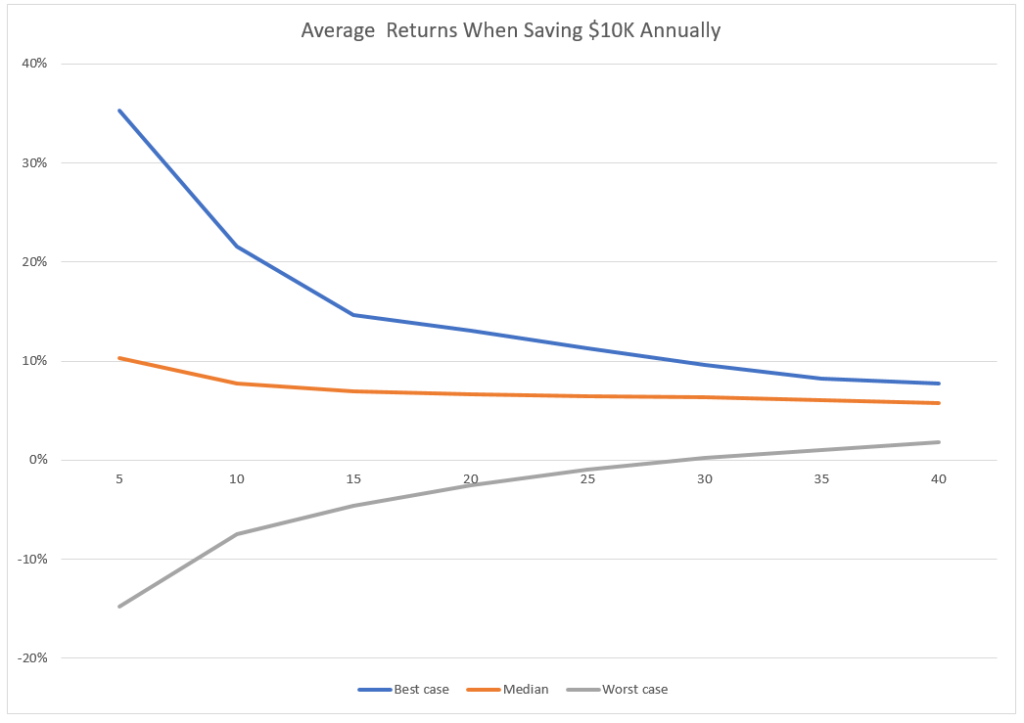
Often if some writer is talking about this “all stocks” strategy, she or he includes a chart that shows how as time passes the annual return on stocks “reverts to the mean.” Or “averages out.” Here’s a crude version of one these charts I whipped up for another blog post, Unreliability of Long-run Stock Market Returns.

Picture of long return stock market return chart
Figure 1

But chart above fosters a misunderstanding: We aren’t guaranteed to earn that better average return on stocks if we just hold on long enough. Yes, you or I will probably get a better result from an all-stocks portfolio. But we won’t for sure “guaranteed” get that.  A significant chance also exists we’ll lose money with an all-stocks portfolio as compared to a balanced portfolio that includes stocks and bonds. Or that we’ll more likely run out of money in retirement if we use an all-stocks portfolio.

Because of this reality, some people probably want to include bonds in their portfolios. Who? People willing to trade away the higher upside from stocks and the likely higher average return for dodging some worst-case scenarios.

But Stocks Always Beat Bonds Right?

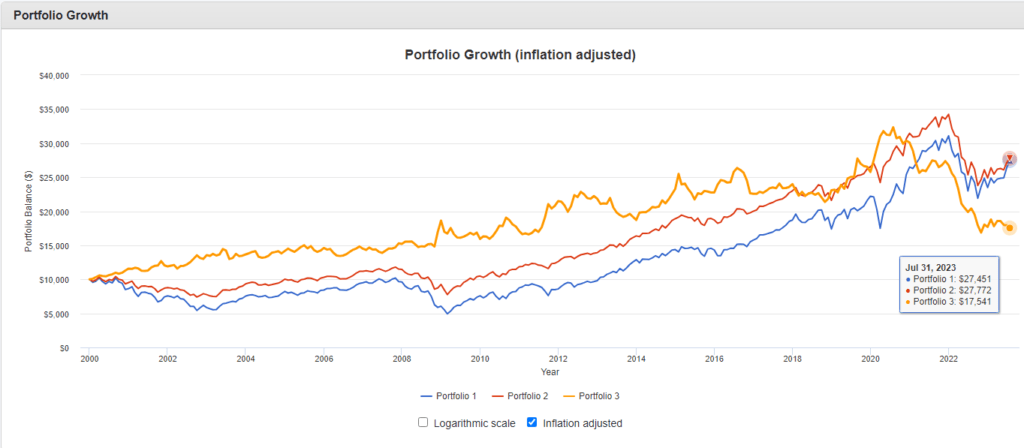
I’m going to get pretty gritty about the details in a few paragraphs. But before I do that? Let me first show graphically a very recent example where an all stocks portfolio loses compared to a balanced portfolio which holds 70 percent in stocks and 30 percent in U.S. Treasury bonds. Figure 2 below shows a line chart the Portfolio Visualizer Backtest Portfolio tool draws for three example portfolios. The blue line shows a 100 percent allocation to US stocks. The red line shows a 70 percent allocation to US stocks and a 30 allocation to US long treasuries. And the yellow line shows a 100 percent allocation to US long treasuries.

Bonds matter if they reduce risks of all stock portfolios
Figure 2

Two observations. First, if you started in 2020, over the next two decades, an all-stocks portfolio (the blue line above) performed more poorly than an all bond portfolio (the yellow line above). The all stocks portfolio only catches up in year 21. (This shows in the chart when the yellow line crosses the blue line.)

Second, even after more than 22 years? A balanced portfolio (the red line) beats the all stocks portfolio (again the blue line). No, you’re right. The all stocks portfolio may be ahead at year 25. Or year 30. (I hope it will be. I’m personally allocating 30 percent to US stocks.) But the line chart shown above doesn’t prove that if you or I just hold stocks long enough, we always win. In fact, it hints the opposite.

Note: If you use US intermediate treasury bonds rather than US long treasury bonds, the all-stocks portfolio looks better. But not much. And the intermediate treasuries still do reduce your downside risk over a couple of decades.

Calculating Downside Protection from Bonds

You can use another Portfolio Visualizer too, its Monte Carlo simulator, to assess example effects of adding bonds to your portfolio. Specifically, you can use that tool to get an idea as to how much upside risk you give away by adding bonds, how the average return probably shrinks by adding bonds, and then how the downsize risk probably lessens by adding bonds.

Just follow these steps, for example, to assess the downside risk avoided by adding bonds:

  1. Enter https://www.portfoliovisualizer.com/monte-carlo-simulation into your web browser’s address box.
  2. Set the Cashflows drop-down list box to “No Contributions or Withdrawals.”
  3. Verify the Simulation Model drop-down list box shows “Historical Returns.”
  4. Open the Intervals drop-down list box, and select Custom. Portfolio Visualizer adds two new text boxes: Percentile Intervals and Return Intervals.
  5. Edit the Percentile Intervals values to show 1, 5, 10, 20, 30.
  6. Set the Asset 1 drop-down list box to “US Stock Market.”
  7. Enter 100 into the Asset 1 Allocation text box.
  8. Click Run Simulation.
  9. Check the Inflation Adjusted box.

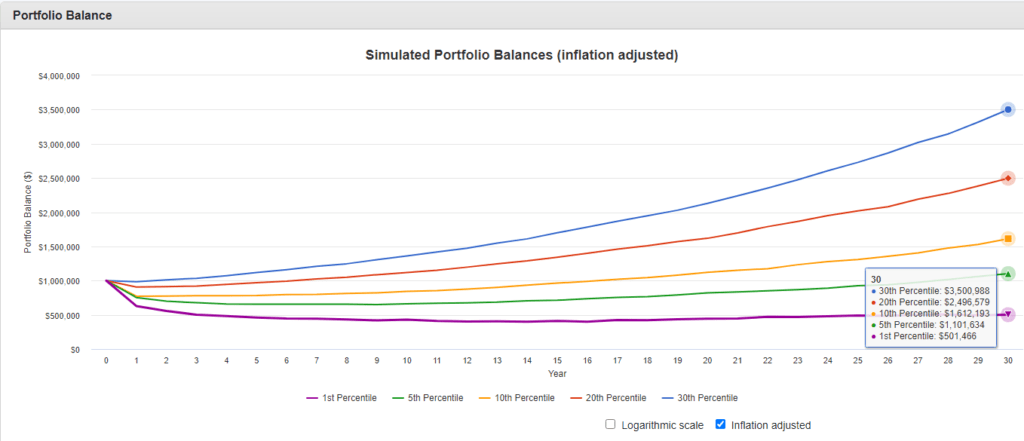
Figure 3 below shows the line chart with the first, fifth, tenth, twentieth and thirtieth percentile outcomes for an all-stocks portfolio based on historical returns. (Click the image to see a larger version of the chart.)

Bond matter because a balanced portfolio minimizes worst-case scenarios
Figure 3

To see what a 70-percent stocks and 30-percent US intermediate treasuries allocation looks like, follow these steps:

  1. Enter 70 into the Asset 1 Allocation text box.
  2. Set the Asset 2 drop-down list box to “Intermediate Term Treasury”.
  3. Enter 30 into the Asset 2 Allocation text box.
  4. Click Run Simulation.
  5. Check the Inflation Adjusted box.

Figure 4 below shows the line chart with first, fifth, tenth, twentieth and thirtieth percentile outcomes based with an balanced portfolio generating historical returns

Bonds matter as a balance portfolio proves
Figure 4

The big thing to note: The all-stocks portfolio’s worst-case scenarios? They’re worse, much worse, that the those that occur for a balanced portfolio.

The “Do Bonds Matter” Simulation Summarized in a Table

The line charts in Figures 3 and 4 make it hard to see precise numbers. But the table below shows the ending values from the two simulations to make comparisons easier.

Percentile 100 % Stocks
Ending Value
70 % Stocks 30 % Bonds Ending Value
1st $501,466 $844,396
5th $1,101,634 $1,438,592
10th $1,612,193 $1,881,653
20th $2,496,579 $2,598,086
30th $3,500,988 $3,310,787

Let me specifically call out four observations.

First observation, the calculations above don’t show actual three-decade long returns for the two portfolios. Not enough unique thirty-year historical outcomes “exist”. Thus, the simulation uses historical returns as the inputs to 10,000 different simulations. (The first percentile shows the average of the worst 100 simulations.) Also, note that if you run your own simulations using a starting value of $1,000,000, you’ll get slightly different ending values. That’s the nature of the simulation.

Second, the risk minimization you get with bonds? You see that by comparing the first percentile, fifth percentile, and tenth percentile ending values.  In all those cases, the worst-case balanced portfolio investor ends up with—per the simulation—a few hundred thousand dollars ahead of the worst-case all-stocks investor. That’s the example benefit of adding bonds. Again, note that the investor in this simulation started with $1,000,000.

Third, somewhere between the 20th and 30th percentiles, the all-stocks portfolio beats the balanced portfolio. That makes sense. Most of the time, an all-stocks portfolio gives you a better return. That’s why you and I want to hold as large a percentage in stocks as we can. Especially early on in our saving.

Fourth, you probably ought to go back and redo your simulations so you can see how well the 50th percentile, the 75th percentile and 90th percentile investors do too. Those investors make out like bandits by loading up on equities.

Just So There’s Not a Misunderstanding

To close, four tangential remarks about this “bonds matter” argument.

First, I’m not arguing everyone should load up on bonds. Rather, I’m trying to show quantitatively how bonds can reduce your downside risk.

Second, for what it’s worth, I’m thinking a modest allocation to bonds. Something like 30 percent. (That’s my actual allocation.) Or 20 percent. Or maybe 40 percent.

Third, I think we follow the suggestion of former Yale endowment fund Chief Investment Officer David Swensen and use U.S. Treasury Bonds and Inflation Protected Securities. (This suggestion from Swensen’s classic book, “Unconventional Success.“)

Fourth, let me reference a couple of related blog posts. You might want to peek at our Unreliability of Long Run Stock Market Returns blog post because it includes a full discussion of that “just be patient everything evens out” line chart that people commonly misinterpret. And you might also want to look at another article here:  Rate of Return of Everything Line Charts. That blog post may be worth skimming too to get a good visual sense of the variability of stock market returns in different countries and over the last 150 years.

How EV Credits Work – Evergreen Small Business

0
How EV Credits Work – Evergreen Small Business

Do you plan on purchasing a new vehicle within the next ten years?  If the answer is yes, and good chance it is, you want to know how EV credits work.

Really, the correct term is “Qualified Plug-In Electric Drive Motor Vehicle Credits,” which is quite a mouthful.  For purposes of this blog post, I’m going to call them EV credits.

Admittedly, I have not personally owned an EV or seriously shopped for one. However, electric motor and battery technology is improving rapidly, the charging network is growing, and the incentives are great, if you can make them work.

I’m going to discuss how EV credits work and how they can benefit, and possibly influence, your next vehicle purchase.

What is an EV Credit?

Put simply, the US government gives you money, in the form of a tax credit, for purchasing a qualified electric vehicle.  The credit has been around for a while.  Maybe you’ve already gotten one.

But, the rules changed in the summer of 2022 with the passing of the Inflation Reduction Act (IRA).  And the changes make the credit less accessible to many taxpayers.

So let’s briefly discuss how EV credits worked before the IRA (pre 2023), and how EV credits work starting in 2023.

EV Credits 2022 and earlier:

If you purchased a qualified electric vehicle, you could claim a non-refundable credit of $2,917 for a vehicle with a battery capacity of at least 5 kilowatt hours, plus $417 for each kilowatt over 5 kilowatts, up to a maximum of $7,500. (Note that “non-refundable” means you can’t get a credit for more than the income taxes you otherwise owe.)

Criteria for EV to qualify:
  • purchased brand new
  • have an external charging source
  • used in the United States primarily
  • have a gross weight rating of less than 14,000 lbs
  • not purchased to resell
  • manufacturer can’t sell more than 200,000 EV’s in the U.S.

BTW, GM sold 200,000 EV’s by Q4 2018, with Tesla reaching 200,000 by Q1 2020 and Toyota reaching 200,000 by Q2 2022.  These brands were ineligible for any more credits under the old rules.

EV Credits 2023 and later:

The maximum credit is still a non-refundable $7,500, but the EV credits work differently with the passing of the IRA.  The IRA broadened the range of vehicles that qualify, but restricted the amount of taxpayers able to take them (more on this later).

First, lets break down the new rules for brand new EV’s.

Criteria for new EV to qualify:
  • purchased brand new
  • have an external charging source
  • used in the United States primarily
  • have a gross weight rating of less than 14,000 lbs
  • not purchased to resell
  • two components; $3,750 credit for critical mineral requirements (critical minerals extracted or processed in the US) and $3,750 for battery component requirements (battery produced or assembled in US)
  • produced by qualified manufacturer
  • final assembly in North America

Number of units sold is no longer a limitation, and, in an effort to stimulate US manufacturing, the final assembly of a qualified EV must be completed in North America.

The website fueleconomy.gov has a neat search engine to look up qualified EV’s.  You just input year/make/model to check eligibility. You can also find a list of manufacturers and qualified models on the IRS website here. The selling dealer is also required to provide you with a written statement detailing, under penalties of perjury, the maximum allowable EV credit for the vehicle you are buying.

The IRA also opened up the EV credit to used vehicles, and is limited to $4,000.

Criteria for a used EV to qualify:
  • must be the first sale other than to the original owner
  • vehicle must be at least two years old
  • had to be a qualified EV when sold new
  • must be sold by a dealer
  • have a gross weight rating of less than 14,000 lbs
  • purchased in the United States
  • credit is limited to 30% of purchase price
  • purchase price must be less than $25,000
  • can be claimed once every three years

Limitations

Earlier I mentioned EV credits will be more restrictive for a lot of taxpayers.  Gone are the days of trading in your top of the line, six figure Tesla Model S every year for the newest latest and greatest, and subsidizing the initial cash outlay with a nice big $7,500 credit at tax time.

There are now MSRP restrictions and adjusted gross income (AGI) restrictions we need to cover.  Let’s begin with the MSRP restrictions.

MSRP Limits:

You cannot claim an EV credit if MSRP exceeds the following amounts:

  • Vans – $80,000
  • Sport Utility Vehicles – $80,000
  • Pickup Trucks – $80,000
  • Other – $55,000

These prices might seem high, but it is easy to cross the threshold when you start adding options to the base price.

For fun, I went to Ford’s website to build a new Lightning truck.  The base price of the Lariat model starts at $69,995.  Add in the extended range battery option and a tonneau cover, and the MSRP jumps to $81,040, making this EV ineligible for any credits.  I guess you’d want to wait on the tonneau cover and buy one with your $7,500 tax credit the following year.

Please note, MSRP does not include tax, title, license, or dealer mark-up fees.  So good news there.

Now let’s cover the new AGI limitations:

AGI Limits:

You cannot claim an EV credit if your AGI exceeds the following amounts:

  • Married Filing Jointly – $300,000
  • Head of Household – $225,000
  • All other taxpayers – $150,000

These are respectable income levels, yes. But I don’t think it is a stretch to assume most (or at least many) people purchasing brand new EV’s likely have an AGI above the threshold.  And there is no phase out, you either qualify or you don’t.

Final Thoughts:

Hopefully no one purchases a new EV and gets surprised they don’t qualify for EV Credits when they file their tax return the following year. This is especially true for the early EV adopters that have already taken EV credits and are not aware the rules have changed, substantially, for 2023.

If the EV credit is a major deciding factor in your car purchasing process, you want to to know how EV credits work. If you follow the rules and don’t make too much money, you should get a nice big tax credit.

Make sure to read our post “Inflation Reduction Act: Tax Credits for Homeowners” for information on additional clean energy property credits.

22 Ultimate Ways to Make Money on the Side: Empower Your Financial Future

0
22 Ultimate Ways to Make Money on the Side: Empower Your Financial Future

Are you looking for ways to make money on the side and achieve financial independence? Look no further! This comprehensive guide covers 22 proven methods for making money, from passive income streams to active side hustles. Whether you’re a student, a stay-at-home parent, or simply looking for extra cash, there’s something for everyone. In this guide, you’ll learn how to make money, fast, and how to cash out once you earn. Here’s we go:

  1. Freelance work – Offer your skills, such as writing, design, and coding, to clients who need your services. You can use websites like Upwork, Fiverr, or Freelancer to find clients and start earning money fast. Make sure you have a strong portfolio to showcase your skills and negotiate a fair rate for your services.
  2. Online surveys – Participate in online surveys and get paid for your opinions. You can sign up for websites like Survey Junkie, Swagbucks, or Vindale Research to start earning money quickly. Make sure you complete the surveys accurately and on time to maximize your earning potential.
  3. Virtual tutoring – Use your knowledge and skills to help students and earn money. You can use websites like Tutor.com, Chegg, or VIPKid to find tutoring opportunities and start earning money fast. Make sure you have a strong understanding of the subject you’re teaching and good communication skills.
  4. Sell handmade items – If you’re creative and love making things, you can sell your handmade items on websites like Etsy, Zibbet, or Handmade at Amazon. You can make anything from jewelry, clothing, home decor, and more. Make sure your items are well-made and priced competitively to attract buyers and maximize your profits.
  5. Dropshipping – Start a dropshipping business by selling products from a supplier to customers. You don’t need to keep inventory, so you can start earning money fast. You can use websites like Shopify or Oberlo to find suppliers and start your business. Make sure you choose a profitable niche and have a strong marketing strategy to attract customers.
  6. Affiliate marketing – Promote products and earn a commission for every sale made through your affiliate link. You can use websites like Amazon, Clickbank, or Shareasale to find products to promote and start earning money fast. Make sure you choose products that are relevant to your audience and have a strong marketing strategy to promote them.
  7. Online courses – Create and sell online courses on platforms like Udemy, Skillshare, or Teachable. You can use your expertise and knowledge to help others and earn money fast. Make sure your course is well-structured, includes engaging content, and is priced competitively to attract students and maximize your profits.
  8. Stock photography – If you have a good eye for photography, you can sell your photos on stock photography websites like Shutterstock, iStock, or Adobe Stock. You can earn money fast by selling your photos to people and businesses who need them for their projects. Make sure your photos are high-quality and unique to attract buyers and maximize your earnings.
  9. Rent out your car – If you have a car that you don’t use frequently, you can rent it out on websites like Turo, Getaround, or HyreCar. You can earn money fast by renting out your car to people who need it for their travels or errands. Make sure you have proper insurance and set clear terms and conditions for renting out your car.
  10. House sitting – Offer your house-sitting services to people who need someone to take care of their home while they’re away. You can use websites like HouseSitter.com, TrustedHouseSitters, or Care.com to find house sitting opportunities and start earning money fast. Make sure you’re trustworthy, responsible, and have good communication skills to attract clients.
  11. Pet sitting – Offer your pet sitting services to people who need someone to take care of their pets while they’re away. You can use websites like Rover, Care.
  12. Rent Out a Room on Airbnb – If you have an extra room in your house, consider renting it out on Airbnb. With millions of users around the world, Airbnb is a great platform for people looking for a place to stay. You can set your own prices, choose your own rules and requirements, and have the freedom to accept or decline reservations. The money you earn can be substantial, especially if you live in a popular tourist destination. Don’t forget to cash out once you earn.
  13. Sell Crafts on Etsy – If you’re a DIY enthusiast or have a passion for crafting, consider selling your handmade items on Etsy. This platform has a large community of buyers who are looking for unique and personalized items. From jewelry to home decor, there’s a wide variety of items you can sell on Etsy. You can also set your own prices and work on your own schedule. Get started today and make money fast by selling your crafts on Etsy.
  14. Be a Virtual Assistant – With the rise of remote work, many businesses are looking for virtual assistants to help them with administrative tasks. If you’re organized and have good time-management skills, this could be a great opportunity for you to make money. Tasks may include scheduling appointments, managing emails, conducting research, and more. You can work from home and earn a good hourly wage. Don’t miss out on this opportunity to make money fast.
  15. Invest in Stocks – Investing in stocks can be a great way to grow your wealth over time. With the help of an online broker, you can buy and sell stocks from the comfort of your own home. Of course, there’s always a risk involved with investing in the stock market, so it’s important to do your research and seek advice from a financial expert if you’re unsure. However, if you’re willing to take the risk, investing in stocks could be a great way to make money.
  16. Participate in Online Surveys – By participating in online surveys, you can earn money just for sharing your opinions. Companies and organizations use these surveys to gather insights and make decisions. Some survey websites pay you in cash, while others offer gift cards or other rewards. It’s a simple and easy way to make money fast. Participating in online surveys is a great way to make some extra cash in your spare time.
  17. Sell Photos Online – If you’re a photography enthusiast, consider selling your photos online. There are many websites that allow you to upload and sell your photos, including Shutterstock, iStock, and Adobe Stock. You can earn a commission on each sale and make money fast by selling your photos online. This is a great opportunity for those who love to take photos and want to make money doing it.
  18. Be a Social Media Manager – If you’re active on social media and have experience managing social media accounts, consider offering your services as a social media manager. Many businesses and individuals are in need of someone to help them manage their social media presence, from creating posts to engaging with followers. With the right skills and a good portfolio, you can make a good income as a social media manager.
  19. Rent Out Your Car – If you have a car that you don’t use often, consider renting it out on Turo. Turo is a car-sharing platform that allows you to rent out your car to others when you’re not using it. You can set your own prices, choose the dates and times your car is available, and earn a good hourly rate. This is a great way to make money fast and make use of an asset that would otherwise be sitting unused.
  20. Sell Crafts and Handmade Items: Turn your passion for crafting into a profitable business by selling your handmade products online on platforms like Etsy, Amazon Handmade, or on your own website. You can start small and grow your business as you gain more customers. Remember to cash out once you earn, so you can reinvest in supplies and materials.
  21. Offer Tutoring Services: If you have expertise in a certain subject, you can offer tutoring services online or in-person. You can use websites like Tutor.com, or create your own tutoring business. Charge a fee for your services and watch your earnings grow. Make money fast by leveraging your knowledge and skills.
  22. Participate in Paid Surveys: You can earn money by participating in paid surveys online. Companies will pay you for your opinions on their products and services. Look for reputable survey websites like Swagbucks, Survey Junkie, or Vindale Research to get started. You can make money fast and cash out once you reach the minimum payout.

With so many options to choose from, you’re sure to find a way to make money that fits your skills and interests. So, let’s dive in and start exploring your options for financial freedom!

Passive Income – The more you know

0
Passive Income – The more you know

Passive income is a term that has gained a lot of popularity in recent years. It refers to the type of income that is generated without active involvement on the part of the individual. Passive income is often seen as an ideal source of income, as it requires very little effort once it has been set up. In this article, we will discuss what passive income is, how it works, and some popular ways to generate it.

What is Passive Income?

Passive income is any income that is earned without active involvement or effort on the part of the individual. This means that the person does not have to work for every dollar they earn – you often hear the expression “make your money work for you.” In contrast, active income refers to the type of income that is generated through direct participation, such as working a job, freelancing, or running a business. In active income, you trade your time for money.

Passive income can come from a variety of sources, such as investments, rental income, and royalties. One of the most appealing aspects of passive income is that it can provide a steady stream of income without your constant time and effort. One of the least understood aspects of passive income relates to taxes – Learn more about passive income and taxes.

How Does Passive Income Work?

Passive income works by creating a source of income that requires little to no ongoing effort on the part of the individual. This can be achieved by investing in assets that generate income, such as stocks, bonds, real estate, and even high-yield savings accounts (during periods of high inflation where APY rates offer decent income).

For example, investing in dividend-paying stocks can provide a steady stream of income in the form of dividends without requiring the investor to manage their portfolio actively. Rental income from real estate is another common form of passive income, as it provides a steady stream of income from tenants without requiring the landlord to manage the property actively.

In some cases, creating a passive income stream may require some initial effort to set up. For example, creating a digital product, such as an ebook or online course, requires upfront effort to create the product, but can generate income for years to come without requiring ongoing effort.

Popular Ways to Generate Passive Income

  1. Real Estate Investing:

    Real estate investing can provide a steady stream of passive income through rental properties. Investors can purchase properties and collect rent from tenants, providing a steady stream of income without requiring ongoing effort.

  2. Dividend Stocks:

    Dividend-paying stocks can provide a steady stream of passive income in the form of dividends. Investors can purchase stocks and collect dividends without requiring ongoing effort.

  3. Peer-to-Peer Lending:

    Peer-to-peer lending allows individuals to lend money to others and earn interest on their loans. This can provide a steady stream of passive income without requiring ongoing effort.

  4. Digital Products:

    Creating digital products, such as ebooks or online courses, can provide a source of passive income. Once the product has been created, it can be sold online and generate income for years to come.

  5. Affiliate Marketing:

    Affiliate marketing involves promoting products or services and earning a commission on any sales made through your unique referral link. This can provide a source of passive income without requiring ongoing effort.

  6. Renting out Property:

    Renting out your property, such as a spare room or parking space, can provide a source of passive income without requiring ongoing effort.

  7. Peer-to-Peer Investing:

    Peer-to-peer investing involves investing in loans to individuals or small businesses through platforms such as Lending Club or Prosper. Investors can earn interest on their investments without requiring ongoing effort.

  8. Royalties:

    Royalties are payments made to creators for the use of their work, such as music or books. This can provide a source of passive income without requiring ongoing effort once the work has been created.

Conclusion

Passive income is a type of income that is earned without active involvement or effort on the part of the individual. It can provide a steady stream of income without requiring constant effort. There are many ways to generate passive income, including real estate investing, dividend stocks, peer-to-peer lending, digital products

8 Ways To Use Trade Fairs To Market A Business Successfully

0
8 Ways To Use Trade Fairs To Market A Business Successfully

One might think that trade fairs have lost their appeal in the 21st century but this assumption is outright wrong to make.

In a world where digital marketing is the buzz word, it seems that offline marketing strategies like attending trade fairs have little to no importance.

Although participating in a trade fair is no longer the number one deal-breaker, it is still an important segment if doing business. You might not make a single sale but you will make valuable leads and establish partnerships there.

How to Use Trade Fairs to Effectively Market Your Business

Taking the time to develop an efficient strategy to market your business at trade fairs is definitely with the effort. Here are some tips to start with when using trade fairs to market your business.

1. Who gets to go to a trade fair?

One of the most important questions regarding your firm’s participation at a trade fair is who gets to go.

If there are only a couple of people in the firm, it is all hands on deck but you have a pool of employees to choose from, take the time to make the right selection.

In general, choose people who have a friendly look and an easygoing, laidback personality. Although this rule does not apply for other business spheres, you want an extrovert, rather than an introvert to represent your brand at a trade fair event.

Prospective clients and business partners that drop by your stand will form the image if your company based on the faces and people they meet there.

2. Crowds attract crowds

This is so old-school marketing that people who work in digital marketing have probably forgotten it altogether.

Every street vendor will tell you that crowds attract crowds, which is why they sometimes introduce fake customers, as comically depicted in the British TV sitcom Only fools and horses. We are not suggesting you adopt the same dishonest practice but you can create a buzz around your brand that will have people flocking to your stand.

Organize a promotion or a giveaway that will get shared on social media a couple of days prior to the actual event. Another neat tactic is to apply for a program that trade fairs usually feature. You could host a speaker at your stand or one of your employees might give a talk on the main stage.

3. Make your trade fair presence stand out

As SEO is important for your digital marketing strategy, the stand is very important to your offline trade fair presence. A simple stand with the logo and the title of the company is not going to cut it because you are competitors will have better presentations.

Don’t get us wrong, there is no need to waste money on fancy stands because there are affordable exhibition stands that promise to grab the attention of visitors for less. Sometimes a simple rack with leaflets and magazines will engage people more than a robotic arm or a similar gizmo.

4. Make a list

You write everything down when you go shopping, right? Well, believe it or not, but the same principle should be applied when it comes to trade fairs.

You often drive for hours or fly across an entire continent to reach the venue so it would be a blow to find out you forgot a vital printout in the office.

It might seem silly but create a list of the things you’ll be bringing to the fair but this will prevent nasty surprises from occurring. The item that you are most likely to forget to pack includes extension cords, business cards, tape, zip ties, markers, small signs, etc.

5. Size is (not) everything

As far as the size of the ideal stand is concerned, you should test-build the stand in the office before you depart for the trade fair.

You have to see if there is enough room for all the promo materials you plan to bring. There should be enough space for interested parties to enter the stand and look around.

Even if you get the surface area of the stand wrong the first time, don’t sweat about it because you can always lease out a bigger space next year. Like any other promotional activity, trade exhibitions are something that you will improve yourself as the years go by.

How to Use Trade Fairs to Effectively Market Your Business

6. Support from the web

The essence of a trade fair is to network online and offer products and services the old-fashioned way. However, this doesn’t mean that an online campaign should entirely be omitted from your marketing strategy.

Promoting your presence at the fair on social media and the company website should go without saying. Your business can invite clients, customers, business partners, and all followers, in general, to come and check out the stand in person.

In order to entice them into visiting the fair, offer them some sort of a discount or a coupon.

7. Burying the hatchet

We’ve mentioned earlier that trade fairs present an ideal opportunity for networking.

Apart from prospective clients and your business associate, there are going to be a lot of competition and colleagues in the business on the fair. The rivalry will be evident but don’t let the negative ions in the air get the better of you, as you should bury the hatchet for the duration of the fair.

In terms of market competition, think of the fair as a truce of sorts. Your competitors in the outside world are actually your partners at the fair.

Use this opportunity to network and share experiences with other players in the industry. After all, this “ceasefire” will last less than a week so take full advantage of it to meet as many business people as possible.

8. Getting in the spotlight

Owning a great stand that that engages visitors is a huge plus but there should be more to your participation at a trade fair. Your aim should be to have your stand media covered, at least by the local news agencies.

Sure, you have a flashy company title and social media activity but if the press gets interested in what you have to offer, then your impact increases dramatically.

Getting in the spotlight

Conclusion

There you go, these are the top strategies you can apply if you want to start using trade fairs to market your business successfully.

Trade fairs remain relevant in the digital age. They help generate leads and partnerships. To maximize their impact, choose friendly, outgoing staff, attract crowds with promotions, and make your booth stand out without breaking the bank.

Prepare a checklist, ensure adequate space, and promote your presence online. View competitors as potential collaborators and aim for media coverage to boost your impact at trade fairs.

Again, don’t focus too much on the actual act of selling goods and services but on networking.

How to Call the United Kingdom from the US [+ Area Codes]

0
How to Call the United Kingdom from the US [+ Area Codes]

International phone calls can get expensive. It pays (literally) to get it right.

If you need to call someone in the United Kingdom (UK) from a phone in the US, you’ve got a few options.

It’s cost-effective to call them using popular online calling apps like WhatsApp or Skype. These are free options as long as you subscribe to the relevant service. 

You can also use online meeting tools like Nextiva, Zoom, or Microsoft Teams.

When you need to physically dial a UK number, like when you don’t have an internet connection, making a call to the UK from American phones becomes a little tricker.

In this post, we include instructions for how to call the UK from a US-based phone number, dissect the intricacies of area codes and mobile phones (cell phones), and run through what you can expect to pay.

Calling in the United Kingdom

Like the US, counties and cities have different area codes in the UK. The majority of UK numbers have 11 digits. A minority of phone numbers have 10 digits. There aren’t any special circumstances for these numbers. It’s a matter of legacy number systems.

A standard UK telephone number looks like this in the UK: 01632960345.

This is commonly broken down into 0 1632 960345.

  • 0 is the country (UK).
  • 1632 is the area code.
  • 960345 is the unique landline number.

UK dial codes by area

In the table below, you can see that not all UK area codes are the same length.

For example, Aberdeen has the code 1224, but Belfast has 28.

This doesn’t change the length of the overall phone number. It’s simply down to historical numbering systems.

It’s worth noting that the area codes in UK phone numbers exist only to separate the geographical location. You can just dial the full phone number when you call a number.

There’s no need to remember any associated area codes and areas. It’s standard practice in the UK to list the complete phone number in any directory, advertisement, or online listing.

City Area Code
Aberdeen 1224
Belfast 28
Birmingham 121
Blackburn 1254
Blackpool 1253
Bolton 1204
Bournemouth 1202
Bradford 1274
Brighton 1273
Bristol 117
Cambridge 1223
Cardiff 29
Colchester 1206
Coventry 24
Derby 1332
Dundee 1382
Edinburgh 131
Glasgow 141
Gloucester 1452
Huddersfield 1484
Leeds 113
Leicester 116
Liverpool 151
London 20
Luton 1582
Manchester 161
Middlesbrough 1642
Newcastle 191
Newport 1633
Northampton 1604
Norwich 1603
Nottingham 115
Oxford 1865
Plymouth 1752
Portsmouth 23
Preston 1772
Reading 118
Sheffield 114
Southampton 23
Stoke-on-Trent 1782
Sunderland 191
Swansea 1792
Swindon 1793
Wolverhampton 1902
Worcester 1905
York 1904

How to Call the United Kingdom From the United States

Calling UK landlines from the US

Before you place a call to the UK, you must enter the 011 exit code.

Next, dial the country code for the UK (44). This replaces the 0 on our example number (01632960345).

Then dial the rest of the phone number as listed. There’s no need to pause when entering the UK area code.

So, you’ve dialed 011 44 1632960345.

Calling the UK from the US

Step 1: Dial the US exit code: 011

Step 2: Dial the UK country code: 44

Step 3: Dial the rest of the UK phone number: 1632960345

You’ve dialed the following:

US Exit Code UK Country Code UK Phone Number
011 44 1632960345

Calling UK mobile phones from the US

The process for calling UK mobile phones from the US is the same as calling a landline. The only difference is the digits dialed in the mobile phone number.

There are no area codes associated with mobile phones in the UK. There are many mobile codes relating to different carriers like Vodafone, O2, and EE.

Before you place a call to the UK, you must enter the 011 exit code.

Next, dial the country code for the UK (44). 

Then dial the rest of the UK cell phone number as listed.

So, you’ve dialed 011 44 7700900077.

US Exit Code UK Country Code UK Cell Phone Number
011 44 7700900077

Calling UK toll-free and non-geographic numbers from the US

Toll-free numbers in the UK are 0800 and 0808. These become +44800 and +44808 in the US. There is still a charge to call UK toll-free numbers in the US.

Other 08xx and 03xx prefixes in the UK represent non-geographic phone numbers with varying calling costs.

Using the same process, you can call any UK toll-free or non-geographic phone service.

Before you place a call to the UK, you must enter the 011 exit code.

Next, dial the country code for the UK (44). 

Then dial the rest of the phone number as listed.

So, you’ve dialed 011 44 3069990000.

US Exit Code UK Country Code UK Non-Geo Number
011 44 3069990000

When to Call the UK

Time zone differences and national holidays are two major factors to consider when dialing a phone number in the UK.

Time zone differences

The whole of the UK runs in the same time zone. So, if you’re calling someone in London, you can be sure they’re in the same time zone as someone in Glasgow or Cardiff.

The UK follows Daylight Saving Time, which has two time zones during the year.

Between the last Sunday in October and the last Sunday in March, the UK follows Greenwich Mean Time (GMT). 

The differences between the US time zones and GMT are outlined below:

US Time Zone Local Time Greenwich Mean Time Difference
Eastern Time 12 Noon 5 PM 5 Hours
Central Time 12 Noon 6 PM 6 Hours
Mountain Time 12 Noon 7 PM 7 Hours
Pacific Time 12 Noon 8 PM 8 Hours
Alaska Time 12 Noon 9 PM 9 Hours
Hawaii Time 12 Noon 10 PM 10 Hours

In the UK, clocks go forward one hour at 1 am on the last Sunday in March and back one hour at 2 am on the last Sunday in October.

The period when the clocks are one hour ahead is called British Summer Time (BST). In 2023, BST is between 26th March and 29th October.

Note this is a different timescale to when the US has daylight savings time. There is a slight overlap period, which makes for slightly amended time differences.

In the US, Daylight Saving Time starts on the second Sunday in March and ends on the first Sunday in November. It can get confusing during the crossover dates, even when you’ve worked with US and UK folks for 15 years.

It’s always best to be aware of when there’s a crossover in Daylight Saving Time. Use World Time Buddy if you’re unsure of the exact time during this period.

National public holidays

Expect most businesses, except those with dedicated 24/7 support functions, to be closed or operate shortened opening times during national holidays.

The United Kingdom has eight standard national holidays.

Public holiday 2023 2024
New Year’s Day Monday 2nd January Sunday 1st January
Good Friday Friday 7th April Friday 29th March
Easter Monday Monday 10th April Saturday 1st April
Early May Bank Holiday Monday 1st May Saturday 6th May
Spring Bank Holiday Monday 29th May Saturday 27th May
Summer Bank Holiday Monday 28th August Saturday 26th August
Christmas Day Monday 25th December Monday 25th December
Boxing Day Tuesday 26th December Thursday 26th December

Note that New Year’s Day is awarded as a national holiday on a Monday when 1st January falls on a Saturday or Sunday.

In special circumstances, the UK can add more national holidays. For example, in 2023, Monday, 8th May, was a national holiday due to the coronation of the new king, King Charles III.

There are also some regional holidays to consider.

Scotland

Scotland has an extra national holiday on 2nd January. If New Year’s Day falls on a Saturday or Sunday, Scotland rolls the public holiday back and celebrates the 2nd January national holiday on the 3rd January.

Scotland also observes St Andrew’s Day on 30th November. Again, the national holiday is pushed to the following Monday if the 30th November falls on a Saturday or Sunday.

Northern Ireland

Northern Ireland has an extra national holiday on 12th July, which marks the anniversary of the Battle of the Boyne. If the 12th of July falls on a Saturday or Sunday, the national holiday is pushed to the following Monday.

How Much Does It Cost to Call the UK From the US?

Calling the UK varies depending on whether you call a landline, cell phone, toll-free, or non-geographic number.

The rates indicated below are taken from Nextiva’s international rate card. These are applicable when you use Nextiva’s VoIP phone system.

Always check with your telephone provider if you’re unsure of the bundled minutes in your calling plan.

UK Call Type Example Digits Dialed Price Per Minute (USD)
Landline 011 (44) 203xxxxxxx $0.02
Cell Phone 011 (44) 7xxxxxxxxx $0.58
Toll-free 011 (44) 8xxxxxx $1.02
Non-geographic 011 (44) 81xxxxx $1.62
Premium 011 (44) 9xxxxxxx $3.6

More Info: Compare International Calling Rates from Nextiva

How to Make Business Phone Calls to the UK Using Nextiva

For security, international dialing is disabled by default on Nextiva accounts. Authorized account holders can enable international calls by contacting support. 

Once that’s enabled, dialing UK phone numbers from the US is easy.

Dialing the United Kingdom from Nextiva

When calling the UK from the US using Nextiva, it would look like this: 

  • Step 1: Dial the exit code 011. This tells your phone service that you are trying to dial out of the United States.
  • Step 2: Dial 44This is the international country code for the United Kingdom.
  • Step 3: Dial the area code. Area codes in the UK span from two to five digits. If you encounter any area code that starts with 0, you can omit the 0 while entering the phone number.
  • Step 4: Dial the phone number. The phone number should have 10 digits, which includes the area code. If it is a mobile number, it will have nine digits.

Tip: When dialing, you don’t need to enter dashes or plus signs.

The Importance Of Integrating Digital And Traditional Marketing

0
The Importance Of Integrating Digital And Traditional Marketing

Denis Sinelnikov is the CEO of Media Components and Curis Digital, an award-winning, full-service digital marketing agency.

It’s the digital age. Between work, shopping and entertainment, we’re online several times a day (and an increasing number of us are online “almost constantly,” according to Pew Research). So why am I, a digital marketer, talking about traditional marketing? Because we still operate in the physical world. While online consumes much of our daily life, it’s not everything—not yet.

So, let’s look at why it’s important to integrate digital and traditional marketing.

Why Traditional Marketing Still Matters

Before we can look at integrating digital marketing and traditional marketing, we need to understand why the latter is still important. Traditional marketing can help brands:

• Build trust with local consumers.

• Break through online clutter (without looking, name the first two ads you saw on this page).

• Expand their reach.

• Increase the effectiveness of their digital marketing efforts.

This last point is, to me, the most crucial in illustrating why you should integrate your digital and traditional marketing. Local SEO is important for businesses that need to market in their geographic region. However, if you’re searching Google for a local plumber and you see two companies come up—one that you’ve seen advertised on Home Depot’s website and one whose jingle you just heard on the radio—which are you going to choose?

While you might click the link for the company that advertises on the Home Depot site, most people will click on the company they saw around town. The reason comes down to trust.

In marketing for one of our clients, AAA Distributor—a local kitchen, bath and flooring store in Philadelphia—our goal was to get people in the door at their showroom. Our digital marketing was important, but it was only one part of our strategy. On the digital side, we focused on building strong SEO with content and keyword management, as well as PPC ad placement and social media. Meanwhile, we took to the streets and the radio waves, placing billboards and airing ads on local radio stations. The result: increased traffic into their showroom (and their website) and increased sales.

I like to think of it this way: traditional builds trust and digital remarketing strengthens that.

How Traditional Marketing Builds Trust

Communication theorist Marshall McLuhan coined the phrase, “The medium is the message.” That phrase is vital to marketing. The medium you present your message on will influence how people perceive it. While we all rely on the internet, it’s not what we consider “local.” We use it to communicate with people all over the world.

On the other hand, television, billboards, mail flyers and radio are all local mediums. They are where we live, work and entertain ourselves offline. These mediums are familiar because they’re around us. As a result, we’re likely to trust them as sources of information.

For example, Google can show you gas stations and fast-food restaurants on your map while you’re traveling. But do you use that feature, or do you look for the billboard and road signs advertising a gas station or restaurant? While digital tools and digital marketing continue to grow in importance, the value of ad placement where a person physically is can never be replaced.

Integrating Your Digital and Traditional Marketing Efforts

Now that we’ve looked at why integrating traditional and digital marketing is important, let’s look at how to do that integration right. Just as you should never run your social media and PPC marketing completely independently of each other, your digital and traditional marketing need to work together and complement each other. Here, we’re not going to look at the individual avenues for your digital and traditional marketing. Instead, I want to talk about where they cross over.

Match your messaging between mediums. Your digital marketing should have a throughline (such as a company’s motto or tag line) that carries through from one digital medium to another. Bring that over into your traditional marketing mediums as well (this may mean reworking it to something that works in audio format as well as written).

Let your traditional and digital marketing support each other. Include QR codes in print advertising, television ads, and on street-level marketing to encourage people to visit a website or learn more about a service. Meanwhile, you can capture lead information by offering to mail print brochures and branded samples using sign-up forms on your website or from social media.

Participate in local events and promote them online. Sponsor a local event, take part in a trade show or set up a table at a local convention. Meanwhile, advertise these events and opportunities on your social media, website and other digital marketing channels. This will build your brand locally and boost your local SEO rankings.

Let your advertising content crossover mediums. Your television ads don’t just have to run on television. Nor do your radio ads only have to be on the radio. Use your television ads on YouTube and get your radio ads into podcast spots. By sharing your message across both traditional and digital mediums, you can increase your reach and build brand recognition.

The marketing world continues to change and evolve. In my experience, digital marketing has better tracking KPI mechanisms and, therefore, can be more valuable. However, traditional is great for multi-layering your marketing plan to get prospects from all sides. If you learn now how to integrate your digital and traditional marketing strategies, you’ll be ready for the next change that comes.


Forbes Agency Council is an invitation-only community for executives in successful public relations, media strategy, creative and advertising agencies. Do I qualify?


Business Credit: What It Is and How to Build It

0
Business Credit: What It Is and How to Build It

A good business credit score can be a game changer for your small business. With good business credit, you can more easily secure financing, get better terms from your vendors, attract better investors, lower your insurance rates, and even increase the value of your business.

So what is business credit? And how do you build it?

Let’s take a look at how business credit works, how it can help you grow your small business, and how you can build it.

What Is Business Credit?

A business credit score is a reflection of your business’s creditworthiness. Basically, it tells lenders how likely you are to pay back any money that you borrow. Just like a personal credit score, a higher score can bring a number of borrowing benefits — from lower interest rates to higher likelihood of approval.

Any small business can build business credit (with the exception of sole proprietorships). You just need your employer identification number (you can obtain yours for free with the IRS assistance tool), a business bank account and some good business borrowing habits.

How Does Business Credit Work?

When you take out a business loan, establish trade lines or open a business credit card with a lender or vendor that reports to the credit bureaus, your payment history and other information will likely be reported back to one of these bureaus.

Your business credit score is calculated from the information in your business credit reports. This can include your repayment and credit history, your debt usage, the amount of debt you’re carrying and the age of your business.

You’ll notice that your business credit score doesn’t look the same as your personal score. This is because personal business scores range from 300 to 850, while business credit scores range from 0 to 100. Most lenders consider 80 or above to be a good business credit score.

The business credit bureaus may also use different measurements and names for your business credit score. While exploring you may see references to DUNS numbers or PAYDEX scores. DUNS numbers are used by Dun & Bradstreet to help identify your business in their system (your lenders and partners will be able to see and verify your business this way as well). A PAYDEX score is another name for your business credit score.

What Are the Business Credit Bureaus?

There are three major business credit bureaus that collect the information used on your business credit report.

  • Dun & Bradstreet
  • Experian Business
  • Equifax Business

A big part of your small business credit report will be made up of the information that is reported to the bureaus, but the bureaus can also pull information from public records, your corporate financial reports, press releases or news stories and of course self-reported information. When you review your report you’ll see all this information plus your business’ information. This can include names, addresses, phone numbers, your business structure (i.e. limited liability company), etc.

What Is a Business Credit Score Used For?

Your business credit score is used for many purposes —  and some of them may surprise you.

Business financing. Many lenders use your business credit profile to help them make decisions about borrowers. This may apply to business credit cards, small business loans or a business line of credit. Some lenders may also use your personal credit score if you don’t have established business credit.

Vendor or supplier contracts. Vendors use business credit scores to determine if your business would be a good customer. A good score shows that you’re more likely to pay invoices on time.

Insurance rates. Your business credit score can influence the rates and terms of your insurance.

Partnerships and investors. Your credit score is one of many indicators of your business’s financial health. Most potential partners and investors are more inclined to work with a business that has healthy finances.

Why It’s Important To Build Your Business Credit

A good business credit score can make it easier to grow your business and reach your goals. It opens doors to new opportunities. Here are just a few reasons why building your business credit is important:

It makes it easier to secure financing. With good business credit, you’re more likely to be able to secure financing. There are many types of business credit, but a good score can also land you lower interest rates, higher credit limits and more favorable terms. Though there are often many other factors that go into a lender’s decision, a good credit score can smooth the way.

It can protect your personal finances and credit. When you use a business card or business loan, it can help insulate your personal credit score from the ups and downs of running a business. According to the Small Business Administration (SBA), 46% of all small business owners use personal credit cards for business expenses. This can run up their credit utilization rate and likely doesn’t offer the amount of capital that they need. Plus, if anything prevents them from making the payments on time it’ll be the owner’s personal credit being affected. Using business credit can help protect you from this.

Your vendors may offer you better deals. Vendors love businesses they know they can rely on. A good business credit score can show that you’re a trustworthy and reliable customer. They may give you better rates or offer you deals to keep you around.

It can increase the value of your business. Your business credit score is a transferable asset. That means if you ever decide to sell your business, the credit score goes with it. A good credit score can make your business a more valuable acquisition.

Your insurance rates might be lower. Insurance companies are also more likely to extend lower rates and premiums if you have a good business credit score.

How Do I Check My Business Credit Score?

You can check your business credit report and your business credit score on a number of different sites. (You may recognize some of the companies you use to monitor your personal credit reports.) Keep in mind that you’ll likely have to pay. There are some free options, but they’re often not very detailed — you pay for what you get. You can access your report through any of the major business credit reporting agencies.

One of the major differences between personal and business credit scores is that anyone who pays can access your full business credit report.

How Do I Build Better Business Credit?

If you’re an entrepreneur or small business owner looking to build credit, you may not know where to start. It can be a little overwhelming at first, especially if you’re a new business or startup. But building business credit can help you thrive. Just keep in mind that like personal credit, your business credit rating won’t become perfect overnight.

Know your score. The first step to improving your credit is to know where you are. Take the time to get familiar with your business credit profile and understand what it says about your business’s credit. This can show you where you can improve the most.

Get financing that helps build your score. The next time you need financing, whether you need to fill cash flow gaps or fund a new project, look for lenders that report to the business credit bureaus. You don’t always need to have an established business credit history to secure financing — some lenders will use your personal information or ask for a personal guarantee. This kind of lending can help you build your score. You can’t establish a credit history if you don’t have anything in your profile to report.

Pay on time. If you have any credit lines, loans or other payments, it’s important to make on-time payments. Just like your personal credit history, this is one of the biggest factors that goes into calculating your business score.

Establish trade accounts with your suppliers. Vendor credit is relatively easy to obtain and your prompt payments with suppliers are a good way to build a strong profile. Thirty- or 60-day payment terms might not be a $50,000 or $100,000 small business loan, but it can help build your credit profile. Just make sure your vendors report to the credit bureaus.

Monitor your credit profile. While you’re working on building your business credit, make sure you keep an eye on your profile. This can help you identify any red flags, mistakes or areas for further improvement.

About Baylee Patel

Baylee Patel, CFEI, is a copywriter specializing in finance. Before joining Enova in 2022, she worked for a financial planning firm in Northern Virginia, where she regularly contributed articles on financial literacy, personal finance and other monetary trends. She graduated from Virginia Commonwealth University with a bachelor’s degree in communications and received her certification for financial education instruction from the National Financial Educators Council.